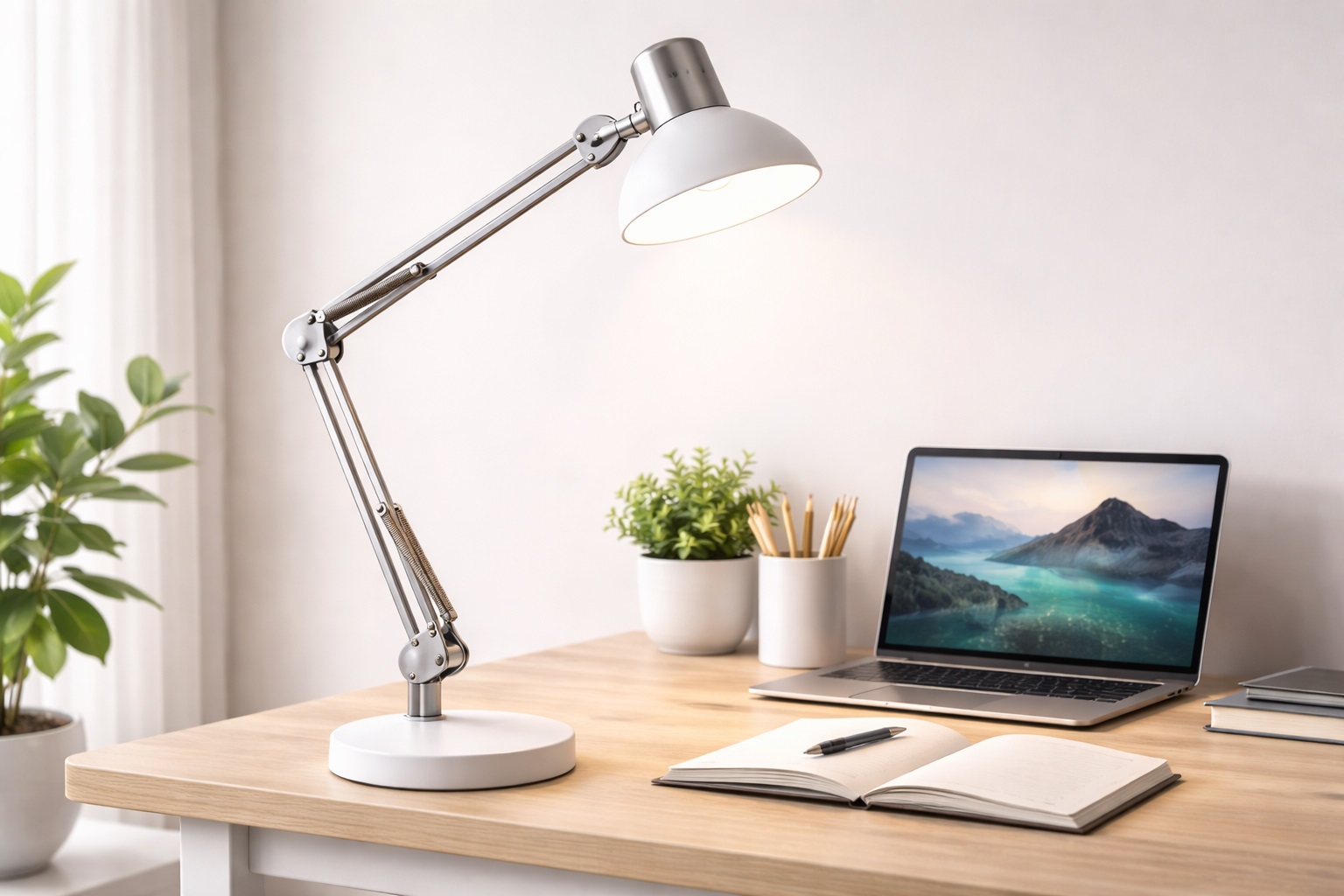
Best Budget Desk Lamps: Bright Lighting Without the Price Tag
Good task lighting doesn't have to come with a premium price tag. A lot of what makes a desk lamp genuinely useful — even brightness, a stable base, and a head that actually points where you need it — has very little to do with cost once you get past the lowest end of the market. The main risk with budget lamps isn't that they're underpowered; it's that some models cut corners in ways that aren't obvious until you've been using one for a few weeks.
This guide breaks down the budget desk lamp styles that consistently deliver solid value for home office workers and students who need functional lighting without spending on features they won't use. Each entry covers a distinct approach — from bare-bones LED lamps to budget options with added conveniences like USB charging — along with where each style's compromises tend to show up.
None of the categories below claim to match a premium lamp feature for feature. What they do offer is dependable, evenly distributed light for reading, typing, and general desk work at a fraction of the cost, which is exactly what most buyers in this category are actually looking for.
It's worth separating two different budget shopper mindsets before diving in. Some buyers are looking for the single cheapest lamp that still functions reliably, treating it almost as a disposable purchase. Others are looking for the best value within a modest budget — willing to spend a little more than the absolute minimum in exchange for a feature that genuinely improves daily use. Both approaches are reasonable, and the categories below serve each of them differently.
There's also a practical reason to read through all six categories rather than jumping straight to the cheapest listing you find. The difference between a good match and a poor one here isn't really about spending more money — it's about matching a specific design trait, like a clip mount or an articulating arm, to a desk problem you already have. Skipping straight to price comparisons often produces a lamp that's fine on paper but wrong for the actual desk layout.
Top 6 Budget Desk Lamps (Detailed Reviews)
Each of the six styles below solves a slightly different budget lighting need, from the absolute cheapest functional option to lamps that add small conveniences without pushing the price much higher. Matching the category to what you'll actually use daily matters more here than chasing the lowest price alone.
1. LED Desk Lamp Under $20 – Best For the Absolute Lowest Price
This category represents the entry point of the desk lamp market — simple LED lamps priced low enough that cost is barely a consideration. They typically offer a single or basic set of brightness levels and a straightforward on-off or touch control, without the extras found in pricier options.
What matters most in this price bracket is whether the lamp still delivers even, glare-free light despite its low cost, and the better options in this category manage that reliably. The trade-off tends to show up in build materials and long-term durability rather than in the actual light output, which is often perfectly adequate for basic desk use.
In practice, the smartest way to shop this bracket is to compare price against what you'd otherwise spend on a backup lamp or an extension cord, since a lamp at this price point is often cheaper than the accessories some buyers pair with pricier lamps anyway.
- Pros:
- Lowest price point in the desk lamp category
- Simple, no-fuss operation with minimal learning curve
- Adequate brightness for everyday reading and typing tasks
- Low financial risk if your needs or preferences change
- Cons:
- Limited brightness adjustment compared to pricier options
- Plastic components may feel less durable over years of daily use
Best For: Buyers who want the cheapest functional lamp available and don't need adjustable brightness or extra features.
Why We Recommend It: It proves that decent task lighting doesn't require much of an investment at all, which matters for anyone furnishing a workspace on a tight budget. It's also a sensible way to add lighting to a secondary desk or workspace without spending much per lamp, and a reasonable starting point for anyone who isn't yet sure what features they'll actually want in a lamp long-term.
2. Adjustable Budget Lamp – Best For Flexible Positioning
Stepping up slightly from the bare minimum, the adjustable budget lamp adds a bendable neck or articulating arm that lets you redirect light exactly where you need it, without a significant jump in price. This small addition solves one of the most common frustrations with fixed-position lamps — light that's always slightly in the wrong spot.
Because the added flexibility comes from a simple mechanical joint rather than an electronic feature, it doesn't meaningfully raise manufacturing cost, which is why this category remains solidly within budget territory despite the extra usefulness.
- Pros:
- Adjustable neck or arm redirects light to exactly where it's needed
- Still priced well within typical budget-lamp ranges
- More versatile than fixed-position lamps for different desk layouts
- Useful for reading, typing, and close detail work alike
- Cons:
- Joints on cheaper models can loosen with heavy daily repositioning
- Slightly bulkier footprint than a simple fixed lamp
Best For: Buyers who need to redirect light for different tasks throughout the day without paying for a premium lamp.
Why We Recommend It: The added flexibility solves a genuinely common annoyance without pushing the price out of budget range, making it one of the best value additions in this category. For buyers switching between typing, reading, and writing tasks throughout the day, the ability to redirect light quickly is worth more than it might initially seem.
3. LED Lamp With Clip Mount – Best For Small or Crowded Desks
A clip-mounted lamp attaches directly to the edge of a desk or shelf rather than taking up its own footprint on the work surface. For anyone working with a small desk that's already crowded with a keyboard, monitor, and notebooks, this design frees up valuable surface space that a traditional base-mounted lamp would otherwise occupy.
The clip mechanism does require a desk edge thick enough to grip securely, so it's worth checking compatibility with your specific desk before buying. Once mounted properly, though, it tends to stay firmly in place without shifting during normal use.
- Pros:
- Frees up desk surface space compared to base-mounted lamps
- Works well on small, crowded, or oddly shaped desks
- Clip mount keeps the lamp firmly in place once attached
- Easy to reposition along the desk edge as needed
- Cons:
- Requires a desk edge within the clip's supported thickness range
- Not usable on desks with very thick edges or unusual shapes
Best For: Buyers with small or cluttered desks who need lighting without sacrificing surface space.
Why We Recommend It: It solves a real spatial problem that base-mounted lamps can't, making it a smart pick for compact desks, dorm rooms, or crowded workstations. Reclaiming even a few inches of surface area can meaningfully change how usable a small desk feels day to day.
4. Swing Arm Budget Lamp – Best For Extending Reach Across a Desk
A swing arm design uses a jointed arm to extend the lamp head well beyond its base, giving it reach across a wider desk than a simple gooseneck lamp can typically manage. This makes it useful for larger desks where a fixed-position lamp would leave certain areas dimly lit.
Budget swing arm lamps generally use simpler joints than premium versions, so don't expect the same buttery-smooth movement or heavy-duty tension found in higher-end drafting lamps. For basic desk use, though, the reach and flexibility remain a genuine upgrade over simpler designs.
- Pros:
- Extended reach covers more of a larger desk surface
- Multiple joints allow more precise light positioning
- Compact base takes up relatively little desk space for the reach it provides
- Good option for desks where a fixed lamp would leave dead spots
- Cons:
- Joint tension on budget models can loosen faster than premium designs
- Slightly more assembly involved than simpler lamp styles
Best For: Buyers with larger desks who need a lamp that can extend and reposition across a wider area.
Why We Recommend It: The extended reach addresses a lighting gap that simpler budget lamps can't cover, without requiring a jump to premium pricing. Anyone who has dealt with a dim corner of an otherwise well-lit desk will appreciate what the extra articulation solves.
5. Budget Lamp With USB Port – Best For Charging Convenience
This category adds a small built-in USB charging port to an otherwise standard budget lamp, letting you charge a phone or small device without needing a separate outlet or charging block nearby. It's a small addition, but a genuinely convenient one for a desk that's already tight on outlet access.
The USB port typically shares the lamp's existing power connection rather than requiring separate wiring, which keeps the added cost modest. Charging speed is usually adequate for a phone but shouldn't be expected to match a dedicated fast-charging adapter.
- Pros:
- Built-in USB port reduces the need for extra outlets or adapters
- Convenient for charging a phone while it sits on the desk
- Added feature comes at only a modest price increase over basic lamps
- Reduces cable clutter compared to a separate charging block
- Cons:
- Charging speed is generally slower than a dedicated fast charger
- Only useful if you actually need a charging port at your desk
Best For: Buyers who want a small convenience upgrade and regularly charge a phone or small device at their desk.
Why We Recommend It: It adds genuine daily convenience for very little extra cost, which is exactly the kind of upgrade worth paying slightly more for in a budget category. Consolidating a charging point and a light source into one device also means one less cable competing for space on the desk.
6. Minimalist Budget Desk Light – Best For a Clean, Simple Look
For buyers who want a lamp that looks intentional rather than purely functional, the minimalist budget desk light offers a clean, understated design without straying into premium pricing. These lamps typically use a simple cylindrical or slim rectangular shape rather than a visible gooseneck or swing arm.
The simplified design does mean less adjustability than articulating lamp styles, so it suits buyers who have a fixed spot in mind for their lighting rather than those who need to redirect light frequently throughout the day.
Because these lamps are usually built around a single fixed light source rather than a repositionable head, placement matters more upfront than with a gooseneck design — it's worth deciding exactly where the lamp will sit before buying, since there's little room to correct for a poor initial placement afterward.
- Pros:
- Clean, simple design fits a variety of desk aesthetics
- Compact footprint takes up minimal desk space
- Straightforward to use with basic touch or button controls
- Blends into a tidy desk setup rather than standing out visually
- Cons:
- Limited or no adjustability compared to gooseneck or swing arm designs
- Fixed positioning may not suit every desk layout
Best For: Buyers who want a simple, visually clean lamp and don't need extensive light repositioning.
Why We Recommend It: It delivers a tidy, considered look at a budget price point, which is harder to find than functional-but-plain designs in this category. For a desk setup where appearance matters as much as function, this is often the easiest way to avoid the utilitarian look many budget lamps default to.
Across all six categories, the general pattern holds: budget desk lamps trade some durability, adjustability, or refinement for a significantly lower price, but the core function — usable, even lighting for desk work — remains solid across nearly all of them. The right pick comes down to which small compromise matters least for your specific desk and habits.
It's also worth noting that these categories aren't mutually exclusive in practice. A clip-mounted lamp can also include a USB port, and a swing arm design can come with a minimalist finish. Use the categories above as a guide to which features matter most to you, then look for a specific product that combines the right ones rather than assuming you have to choose exactly one style and nothing else.
Buying Guide: How to Choose the Best Budget Desk Lamp
Beyond the basic style, a handful of practical details separate a budget lamp that performs well for years from one that disappoints within a few months. These are the factors worth checking closely before buying.
1. Lumen Output for the Price
Brightness is measured in lumens, and it's worth comparing this figure across similarly priced lamps rather than assuming price alone indicates brightness. Some budget lamps genuinely outperform others at the same price point simply due to more efficient LED components.
2. Base Stability
A lightweight lamp with a narrow base can tip over easily, especially on a desk that gets bumped often. Look for a wider, weighted base even on a budget model, since this affects daily usability more than almost any other single feature.
3. LED Bulb Efficiency and Lifespan
Quality LED components last significantly longer and produce more consistent light over time than cheaper diodes. While it's hard to verify this from a listing alone, reviews that mention long-term brightness consistency are a useful signal.
4. Brightness Adjustment Options
Even a basic two- or three-level brightness switch adds real flexibility for different tasks and times of day. A single fixed brightness level is the biggest limitation to watch for in the cheapest lamps.
5. Build Quality at a Low Price Point
Check the materials used for the base and neck, since these areas take the most physical wear. A metal or weighted base tends to hold up better over time than an all-plastic construction, even within the same price bracket.
6. Light Color Temperature
Cooler light temperatures tend to suit focus-heavy tasks like reading and studying, while warmer tones are gentler for evening use. Some budget lamps offer adjustable color temperature, which adds useful flexibility without much added cost.
7. Glare and Eye Comfort
A lamp with a diffused or shielded LED source reduces harsh glare compared to an exposed bulb design. This matters more than raw brightness for anyone using the lamp for long reading or study sessions.
8. Cord Length and Placement
Check the cord length against your desk's distance from the nearest outlet before buying, since a lamp with a too-short cord often ends up needing an extension cord that wasn't part of the original budget.
9. Noise and Flicker
Some cheaper LED drivers can produce a subtle flicker that's more noticeable on camera or under prolonged use than in a quick glance. Reviews mentioning flicker-free operation are worth prioritizing if you're sensitive to this.
10. Space Efficiency
Consider how much desk space the lamp's base and arm actually occupy. On a small or crowded desk, a clip-mounted or slim design can matter more than a few extra lumens of brightness.
11. Warranty Coverage
Even budget lamps sometimes include a short warranty period, which is worth checking given how much daily use a desk lamp gets. A warranty, even a brief one, is a reasonable signal of basic manufacturer confidence.
12. Return Policy
Because lighting quality is hard to judge from photos alone, check the seller's return policy in case the brightness or color temperature doesn't match your expectations once you're using it daily.
13. Added Features Versus Core Function
Decide whether extras like USB charging or touch dimming are genuinely useful to you, or whether they'd just add cost without real benefit. A lamp that nails the basics is often a better buy than one with features you won't use.
14. Long-Term Value Versus Upfront Cost
A slightly pricier budget lamp with better components can outlast two or three of the cheapest options combined. Consider the likely replacement cycle when comparing prices across similarly styled lamps.
15. Ease of Cleaning and Maintenance
Lamps with simple shapes and fewer crevices collect less dust and are easier to wipe down regularly. This is a minor detail, but one that affects how well a lamp looks and performs over months of daily use.
16. Safety Certifications and Overheating
Even at a low price point, a desk lamp should carry a basic safety certification such as UL or ETL listing, confirming it's been tested against overheating and electrical fault risks. This matters more for lamps left on for long work or study sessions, since a poorly regulated driver can run warmer than it should over hours of continuous use. A missing certification isn't always a dealbreaker on an otherwise well-reviewed lamp, but it's worth treating as a tie-breaker between two similarly priced options.
17. Dimmer Switch Type: Touch, Twist, or Button
Budget lamps generally use a touch-sensitive panel, a twist dial, or physical buttons. Touch controls look sleeker but can occasionally misfire with a light brush of the hand, while twist dials and buttons tend to be more deliberate and less prone to accidental changes. Neither is objectively better, but a twist dial suits buyers who rarely change brightness, while buttons suit those who adjust it throughout the day.
Frequently Asked Questions
Are budget desk lamps bright enough for reading and studying?
Most budget LED lamps provide sufficient brightness for reading and general desk work. If you do detailed close-up tasks regularly, look specifically for a model with adjustable brightness levels rather than a single fixed setting.
Do cheaper desk lamps use more electricity?
Not necessarily. Most modern desk lamps, even budget ones, use LED bulbs that are efficient regardless of price. Wattage differences between budget and premium lamps are typically small.
How long do budget LED desk lamps typically last?
With regular daily use, a reasonably built budget lamp can last several years, though components like joints and switches tend to wear out before the LED itself does.
Is a clip-mounted lamp less stable than a base-mounted one?
When properly clipped to a compatible desk edge, a clip mount is generally quite stable, since it's secured directly to the desk rather than relying on its own weighted base.
What's the most common issue with budget desk lamps?
Loosening joints or hinges after repeated adjustment is one of the more frequent complaints, particularly with gooseneck or swing arm designs at the lowest price points.
Do budget lamps come with adjustable color temperature?
Some do, particularly slightly higher-priced models within the budget category, while the cheapest options typically offer a single fixed color temperature.
Can a budget desk lamp cause eye strain?
A lamp with poor diffusion or exposed bulbs can contribute to glare and eye strain during long sessions. Choosing a model with a shielded or frosted light source reduces this risk significantly.
Is it worth paying slightly more within the budget category?
Often, yes. A small price increase within budget tiers frequently buys meaningfully better build quality, brightness adjustment, or LED longevity compared to the absolute cheapest option.
Do USB charging ports on lamps affect brightness or performance?
Generally no, since the charging port typically draws from a separate part of the lamp's power circuit rather than competing with the LED for power.
Are swing arm lamps worth it on a small desk?
Not usually, since their main benefit is extended reach across larger desks. A clip-mounted or compact minimalist lamp tends to be a better fit for small desks.
How do I know if a lamp will fit my desk edge for a clip mount?
Check the listed maximum clip thickness against your desk's actual edge measurement before buying, since clip mounts have a limited compatible range.
Should I buy a budget lamp online or see it in person first?
Online buying offers a much wider selection of budget lighting styles, while an in-person look lets you judge brightness and build quality directly. For most buyers, ordering online with a clear return policy remains the more practical route.
Can a budget desk lamp be repaired if a joint or switch fails?
Repairability varies widely and is often limited on the cheapest models, since parts and components frequently aren't sold separately for budget lamps.
Do budget lamps work well for video calls as fill lighting?
An adjustable budget lamp positioned to face you rather than the desk can work reasonably well as basic fill lighting, though it won't match a lamp designed specifically for on-camera use.
How many brightness levels should a good budget lamp have?
Three levels is a reasonable minimum for genuine flexibility between bright focused work and softer evening use, though even two levels is an improvement over a single fixed brightness.
Is it worth buying two cheaper lamps instead of one better one?
If you need lighting in two separate spots, this can make sense. If it's for a single desk, one well-chosen lamp with the right features usually serves you better than doubling up on lower-quality units.
Do budget desk lamps come in different sizes?
Yes, ranging from compact clip-mounted or minimalist styles to larger swing arm designs. Matching the physical size to your desk space is just as important as comparing brightness or features.
What's a reasonable price range to expect in this category?
Most genuinely useful budget desk lamps fall into a modest, accessible price bracket. Spending noticeably more usually buys extra features like USB charging or adjustable color temperature rather than a dramatically different core lighting experience.
Can I use a budget desk lamp with a smart plug or outlet timer?
Yes, as long as the lamp uses a simple physical on-off switch rather than a touch sensor that needs constant power to stay responsive. A basic switched lamp works well on a smart plug or timer without needing a lamp specifically marketed as smart.
Do budget desk lamps need to be UL or ETL listed to be safe?
A safety listing isn't strictly required for a lamp to function, but it's a meaningful signal the electrical components have been independently tested, which is worth checking given how many hours a desk lamp typically runs.
Final Verdict
A genuinely useful desk lamp doesn't require a large budget — it requires matching the right small feature set to how you actually use your desk. The categories above cover the situations most budget-conscious buyers actually run into, from bare-bones lighting to small conveniences like USB charging.
- For most buyers: An adjustable budget lamp offers the best balance of flexibility and low cost.
- For small or crowded desks: A clip-mounted lamp frees up valuable surface space.
- For the tightest budgets: A basic LED lamp under $20 covers the essentials without any added cost.
Take the time to think through your actual desk setup and habits rather than defaulting to whichever lamp appears first in search results. A lamp that fits your desk size, lighting needs, and daily routine will feel like a far better purchase months later than one chosen purely on price.
It's also worth revisiting your lighting setup occasionally rather than assuming your first lamp purchase is permanent. As your desk, workload, or eyesight needs change, a feature that seemed unnecessary at first — adjustable color temperature, for instance, or a longer reach — may become more valuable than it initially appeared, and budget lamps make that kind of upgrade an easy, low-cost decision.
Ultimately, the appeal of shopping in this category is that the cost of getting it slightly wrong is low. Unlike a premium lamp purchase, trying an affordable option and swapping it for a different style a few months later if it doesn't quite fit your routine is a perfectly reasonable way to land on the right long-term setup without a large upfront commitment.