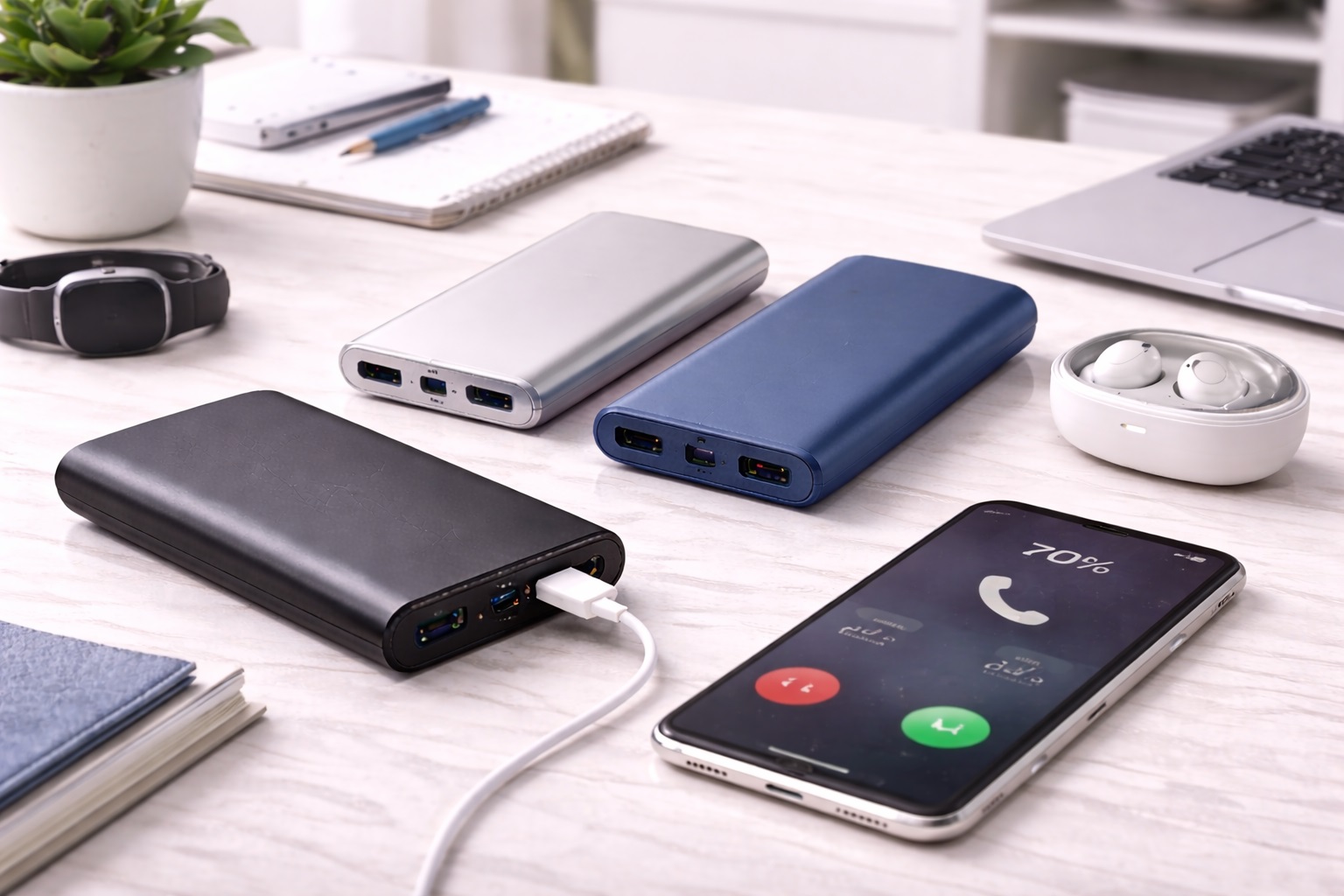
Best Power Banks for Calls: Never Drop Off Mid-Conversation
Voice and video calls drain a phone battery faster than almost any other everyday activity, since the screen typically stays on, the microphone and speaker run continuously, and a data connection stays active throughout. For anyone whose day involves back-to-back calls — sales roles, remote support, recruiters, anyone managing client relationships by phone — battery anxiety during an important conversation is a genuinely disruptive problem, and a power bank chosen specifically for this pattern of use solves it differently than a general-purpose one. General buying advice tends to assume a mix of light texting, browsing, and occasional calls throughout the day, which understates how much faster a battery drains when calls become the dominant activity rather than one item among many.
This guide focuses on what actually matters for heavy call users: enough capacity to survive multiple hours of continuous screen-on, microphone-active use, port selection that covers both a phone and a wireless headset charging case, and charging speed fast enough to top up meaningfully between calls rather than only overnight. We also look at how call use specifically differs from general phone use in terms of battery drain, since treating a call-heavy schedule the same as ordinary phone use tends to leave buyers under-buying capacity relative to their actual daily need.
Below you'll find a side-by-side comparison, detailed reviews of the models that consistently hold up well for heavy call use, a buying guide covering every factor worth checking before you order, and answers to the questions frequent phone and headset users ask most often. Treat the drain-pattern explanations throughout as the reason behind every recommendation that follows, rather than as a separate topic from the product picks themselves.
Top 5 Power Banks for Calls (Detailed Reviews)
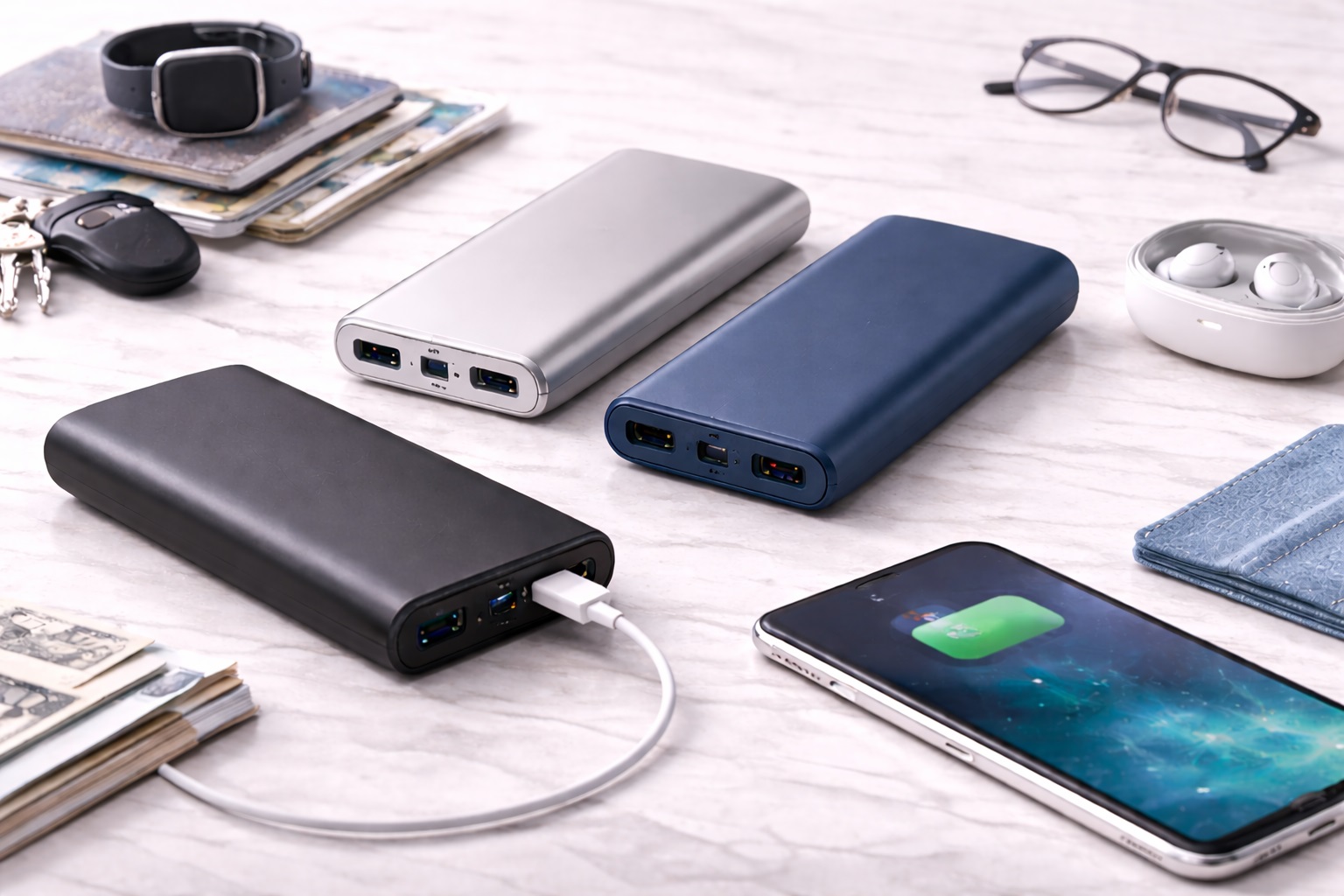
1. 20,000mAh High-Capacity Power Bank – Best for Back-to-Back Call Days
A 20,000mAh power bank delivers four to six full smartphone charges, which matters directly for call-heavy work since a phone actively on a call for several hours drains meaningfully faster than one used for scattered texting and browsing. This capacity means a full day of continuous calls — including video calls, which drain faster still due to the active camera and screen — doesn't require finding a wall outlet between meetings. For anyone whose calendar is booked solid with back-to-back calls, the ability to simply not think about charging until the evening is a genuine, if unglamorous, improvement to the workday.
- Pros:
- Four to six full smartphone charges, covering the heaviest call days
- Multiple ports allow charging a phone and a headset case simultaneously
- 65W USB-C output can also charge a laptop for video calls
- Removes the need to find an outlet between back-to-back calls
- Cons:
- Heavier than smaller options, typically 400–500g
- A full recharge of the bank itself takes six to eight hours
Best For: Sales professionals, support staff, recruiters, and anyone whose workday is structured around continuous phone or video calls.
Why We Recommend It: Call-heavy work drains a phone faster than almost any other use pattern, and this capacity provides genuine margin against running out mid-conversation on the busiest days. Buying for the busiest realistic day rather than a typical day means the bank quietly has margin to spare on lighter days, which is a far better outcome than the reverse.
2. 10,000mAh Slim Fast-Charge Power Bank – Best for Moderate Call Volume
A 10,000mAh slim power bank delivers two to three full smartphone charges, which comfortably covers a moderate call schedule without the bulk of a higher-capacity model. USB-C Power Delivery in the 18W–30W range provides a meaningful top-up between calls, useful for anyone who has a five- or ten-minute gap between conversations rather than a long lunch break to recharge fully. Those short windows add up meaningfully over a full day, and a bank that can capture even a five-minute top-up between calls stretches noticeably further than one that only makes progress over longer stretches.
- Pros:
- Two to three full phone charges — enough for a moderate daily call volume
- Fast USB-C charging usable during short gaps between calls
- Slim enough to keep on a desk or carry between meeting rooms
- Lighter than high-capacity alternatives
- Cons:
- May run out before day's end on the heaviest call schedules
- Not enough capacity for laptop charging
Best For: Buyers with a moderate, not extreme, call volume who want reliable backup without carrying a bulky bank.
Why We Recommend It: For most call schedules short of back-to-back all-day work, this size delivers enough margin without excess weight, striking a reasonable balance between the two extremes of the category.
3. Power Bank with Wireless Charging Stand – Best for Hands-Free Charging During Calls
A power bank built with a fold-out stand lets a phone charge while propped upright and visible during a call, which matters for anyone who needs to glance at notes, a CRM, or a video call window while talking. Charging continues uninterrupted whether the call is audio-only or video, and the stand keeps the phone accessible without lying flat on a desk. For anyone whose calls involve frequently glancing down at a screen for reference material, having the phone upright at eye level is a small but real improvement over reaching down to a flat surface each time. The angle also tends to frame a video call more naturally than a phone propped against a random object, which matters for anyone whose camera is visible to clients or colleagues throughout the day.
- Pros:
- Stand keeps the phone visible and accessible throughout a call
- Works equally well for audio and video calls
- Multiple ports typically included for simultaneous headset charging
- Stable desk footprint reduces cable slippage during a long call
- Cons:
- Larger footprint than a slim bank designed purely for portability
- Stand adds bulk that isn't useful once away from a desk
Best For: Desk-based call workers who need the phone upright and visible while charging throughout the day.
Why We Recommend It: Combining charging with a stand solves two problems specific to call-heavy work — a dying battery and an awkwardly flat phone — in one object.
4. 5,000mAh Ultra-Slim Power Bank – Best for Light Backup Between Calls
A 5,000mAh ultra-slim power bank provides one full smartphone charge in a pocket-sized form, suited to buyers whose call volume is moderate enough that a full backup charge covers any unexpected gap in access to a wall outlet. It won't sustain an entire back-to-back call day, but as pure backup insurance against an unexpectedly long afternoon, it does the job without adding bulk. The goal with this size isn't to eliminate charging anxiety on the heaviest days — it's to cover the more common scenario of a schedule that runs slightly longer than expected. Because it fits easily in a jacket pocket or small bag alongside a phone, it's also the size most likely to actually be carried every day rather than left behind on the days it turns out to matter most.
- Pros:
- One full phone charge — solid backup insurance for lighter call schedules
- Pocket-sized and easy to carry between meeting rooms
- Fast USB-C input for quick overnight recharge
- Minimal added bulk for occasional use
- Cons:
- Not enough capacity for a full back-to-back call day
- Single port limits it to one device at a time
Best For: Buyers with lighter or more variable call schedules who want backup power without carrying a larger bank daily.
Why We Recommend It: For call volume that's more occasional than continuous, this size covers the actual risk — an unexpectedly long day — without excess capacity going unused most days.
5. Multi-Port Power Bank with Priority Charging – Best for Phone Plus Headset Simultaneously
A power bank with dedicated fast-charging ports for both a phone and true wireless earbuds case addresses a specific call-heavy need: keeping both devices charged at once rather than choosing which to prioritize. Some models detect and prioritize output to whichever device needs it most, which matters when a headset case with low charge risks disconnecting mid-call. A phone running at 40% is a manageable inconvenience; earbuds that die mid-conversation and force a scramble for a wired headset is a much more visible disruption to the call itself.
- Pros:
- Dedicated ports keep phone and headset case both charging simultaneously
- Some models intelligently prioritize output based on need
- Removes the choice between charging a phone or a headset case
- Well suited to anyone using wireless earbuds for most calls
- Cons:
- Slightly more expensive than a basic multi-port bank
- Total combined output may be lower per port under heavy simultaneous load
Best For: Heavy wireless-headset users who need both the phone and the headset case reliably charged throughout a call-heavy day.
Why We Recommend It: A dead headset case mid-call is arguably more disruptive than a low phone battery, and this design specifically protects against both failing at once.
Buying Guide: How to Choose the Best Power Bank for Calls
Use these factors to match a power bank to the specific battery-drain pattern of heavy call use, which differs meaningfully from general phone use. Reading through all twelve before shortlisting a model helps avoid the common mistake of applying general power bank advice to a use case that genuinely behaves differently.
1. Capacity and Actual Output
Stated capacity in mAh is measured at 3.7V battery voltage, but output happens at 5V through USB, so real-world usable capacity is typically 60–70% of the printed number. For call-heavy use specifically, budget more conservatively than this baseline suggests, since continuous screen-on, microphone-active use drains a battery faster per hour than typical scattered phone use. A safe rule of thumb is to add roughly 20–30% more capacity than a general-use estimate would suggest if your day genuinely involves several hours of continuous calls.
2. Battery Drain From Simultaneous Call and Charging Use
Making a call while the phone is actively charging is less power-efficient than charging while idle, since the phone draws power for the call at the same time the bank is trying to add charge. Budget for this by expecting a somewhat lower effective charging speed during an active call than the bank's rated output would otherwise suggest. This is normal behavior rather than a defect, and it's worth setting realistic expectations rather than assuming a bank is underperforming simply because a phone charges slower while actively on a call.
3. Charging Speed: Input and Output
Output speed determines how quickly your phone charges from the bank; input speed determines how quickly the bank recharges. USB-C Power Delivery at 18W or higher provides meaningful fast charging during short gaps between calls, which matters more for call-heavy schedules than it does for general use, since the charging windows tend to be shorter and more frequent. A bank that only reaches its fastest charging speed after several minutes of connection is less useful for this pattern than one that starts delivering meaningful power almost immediately.
4. Port Selection and Simultaneous Device Charging
A phone and a wireless earbuds case both need charging in a call-heavy workday, so port count and simultaneous charging capability matter more here than for general use. Confirm the bank can deliver adequate power to both ports at once rather than throttling one when the other is connected. Some budget-oriented banks advertise multiple ports but silently reduce output when more than one device is connected, which defeats the purpose for someone specifically trying to charge two devices at once.
5. Safety Certifications
Look for CE, FCC, or UL certification markings on the bank and its packaging, confirming the product passed basic electrical safety testing. This matters more for a bank under near-continuous daily load from back-to-back charging cycles than for one used only occasionally, since sustained daily use puts more cumulative stress on internal components than intermittent use ever does.
6. Recharge Time for the Bank
A 20,000mAh bank charging at 18W input can take six to eight hours to fully recharge, while a 10,000mAh bank typically takes three to four hours. For call-heavy work, a bank that can meaningfully recharge during a lunch break — which requires faster input speed, ideally 30W or higher — is more practical than one that only recharges effectively overnight. A bank that gets meaningfully topped up over a thirty-minute lunch break behaves very differently in practice than one that's still nearly empty by the time the afternoon calls start.
7. Pass-Through Charging
Pass-through charging lets a bank charge a connected device while it is itself being recharged from a wall outlet, which is genuinely useful for a desk-based call worker who can leave the bank plugged in throughout the day. Not every bank supports this safely, so check the specification explicitly if you plan to rely on it, since without it you're forced to unplug the bank from the wall each time you want to top up a connected device, which quickly becomes annoying during a busy call day.
8. Weight and Portability
Higher capacity always means more physical weight. A 20,000mAh bank weighs roughly 400–500g, a 10,000mAh slim bank around 200–250g, and a 5,000mAh ultra-slim model under 130g. For a bank carried between meeting rooms throughout the day, weight matters more than for one that stays fixed at a single desk. Someone who takes calls from a single home office desk can reasonably prioritize capacity and port count over weight, while someone moving between rooms or buildings should weigh portability more heavily.
9. Display and Status Indication
Basic LED indicators show remaining charge in rough 25% increments. A numeric percentage display gives a clearer read on exactly how much charge remains, which matters more for call-heavy work since knowing whether the bank will last through an afternoon of scheduled calls is genuinely useful planning information. Glancing at a clear percentage before a long call is a small habit that removes any mid-call uncertainty about remaining charge.
10. Heat Management
Fast charging generates heat, and a bank under near-continuous daily load — as call-heavy use tends to produce — experiences more cumulative heat exposure than one used occasionally. Quality designs use metal housings or internal thermal management to dissipate heat safely under this kind of sustained daily use. A bank that stays noticeably cool through a full day of repeated charge cycles is a good sign it's built for this specific kind of heavy, continuous use rather than lighter occasional charging.
11. Wireless Charging Compatibility
A built-in wireless charging pad lets a phone charge while sitting flat on a desk during a call without a cable connection, which some callers find more convenient during a video call where cable placement can be visible on camera. Wireless charging is slower than wired, so it suits gradual desk-based charging better than a rapid top-up between calls. If your video calls are recorded or shared on screen, removing a visible charging cable is also a small aesthetic benefit some callers appreciate.
12. Priority Charging for Phones and Wireless Headsets
Some multi-port banks include smart circuitry that detects which connected device needs charge most urgently and adjusts output accordingly, rather than splitting power evenly regardless of need. This feature specifically benefits call-heavy users juggling a phone and a headset case, since it reduces the chance either device runs critically low during an active call. It's a genuinely thoughtful engineering detail aimed squarely at the exact problem this guide is built around, rather than a generic marketing feature.
13. Cable Quality and Included Accessories
A power bank is only as fast as the weakest cable in the chain, so check whether the included cable actually supports the bank's rated charging speed rather than assuming any USB-C cable will do. A budget cable bundled with an otherwise capable bank can quietly cap output well below what the bank is rated for, which is a common and easily avoidable source of disappointing real-world charging speed. It's worth testing the bundled cable against a known-good cable from another device if charging seems slower than expected, since replacing a single weak cable is a far cheaper fix than replacing the bank itself.
14. Warranty Coverage and Battery Cycle Life
A power bank used near-daily for call-heavy work goes through far more charge cycles per year than one used occasionally, so warranty length is a more meaningful signal here than for casual buyers. Look for at least a twelve-month warranty, and treat an eighteen- to twenty-four-month warranty as a sign the manufacturer has confidence in the cell quality inside. Manufacturers rate battery cells for a specific number of full charge cycles before capacity noticeably degrades, typically 500 or more for reputable brands, and a bank rated for a higher cycle count will hold up better against the frequent charging a call-heavy schedule demands.
Frequently Asked Questions
1. How much capacity do I need for a day of back-to-back calls?
For a genuinely continuous call schedule, 20,000mAh provides real margin, since active calls drain a battery faster than scattered general use. For a moderate call volume with breaks between conversations, 10,000mAh is typically sufficient. If your schedule genuinely varies day to day, sizing for your busiest realistic day rather than your average day avoids the frustration of running short specifically on the days it matters most.
2. Does charging while on a call slow down the charge?
Yes, somewhat. The phone draws power for the active call at the same time the bank adds charge, which reduces net charging speed compared to charging an idle phone. This effect is more pronounced during video calls than audio-only calls due to the additional camera and screen draw. It's a normal characteristic of how phones manage power under simultaneous load, not a sign of a faulty bank or cable.
3. How do I know when to replace my power bank?
Replace it once it no longer holds the charge it used to, typically noticeable after two to three years of regular use. If the bank runs unusually hot, develops a swollen shape, or stops charging altogether, replace it immediately for safety, particularly given how frequently a call-heavy user's bank gets cycled through charge and discharge each week.
4. Can one power bank keep both my phone and wireless earbuds charged all day?
Yes, provided it has at least two ports capable of delivering adequate power simultaneously. A 20,000mAh bank with dedicated multi-device ports comfortably covers a full day of phone plus wireless earbuds case charging for most call-heavy schedules, since an earbuds case draws a relatively small amount of the bank's total capacity compared to the phone itself.
5. Do video calls drain a phone faster than audio calls?
Yes, meaningfully. Video calls keep the screen on at higher brightness and activate the camera continuously, both of which draw significantly more power than an audio-only call with the screen off or dimmed. Budget for faster drain on days with a heavier video call schedule, and consider dimming screen brightness manually during video calls when battery is a concern, since brightness is one of the larger controllable factors in overall drain.
6. Should I prioritize a power bank with a stand if I take a lot of video calls?
It's a genuine convenience if your calls happen at a desk, since it keeps the phone upright and visible while charging rather than lying flat. If your calls happen on the move, a stand adds bulk without adding usefulness, so match the format to where your calls actually take place rather than to features that sound useful in the abstract.
7. Is the most expensive power bank for calls always the best?
Not always. Price reflects features and build quality, but many mid-range options outperform expensive alternatives for everyday call-heavy needs. Match the product to your actual call volume and device combination rather than assuming higher price guarantees better performance. A well-specified mid-range bank that matches your actual call pattern will outperform an expensive bank chosen without that same fit.
8. How long should a quality power bank for calls last?
A well-built power bank from a reputable manufacturer typically lasts two to five years with reasonable care, though near-daily heavy use from call-based work may shorten this somewhat compared to occasional use. Choosing a bank with a longer stated cycle life is a reasonable way to compensate for the heavier usage pattern this kind of work involves.
9. Can I return a power bank for calls if it doesn't suit me?
Most retailers offer a fifteen- to thirty-day return window. Test the bank through a genuinely representative call-heavy day or two before the window closes, since a light testing period won't reveal how it performs under real daily load. A single busy Tuesday of back-to-back calls will tell you more about a bank's real-world fit than a week of light, scattered use ever could.
10. What should I prioritize when buying a power bank for calls?
Start with your actual daily call volume and whether you also need to keep a wireless headset charged, then match capacity and port count to those specific needs rather than general phone-charging assumptions, since call-heavy drain patterns genuinely differ enough from ordinary use to justify a more tailored approach.
11. Does brand name matter for a power bank for calls?
Established brands typically offer more consistent quality control and reliable warranty support, which matters more for a bank under near-daily heavy load. Newer brands can still offer good value, so weigh verified purchase reviews carefully, particularly those describing sustained daily use rather than a single initial impression.
12. Will a power bank help if my phone gets hot during long calls?
Not directly — phone heat during long calls is usually related to processor load and screen brightness rather than the charging bank. However, using a bank with good thermal management avoids adding extra heat to an already warm device during a long charging session, which is a reasonable secondary benefit even if it doesn't address the underlying cause of phone heat during calls.
13. Can I bring a power bank through airport security for work travel calls?
Yes, in carry-on luggage. Most airlines permit power banks up to 100Wh (roughly 27,000mAh) without special approval, which covers every capacity discussed in this guide. Power banks are generally not permitted in checked baggage due to fire-risk regulations around lithium batteries, so if your call-heavy work involves regular travel, keep the bank in your carry-on and expect to declare it separately during security screening at some airports.
14. Does cold weather affect a power bank's performance for outdoor calls?
Yes. Lithium-ion batteries lose usable capacity temporarily in cold conditions, and both the bank and the phone connected to it will charge and discharge less efficiently below roughly 0°C (32°F). Performance returns to normal once the bank warms back up, so this is a temporary effect rather than lasting damage. Anyone taking calls outdoors in cold weather regularly should keep the bank in an inside pocket close to body heat between uses rather than in an exposed bag pocket.
Final Verdict
- Best for Back-to-Back Call Days: 20,000mAh High-Capacity Power Bank — genuine margin against running out on the heaviest days.
- Best for Moderate Call Volume: 10,000mAh Slim Fast-Charge Power Bank — enough capacity without excess weight for typical schedules.
- Best for Hands-Free Charging During Calls: Power Bank with Wireless Charging Stand — keeps the phone visible and charging at once.
- Best for Light Backup Between Calls: 5,000mAh Ultra-Slim Power Bank — covers the occasional unexpectedly long day.
- Best for Phone Plus Headset Simultaneously: Multi-Port Power Bank with Priority Charging — protects against both devices running low at once.
The right power bank for call-heavy work comes down to matching capacity and port selection to your actual daily call pattern rather than a general-purpose phone-charging assumption. Use the comparisons and buying guide above to keep every call connected from the first meeting of the day to the last. A bank chosen with your real drain pattern in mind quietly removes one more variable from an already demanding workday, which is worth more than its modest cost suggests.