Best Non-Slip Resistance Bands in 2026
Resistance bands have quietly become one of the most versatile tools in strength training, and the biggest complaint most people have about them has nothing to do with resistance levels or price. It is slippage. A band that rolls, bunches, or slides during a squat or a glute bridge does not just interrupt your set, it can throw off your form and increase the chance of a pinch or a snap against bare skin. That is why non-slip resistance bands, particularly those built with a woven fabric grip, have moved from a niche accessory to a mainstream staple in home gyms and studios alike.
In this guide, we break down eight of the most talked-about resistance band options on the market in 2026, from heavy-duty tube sets designed for serious strength work to fabric hip circles built specifically to stay put during lateral movements. We look at what each band is made from, how the grip technology holds up during real workouts, and which type of user each option tends to suit best. Whether you train at home, travel frequently, or are recovering from an injury under professional guidance, there is a non-slip band built for your situation.
We also walk through the practical factors that matter most when shopping for resistance bands, including material durability, resistance progression, comfort, and safety, so that by the end of this article you will know exactly what to look for regardless of which brand you ultimately choose. None of these products were tested identically in a lab setting; instead, this guide draws on published specifications, brand positioning, and well-established category knowledge to help you compare options confidently.
Top 8 Best resistance bands Picks (Detailed Reviews)
1. Rogue Tube Bands – Best For Heavy-Duty Strength Training
Rogue Fitness built its reputation on equipment that survives commercial gym use, and the Rogue Tube Bands carry that same philosophy into the resistance band category. Constructed from industrial grade rubber, these tube bands are designed for lifters who want to layer resistance for heavy compound movements like deadlifts, presses, and assisted pull-ups. At around $50, they sit at the premium end of the lineup, but the tubing feels noticeably thicker and more resilient than the latex loops many casual users start with.
- Pros:
- Industrial grade rubber that resists stretching out of shape over time
- Handles heavy compound lifts without excessive give
- Backed by a well-known, established fitness brand
- Consistent resistance feel across repeated sets
- Cons:
- Higher price point than most loop-style alternatives
- Limited color and length options compared to entry-level sets
- Tube style requires handles or anchors for many exercises
Best For: Lifters who already have a training routine built around heavier compound movements and want a band that can handle serious load without feeling flimsy.
Why We Recommend It: The build quality here is the standout. Industrial grade rubber tubing tends to outlast thinner latex options, and for anyone using bands to supplement barbell or bodyweight training, that durability translates directly into fewer replacements over the life of a program. If your budget allows for one premium purchase in this lineup, this is where the extra spend tends to show up most in daily use.
2. Letsfit Resistance Loop – Best For Beginners on a Budget
The Letsfit Resistance Loop set is one of the most approachable entry points into resistance training we came across, priced at roughly $10 for a set that includes five varying resistance levels. That range matters more than it might seem at first glance, because it lets a new user progress from light warm-up work all the way to more demanding strength exercises without needing to buy a second set.
- Pros:
- Five varying resistance levels included in one affordable set
- Compact enough to toss in a gym bag or suitcase
- Low cost makes it an easy first purchase for new lifters
- Simple loop design works for legs, arms, and core movements alike
- Cons:
- Thinner latex construction than premium tube-based options
- Fewer color-coded distinctions than dedicated therapy bands
- Not intended for the heaviest strength-training loads
Best For: First-time buyers and anyone who wants a low-commitment way to test whether resistance band training fits their routine before investing further.
Why We Recommend It: Few products in this category offer this much resistance variety for this little money. It is a practical, no-frills way to build a habit before spending more on specialized equipment. For anyone unsure whether banded training will stick as a habit, this is about as low-risk a starting point as the category offers.
3. TheraBand Professional – Best For Rehab & Physical Therapy
TheraBand is a name most physical therapy clinics already recognize, and the TheraBand Professional line leans into that legacy with its familiar color-coded resistance levels. At about $15, this option is designed less around maximal strength gains and more around controlled, progressive resistance, which is exactly what rehabilitation protocols typically call for.
- Pros:
- Color-coded levels make it easy to follow a therapist's program
- Long-standing reputation within clinical and rehab settings
- Flat band design is gentle on joints during controlled movements
- Affordable enough to keep multiple resistance levels on hand
- Cons:
- Not built for explosive or high-load strength training
- Flat bands can be less versatile for anchored exercises
- Color-coding conventions may vary slightly between product lines
Best For: Anyone working through a rehabilitation plan, prehab routine, or mobility program where controlled, incremental resistance matters more than raw strength output.
Why We Recommend It: The clinical pedigree here is hard to overstate. When a therapist or trainer references resistance levels by color, a TheraBand product is often the reference point, which makes communication and progression tracking simpler. That consistency across clinics and home programs alike is a genuine practical advantage over lesser-known alternatives.
4. Veick Resistance Set – Best For Home Gym Versatility
The Veick Resistance Set stands out for including a door anchor, which instantly expands what you can do with a set of bands beyond simple loop exercises. Priced around $35, it is positioned as a mid-range option for people building out a home gym who want bands that can substitute for cable machine movements like rows, presses, and face pulls.
- Pros:
- Included door anchor unlocks cable-style exercises at home
- Mid-range pricing balances features against cost
- Works well alongside handles for upper-body training
- Reasonably durable for regular home use
- Cons:
- Door anchor setup takes a bit of trial and error at first
- Not as travel-friendly as compact loop sets
- Premium tube brands may still outlast it under heavy daily use
Best For: Home gym owners who want one set of bands to replace several different cable machine attachments without buying separate equipment.
Why We Recommend It: The door anchor is the differentiator. It turns a basic band set into something closer to a compact cable station, which is genuinely useful for anyone training primarily at home. For someone without space or budget for a full cable machine, this is a surprisingly capable substitute.
5. Whatafit Resistance Bands – Best For Full-Body Workouts
Whatafit built its set around combined resistance, advertising up to 150 lbs total when multiple bands are stacked together. At approximately $25, it is aimed at users who want one kit that can cover everything from light mobility work to more demanding full-body circuits, all within a single purchase.
- Pros:
- Stackable bands allow up to 150 lbs of combined resistance
- Covers a wide range of exercises in one kit
- Reasonably priced for the amount of included resistance
- Suits both upper- and lower-body training
- Cons:
- Stacking multiple bands can feel bulky mid-set
- Individual bands are thinner than dedicated heavy-duty tubing
- Color options are more limited than some competitors
Best For: Users who want a single set that scales from light recovery sessions to challenging full-body strength circuits without buying separate equipment for each intensity level.
Why We Recommend It: The scalability is the appeal. Being able to combine bands for heavier work, then strip back down to a single light band for warm-ups, makes this a genuinely flexible option for varied training days. That flexibility is especially useful for households where more than one person shares the same set of equipment.
6. Bodylastics Stackable – Best For Safety-Conscious Lifters
Bodylastics built its reputation around anti-snap technology, a detail that matters a great deal to anyone who has experienced a band failing mid-rep. At around $30, the Stackable set focuses on giving lifters confidence that the bands will hold up under tension rather than fraying or snapping unexpectedly.
- Pros:
- Anti-snap technology designed to reduce failure risk under load
- Stackable format allows for progressive resistance increases
- Well regarded among users who train with heavier resistance
- Reasonable mid-range price for the safety features included
- Cons:
- Still requires periodic inspection like any resistance band
- Slightly bulkier when multiple bands are combined
- Fewer beginner-specific resistance levels than dedicated starter sets
Best For: Lifters who prioritize safety and peace of mind, especially those stacking multiple bands for heavier resistance where a failure would be more consequential.
Why We Recommend It: Anti-snap construction is a meaningful safety upgrade for anyone pushing bands toward their upper resistance limits, and it is the kind of feature that pays off precisely when you need it most. It is a small line item on the spec sheet that matters far more once you are stacking several bands together.
7. Peach Bands Hip Bands – Best For Glute & Lower-Body Activation
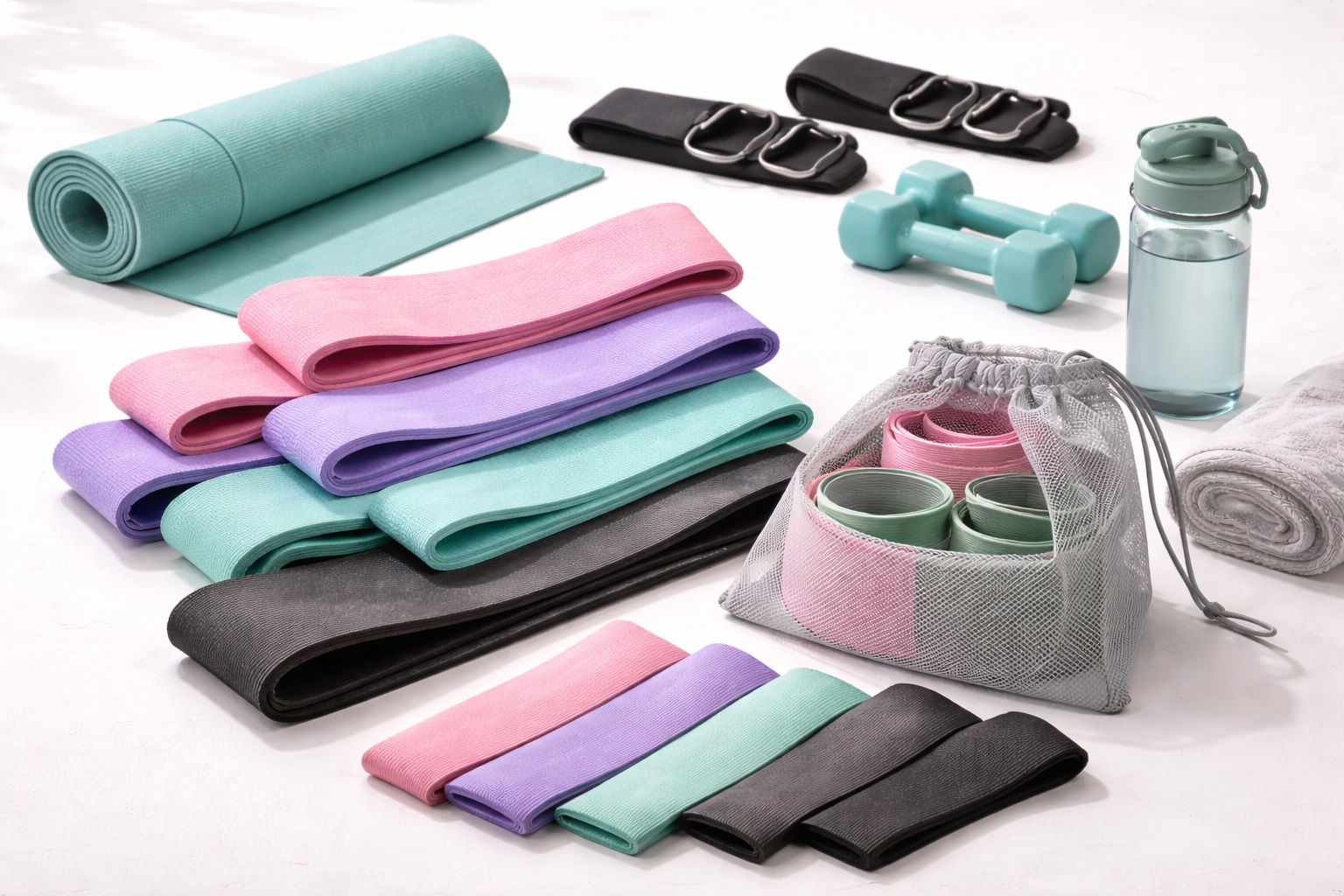
Peach Bands built its entire product around the fabric non-slip design that this whole guide is centered on. At roughly $20, this set of hip bands is purpose-built for lateral and glute-focused movements like banded walks, hip thrusts, and clamshells, where a rolling or bunching band can genuinely ruin a set.
- Pros:
- Fabric non-slip design stays put during lateral movements
- Wide construction is more comfortable against skin than thin latex
- Purpose-built for glute activation and lower-body circuits
- Machine washable fabric makes hygiene easier over time
- Cons:
- Narrower use case than full-body tube or loop sets
- Not designed for upper-body or anchored exercises
- Fabric construction adds slightly more bulk to a gym bag
Best For: Anyone whose training focuses heavily on glute activation, hip mobility, or lower-body warm-ups where a band that stays fixed in place is non-negotiable.
Why We Recommend It: This is the band that best represents the non-slip category by design rather than as an afterthought. The fabric grip genuinely solves the rolling problem that plagues thinner latex loops during lateral work, which is precisely the frustration that sends most shoppers searching for a non-slip option in the first place.
8. Fitbit Resistance Bands – Best For Travel & On-the-Go Training
Fitbit's entry into resistance bands leans on durable latex construction and a compact form factor, priced around $40. For a brand better known for wearables, the appeal here is less about a novel grip technology and more about a lightweight, packable set that pairs naturally with a broader fitness-tracking routine.
- Pros:
- Durable latex holds up well to frequent packing and unpacking
- Compact and lightweight, ideal for suitcases or gym bags
- Recognizable brand with broader fitness ecosystem appeal
- Straightforward design with minimal learning curve
- Cons:
- Priced higher than comparable latex-only competitors
- Fewer specialized grip features than dedicated fabric bands
- Latex may not suit users with sensitivities to the material
Best For: Frequent travelers or anyone who wants a simple, reliable band set that fits easily into carry-on luggage without adding meaningful weight.
Why We Recommend It: The portability-to-durability ratio is strong here. It will not replace a dedicated fabric hip band or a heavy tube set, but as a grab-and-go option it covers the basics reliably, which is often exactly what a hotel room or airport lounge workout calls for.
Buying Guide: How to Choose the Best resistance bands
Not every resistance band is built for the same purpose, and the right pick depends heavily on how and where you plan to train. Below are the factors we weigh most heavily when evaluating a set, whether it is a fabric hip circle, a rubber tube, or a stackable loop system.
1. Material & Durability
The base material determines how long a band will last under regular use. Industrial grade rubber and durable latex tend to resist stretching out of shape, while thinner materials can degrade faster with frequent stacking or heavy tension. Checking for reinforced stitching or seamless construction is a good habit before committing to a set.
It also helps to think about how the band will be used week to week. A set that only sees light stretching sessions can get away with thinner material, but anything used for daily strength circuits benefits from the added thickness and reinforced seams found in higher-end tubing and fabric constructions.
2. Grip Technology: Fabric Sleeves vs Latex Tubing
This is the defining question for non-slip performance. Fabric-covered bands generally stay put better during lateral or hip-focused movements because the woven material creates friction against skin or clothing, while latex tubing can roll or slide, especially once it warms up during a workout.
That said, fabric is not automatically the right answer for every movement. Tube bands with smooth latex still excel at pulling and pressing exercises where the band travels through a full range of motion, so many experienced users end up keeping both types on hand for different parts of a workout.
3. Resistance Level & Progression
Look for a set that offers a clear path forward as you get stronger, whether that means multiple color-coded bands, stackable tubes, or a single band with an unusually wide resistance range. A set that maxes out too quickly will need replacing sooner than one built with progression in mind.
A useful test is to imagine your training six months from now. If you expect to get noticeably stronger, buying a set with room to grow, rather than one that only covers your current fitness level, will save you from an unplanned second purchase down the road.
4. Comfort & Fit During Use
Thin bands can pinch or dig into skin during longer sets, particularly around the thighs or upper arms. Wider fabric bands and padded handles tend to reduce this issue, which matters more than it seems once you are several reps into a challenging set.
Comfort also affects consistency. A band that pinches or chafes is one you are less likely to reach for regularly, so trying a few different widths and materials, when possible, can make a meaningful difference in how often the equipment actually gets used.
5. Portability & Storage
If you travel often or train in multiple locations, a compact set that packs into a small pouch is worth prioritizing over a bulkier kit, even if the bulkier kit offers marginally more features.
Loop bands and lightweight tube sets tend to travel best, while door-anchor kits with multiple attachments are usually better suited to a fixed home gym setup where you are not repacking them after every session.
6. Anchor Points & Attachments
Door anchors, handles, and ankle straps meaningfully expand what a band set can do, effectively turning it into a mini cable machine. If you plan to do rows, presses, or face pulls, confirm the set includes or supports these attachments.
Even if a set does not include these accessories out of the box, many are compatible with universal attachments sold separately, so it is worth checking compatibility before assuming you will need an entirely different product.
7. Safety Features
Anti-snap construction and reinforced connection points reduce the risk of a band failing mid-set, which becomes more important as you stack multiple bands for heavier resistance. This is a detail worth paying extra for once you are working near a band's upper limit.
Regularly inspecting bands for small nicks, discoloration, or thinning is just as important as the technology itself. Even the most durable anti-snap band will eventually wear down, and catching early warning signs prevents a failure during a heavy set.
8. Versatility Across Exercises
Some bands are purpose-built for a narrow set of movements, like hip circles for glute work, while others are designed to handle everything from squats to shoulder presses. Decide whether you want one all-purpose set or several specialized bands for different training goals.
Many experienced users eventually land on a small collection rather than a single band, pairing a fabric hip circle for activation work with a tube set for pressing and pulling movements, since each format genuinely does its job better than a one-size-fits-all option.
9. Price vs Value
Resistance bands span a wide price range, and a higher price does not automatically mean better performance for your specific use case. A $10 set with strong reviews may outperform a $50 set for a beginner's needs, so weigh cost against how frequently and intensely you plan to train.
Consider cost per year of expected use rather than the sticker price alone. A slightly more expensive band that lasts three times as long often works out cheaper in the long run than repeatedly replacing a bargain set.
10. Skin Sensitivity & Latex-Free Options
Some users experience irritation from latex, which is worth checking before purchase if you have known sensitivities. Fabric-covered bands or latex-free alternatives are widely available and solve this issue without sacrificing performance.
Even without a diagnosed sensitivity, some people simply find fabric more pleasant against the skin during sweaty workouts, since it tends to absorb moisture rather than sticking the way bare latex sometimes can.
11. Brand Reputation & Warranty
Established fitness brands often back their bands with a warranty or replacement policy, which adds peace of mind for a product that experiences repeated tension over its lifespan. Reading customer feedback on long-term durability is a useful step before buying.
A strong warranty is also a signal of confidence from the manufacturer. Brands that stand behind their bands for a year or more are typically more comfortable with how their materials hold up under sustained, repeated use.
12. Sizing & Loop Length
Loop bands come in different lengths and widths, and the right size depends on your height and the exercises you plan to do. A band that is too short can restrict range of motion, while one that is too long may not provide enough tension for smaller movements.
Taller users in particular should double-check length specifications before buying, since a band sized for an average frame can feel noticeably restrictive during full-range movements like standing lateral raises or overhead presses.
13. Maintenance & Care
Simple habits extend the life of any resistance band. Storing bands away from direct sunlight, avoiding sharp edges or rough flooring, and following the manufacturer's cleaning instructions all help maintain elasticity and grip over time.
Rotating between two sets, rather than relying on a single band for every session, can also reduce wear and extend overall lifespan, since each set gets more recovery time between uses.
Frequently Asked Questions
What makes a resistance band non-slip?
Non-slip resistance bands typically use a fabric or textured outer layer instead of smooth latex or rubber. This creates friction against skin or clothing, helping the band stay in place during lateral and rotational movements where standard bands tend to roll.
Are fabric resistance bands better than rubber ones?
It depends on the exercise. Fabric bands generally excel at glute and hip-focused movements where staying in place matters most, while rubber tube bands are often better suited to heavier, full-range strength exercises like rows and presses.
How long do resistance bands typically last?
Lifespan varies by material and usage frequency, but with proper storage and care, most quality bands can last well over a year of regular training before showing significant signs of wear.
Can beginners use heavier resistance bands safely?
Beginners are generally better served starting with lighter resistance and focusing on form before progressing to heavier bands. Color-coded or multi-level sets make this progression easier to manage.
Do resistance bands work as well as free weights?
Resistance bands provide variable tension that changes throughout a movement, which offers a different training stimulus than free weights. Many trainers use both together rather than treating one as a full replacement for the other.
How do I choose the right resistance level to start with?
Start with a level that lets you complete a full set with good form and only mild fatigue by the final rep. If a band feels too easy after a few sessions, it is time to progress to the next level.
Are non-slip bands safe for sensitive skin?
Fabric-covered bands are generally gentler on skin than thin latex loops, which can pinch. Anyone with a latex sensitivity should look specifically for latex-free fabric or synthetic options.
Can resistance bands be used for physical therapy?
Yes, resistance bands are widely used in rehabilitation settings, often with color-coded levels that let therapists prescribe precise, progressive resistance for recovering muscles and joints.
How do I stop a resistance band from rolling up during exercises?
Choosing a wider, fabric-based band significantly reduces rolling compared to thin latex loops. Proper placement above the knee or around the widest part of the thigh also helps keep bands stable.
What is the difference between loop bands and tube bands?
Loop bands are continuous circles typically used for lower-body and activation work, while tube bands usually have handles on each end and are better suited to upper-body pulling and pressing movements.
How should I store my resistance bands?
Keep bands away from direct sunlight and sharp objects, and store them loosely coiled rather than tightly knotted to help preserve elasticity over time.
Can resistance bands actually help build muscle?
Yes, resistance bands create tension throughout a movement, which can stimulate muscle growth effectively, especially when combined with progressive overload through heavier bands or stacked combinations.
Are more expensive resistance bands worth the extra cost?
Premium bands often use higher-grade materials that resist snapping and stretching out longer, which can be worth the investment for frequent users, though budget sets remain a smart choice for beginners testing the waters.
Can I combine resistance bands with weights in the same workout?
Yes, many lifters pair bands with dumbbells or barbells to add variable resistance to a lift, increasing tension at the top of a movement while keeping it lighter at the bottom. This combination is common in intermediate and advanced strength programs.
What resistance level should I buy if I am not sure of my strength?
When in doubt, a multi-level set is the safer purchase. It lets you start light and work upward without guessing at a single resistance number, which is especially useful if you are new to banded training or returning after time off.
Final Verdict
- Top Pick: Rogue Tube Bands for overall excellence.
- Budget Choice: TheraBand Professional for great value.
- Premium Choice: Letsfit Resistance Loop for high-end features.
There is no single best resistance band for every situation. If your training centers on heavy compound movements, a rubber tube set like the Rogue Tube Bands will hold up best under sustained tension. If your focus is glute activation and lateral work, a fabric non-slip design like the Peach Bands Hip Bands solves the rolling problem that plagues thinner alternatives. Whichever direction you choose, prioritizing grip technology, material durability, and safety features will serve you far better in the long run than chasing the lowest price alone.