Best Compass for Mountaineering in 2026
Above treeline, a compass has to do more than confirm a general direction of travel. Navigating exposed ridgelines, whiteout conditions, and technical approaches demands precise bearings, declination adjustment that matches the specific range you are climbing in, and hardware that keeps working when temperatures drop and gloves make fine adjustments harder. This guide compares eight compasses commonly carried by mountaineers, from rugged lensatic designs to lightweight baseplate models suited to lower-elevation approach trails. Each one serves a different point in a typical climbing day, and matching the right tool to the right stage of a route, rather than assuming one compass must handle everything, tends to produce the most reliable overall setup.
Mountaineering navigation also tends to pair a compass with a topographic map and, increasingly, a GPS device or phone app as backup, so the compass itself needs to be dependable rather than flashy. This guide compares the top compass models for mountaineering, weighing durability, sighting accuracy, and weight against the realities of alpine travel, followed by a detailed buying guide and FAQ section to help you match a compass to your own routes and objectives. None of the eight picks below are ranked as universally best, since the right choice depends heavily on whether your season involves moderate scrambles, technical rock, or extended glacier travel.
Top 8 Best Compass Picks (Detailed Reviews)
1. Brunton TruArc 15 – Best For Alpine Navigation
The Brunton TruArc 15 combines a sighting mirror, a global needle, and adjustable declination correction into a rugged package built for serious alpine use, at a price point of around $55. Its global needle is particularly useful for climbers who travel to ranges in different parts of the world, since it reads accurately across a much wider range of latitudes than a standard needle calibrated for a single hemisphere. Brunton has a long history of building durable field instruments, and the TruArc 15's solid mirror hinge and housing are designed to hold up to the knocks and temperature swings common on alpine routes. Many guides carry this exact model as their primary compass for years running, which speaks to how well it holds up across repeated seasons of rough handling and freeze-thaw cycling.
- Pros:
- Mirror sighting improves bearing accuracy on exposed ridgelines
- Global needle performs reliably across different mountain ranges and hemispheres
- Adjustable declination correction saves recalculating for every new range
- Cons:
- Bulkier and heavier than a minimalist baseplate compass
- Higher price than entry-level options
Best For: Mountaineers who travel to different ranges and need a compass that adapts to varying latitudes without recalibration.
Why We Recommend It: Its combination of global needle accuracy and rugged construction makes it a dependable all-around choice for serious alpine objectives.
2. Cammenga 3H Tritium – Best For Extreme Conditions
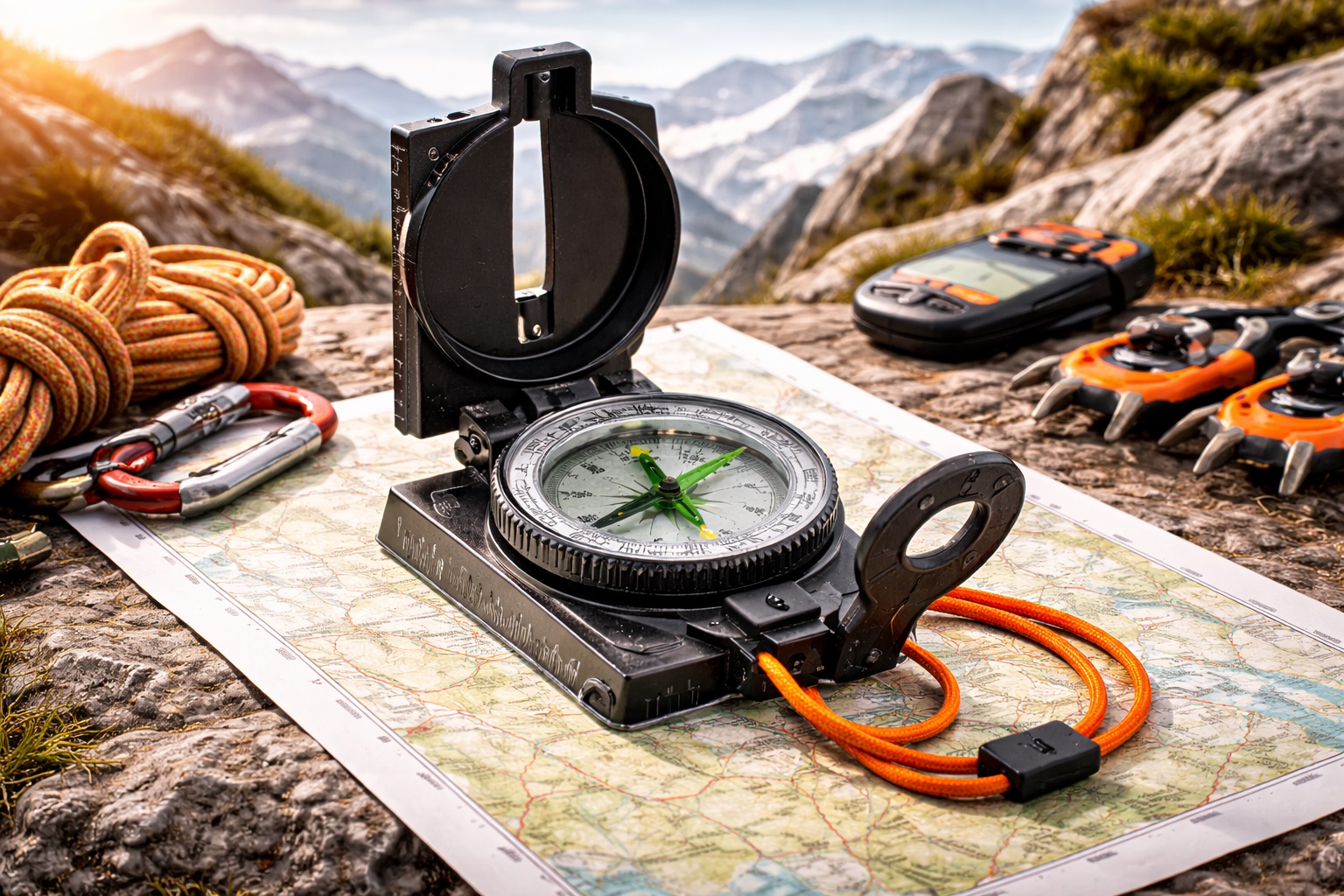
The Cammenga 3H Tritium is a military-grade lensatic compass built for exactly the kind of harsh, unpredictable conditions found at altitude, priced around $90. Its tritium illumination glows without batteries or a flashlight, which matters on routes where alpine starts happen well before sunrise and descents often finish after dark. The floating, induction-dampened dial and rugged housing are designed to resist sticking in cold temperatures and to survive the kind of rough handling that comes with technical terrain and glove-heavy travel. Its origins as a military-issue instrument mean it was designed from the outset for exactly the kind of abuse alpine travel dishes out, rather than adapted from a recreational baseplate design.
- Pros:
- Tritium markings remain visible during pre-dawn starts and late descents
- Rugged housing built to withstand harsh alpine conditions
- Floating dial resists sticking in cold temperatures
- Cons:
- No flat baseplate, so map plotting takes an extra step
- Heaviest and bulkiest option in this lineup
Best For: Climbers on multi-day objectives who navigate in genuinely extreme cold, wind, or low-visibility conditions.
Why We Recommend It: When conditions turn harsh and reliability matters more than convenience, its rugged build and battery-free illumination are hard to beat.
3. Suunto MC-2 – Best For Technical Routes
The Suunto MC-2 is frequently the compass of choice for guides and instructors working technical alpine terrain, combining a global needle, adjustable declination, a clinometer, and a sighting mirror at around $65. The clinometer is a genuine asset above treeline, letting climbers estimate slope angle for avalanche awareness or route-finding without relying solely on contour lines on a map. For anyone whose objectives include glaciated terrain or steep snow slopes, having slope-angle estimation built into the same tool used for bearings is a meaningful convenience. It also means one less separate instrument to carry, dig out, and keep track of during a long summit push when time and attention are both limited.
- Pros:
- Clinometer supports slope-angle estimation for avalanche-aware travel
- Global needle and declination adjustment work together across ranges
- Mirror sighting supports precise bearings on exposed terrain
- Cons:
- Highest price point among the baseplate and mirror options here
- More features to learn before they become second nature
Best For: Climbers and guides navigating technical or glaciated terrain who want slope-angle readings alongside standard bearings.
Why We Recommend It: The built-in clinometer adds a genuinely useful safety-relevant feature that few other compasses on this list offer.
4. Suunto A-10 – Best For Basecamp and Approach Trails
The Suunto A-10 is a simple, affordable baseplate compass that earns its place on a mountaineering list mainly for approach trails, basecamp navigation, and as an ultralight backup to a more technical primary compass, at around $25. It is not built for technical alpine sighting, but for straightforward navigation on marked or moderately marked trails leading to a route's start, it is more than capable and adds very little weight to a pack that is already loaded with technical gear. Many climbers keep one clipped near the top of a pack specifically for the approach hike, saving a heavier mirror compass for the technical objective itself.
- Pros:
- Very lightweight, ideal as a secondary or approach compass
- Simple design that is quick to use when tired
- Backed by Suunto, a well-established navigation brand
- Cons:
- No mirror or clinometer for technical route-finding
- Less suited to precise long-distance sighting on exposed terrain
Best For: Climbers who want a lightweight compass for the approach and basecamp portions of a trip, or a low-weight backup to a primary compass.
Why We Recommend It: Its minimal weight makes it easy to justify carrying as insurance without adding meaningful bulk to an already heavy pack.
5. Silva Explorer – Best For Multi-Day Expeditions
The Silva Explorer pairs a clear baseplate with a DryFlex rubber grip, which becomes noticeably more valuable on multi-day expeditions where hands are frequently cold, wet, or gloved, at a price of around $30. A secure grip matters more than it might seem when you are trying to take an accurate bearing with numb fingers at altitude, and the Explorer's ergonomics are built specifically to address that kind of real-world friction. Over the course of a multi-day expedition, small comfort details like grip texture add up, since a compass that is fiddly to hold gets checked less often exactly when consistent navigation matters most.
- Pros:
- DryFlex grip stays secure with wet or gloved hands
- Clear baseplate supports straightforward map work at basecamp
- Reasonable weight for extended expeditions
- Cons:
- No sighting mirror for precise long-distance bearings
- Fewer advanced features than the MC-2 or TruArc 15
Best For: Climbers on longer expeditions who need a compass that stays usable through repeated days of cold, wet handling.
Why We Recommend It: Ergonomics that hold up across many uses in harsh conditions matter as much as raw precision on extended trips.
6. Suunto M-3 – Best For Ridge and Summit Navigation
The Suunto M-3 adds adjustable declination correction to a clear baseplate design at around $50, making it a solid middle-ground option for ridge walking and summit navigation where precise bearings matter but a full mirror-sighting setup may be more than is needed. Setting declination once for the specific range you are climbing removes a common source of error on routes where a few degrees of drift can mean the difference between the correct ridge and an adjacent one. Its lighter weight compared to a full mirror compass also makes it an easy choice for climbers trying to trim ounces without giving up meaningful accuracy.
- Pros:
- Adjustable declination correction improves accuracy for specific ranges
- Clear baseplate for straightforward navigation
- Lighter than full mirror-sighting compasses
- Cons:
- No mirror, so long-distance sighting is less precise
- Higher price than the most basic baseplate options
Best For: Climbers who want declination correction for ridge and summit navigation without the added weight of mirror sighting.
Why We Recommend It: It solves the most common source of bearing error at a lighter weight than the full-featured mirror compasses on this list.
7. Brunton 8010 – Best For Emergency Backup
The Brunton 8010 is a simple, inexpensive compass that many mountaineers carry purely as an emergency backup, priced around $20. If a primary compass is lost, dropped down a crevasse, or damaged, having a basic spare tucked into a first aid kit or repair kit means you are never fully without a way to establish a rough bearing back to camp or a known trailhead. For a few extra dollars and a couple of ounces, it removes one of the more stressful single points of failure on a remote objective.
- Pros:
- Very affordable, making a spare easy to justify
- Small and light enough to stash in an emergency kit
- Simple enough to use even when exhausted or stressed
- Cons:
- No declination adjustment
- Limited precision compared to mirror or lensatic designs
Best For: Mountaineers who want a low-cost, low-weight backup compass as insurance against losing their primary navigation tool.
Why We Recommend It: A redundant navigation plan matters in the mountains, and this compass fills that role at minimal weight and cost.
8. Silva Ranger – Best For Guided Expeditions
The Silva Ranger, at around $45, is a longtime favorite among mountain guides thanks to its adjustable declination screw and sighting mirror, which together support fast, accurate bearing-taking during guided trips where efficiency matters as much as precision. Its durable baseplate construction is built to withstand repeated use across a guiding season, and its familiar layout means many climbers have already trained on this exact model before their first serious expedition. Guides often prefer a compass that clients already recognize, since less time spent explaining an unfamiliar tool means more time focused on the actual route.
- Pros:
- Declination correction screw removes a common navigation error
- Mirror sighting supports accurate bearings under time pressure
- Durable construction suited to repeated guiding use
- Cons:
- Steeper learning curve than a basic baseplate model
- Adds cost and weight over simpler compasses
Best For: Guided groups and climbers who want a proven, widely trusted compass with mirror sighting and declination adjustment.
Why We Recommend It: Its long track record among professional guides speaks to how well it performs under real expedition conditions.
Buying Guide: How to Choose the Best Compass for Mountaineering
Choosing a mountaineering compass means balancing precision against weight, and durability against cost. The sections below cover the specific factors that matter most once you move from trail hiking into alpine terrain, where conditions are harsher and mistakes carry higher consequences.
1. Baseplate, Mirror, or Lensatic Design
Baseplate compasses are lightweight and easy to use for planning routes on a map at basecamp, while mirror compasses add sighting accuracy for exposed ridgelines and distant landmarks. Lensatic compasses trade a flat baseplate for rugged, precise sighting and better cold-weather durability, which is why many serious mountaineers carry one alongside a lighter baseplate model. Deciding which design to prioritize usually comes down to whether your objective involves more time planning routes at camp or more time actively sighting bearings on exposed terrain.
2. Global Needle for Multi-Range Travel
If your objectives take you to mountain ranges across different latitudes, a global needle avoids the sluggish or tilted readings a standard needle can show far from where it was calibrated. For climbers who stick to one general region, a standard needle is usually sufficient. Checking whether a compass is described as globally balanced before an international trip can save a frustrating surprise once you are already at your destination.
3. Declination Adjustment for Each Range
Declination varies significantly by location, and mountain ranges often sit in areas with notably different correction values than nearby lowlands. A compass with adjustable declination lets you reset the correction for each new range rather than doing mental math on exposed terrain where mistakes are costly. Reviewing the local declination value from a current map before every trip, rather than relying on memory from a previous climb, is a simple habit worth building.
4. Cold-Weather Reliability
Liquid-filled capsules can develop bubbles or sluggish needle movement in extreme cold, so look for compasses specifically noted for reliable performance at low temperatures. Lensatic compasses with floating, induction-dampened dials tend to handle cold better than basic liquid-filled baseplate models. Testing needle movement before a trip, especially if the compass has been stored somewhere cold, is a quick way to catch a problem before it matters on route.
5. Weight Versus Feature Trade-offs
Every gram matters on a technical objective, so weigh whether a mirror, clinometer, or global needle is worth the added weight for your specific routes. Many mountaineers carry a lightweight baseplate compass for general use and a heavier, more capable compass only for the technical crux of a trip. Laying gear out before a trip and asking whether each feature will genuinely be used on this specific objective helps avoid carrying dead weight.
6. Glove Compatibility and Grip
A compass that is difficult to operate with gloved or numb hands becomes a liability exactly when you need it most. Textured grips, larger dials, and simple, uncluttered controls all matter more in mountaineering than in casual trail navigation. Practicing with a compass while wearing your actual climbing gloves before a trip is a simple way to confirm it will work when it counts.
7. Sighting Mirror Durability
A mirror hinge that loosens or a mirror surface that scratches easily reduces sighting accuracy over time. Look for a solid, well-built hinge mechanism, since this is one of the first components to wear on lower-quality mirror compasses subjected to repeated pack abrasion. A protective case or pouch adds negligible weight and meaningfully extends the life of the mirror surface across many trips.
8. Clinometer for Slope and Avalanche Awareness
A built-in clinometer provides a quick slope-angle check that supports avalanche-aware decision-making on snow-covered terrain. It is not essential for every objective, but for glaciated or snow-climbing routes, it adds a genuinely useful safety-relevant data point. It should always supplement, rather than replace, formal avalanche training and terrain assessment skills.
9. Luminous and Tritium Illumination
Alpine starts often begin in the dark, and descents can run late, so illumination that does not depend on a separate light source is a real asset. Tritium illumination on lensatic compasses outperforms standard luminous paint in this respect, since it never needs recharging. Standard luminous paint still works reasonably well as long as it gets a few minutes of direct light exposure before it is needed.
10. Redundancy and Backup Compasses
Given the consequences of losing a compass on an exposed route, many mountaineers carry a lightweight backup alongside their primary compass. This redundancy costs very little in weight or money compared to the risk of navigating with no compass at all after a loss or failure. Storing the backup in a different pocket or pack compartment than the primary compass further reduces the odds of losing both at once.
11. Baseplate Rulers for Route Planning
Even on technical objectives, most route planning happens on a map at basecamp before a climb, where a baseplate compass with clear rulers speeds up measuring distances and plotting bearings for the approach and descent. Doing this planning carefully before a climb reduces how much in-field navigation decision-making is needed once you are already tired or in poor visibility.
12. Durability Under Repeated Temperature Swings
Compasses used across many seasons of alpine travel experience repeated freezing and thawing cycles, which can stress seals and housings differently than steady room-temperature use. Rugged, purpose-built models tend to hold up better to this kind of cycling over years of use. Inspecting seals and housing for any visible cracking before a season's first big trip is a cheap way to catch developing problems early.
13. Matching the Compass to Your Specific Objectives
A weekend scrambler tackling moderate peaks has different needs than an expedition climber attempting multi-week glaciated routes, and there is no shame in starting with modest gear and upgrading as your objectives grow more ambitious. Be honest about the terrain and conditions you actually face before paying for features suited to more extreme objectives than your own. It is generally easier to add a second, more advanced compass later than to guess wrong on your first purchase and rebuy immediately.
Frequently Asked Questions
Do mountaineers need a different compass than hikers?
Not necessarily a completely different compass, but mountaineering conditions, cold, altitude, gloves, and exposed terrain, make features like declination adjustment, cold-weather reliability, and secure grips more valuable than they are for casual trail hiking. A compass that performs adequately for a summer day hike may reveal real limitations once tested at altitude in freezing wind.
Should I carry a baseplate compass or a lensatic compass for mountaineering?
Many mountaineers carry both: a lightweight baseplate compass for route planning at basecamp and a more rugged lensatic or mirror compass for precise bearings on the technical portions of a climb. This two-compass approach is common enough among experienced mountaineers that it should not be seen as overkill for anyone attempting serious objectives.
Does cold weather affect compass accuracy at altitude?
Extreme cold can occasionally cause a liquid-filled capsule to develop a bubble or the needle to move sluggishly. Compasses built for rugged conditions, including lensatic designs with induction-dampened dials, are generally more resistant to this than basic liquid-filled baseplate models. Keeping a compass in an inner layer close to body heat when not actively in use can also help minimize cold-related sluggishness.
Is a clinometer necessary for mountaineering navigation?
It is not strictly necessary, but it is a genuinely useful feature for glaciated or snow-covered terrain where slope-angle awareness supports avalanche-conscious decision-making alongside standard bearing-taking. It works best as one input among several, alongside proper avalanche education and current conditions reports.
Can I rely on GPS instead of a compass in the mountains?
GPS devices and phone apps are useful tools, but batteries fail in cold weather and signal can be unreliable in deep valleys or under heavy cloud cover. A physical compass has no battery to fail and is widely considered essential backup equipment for serious alpine travel. Most experienced mountaineers treat GPS as a helpful convenience layered on top of, rather than a replacement for, solid map and compass skills.
How important is a global needle for mountaineering?
It matters most for climbers traveling to ranges across different latitudes or hemispheres. If your objectives stay within one general region, a standard needle is typically accurate enough. International guiding trips are the clearest case where a global needle pays off in noticeably better accuracy.
Why do some mountaineers carry a backup compass?
Losing or damaging a compass on an exposed route can leave you without a reliable way to navigate back to camp or a known trailhead, so a lightweight, inexpensive backup is common insurance against that risk. Even experienced climbers who rarely need it still describe carrying one as a form of cheap peace of mind.
How much does compass weight actually matter on a climb?
On multi-day technical objectives where every gram is weighed carefully, the difference between a lightweight baseplate compass and a full-featured mirror compass can be meaningful, though it is rarely the single deciding factor in overall pack weight. Bigger weight savings usually come from other gear categories, so it is worth keeping the compass decision in perspective.
Does a mirror compass work well with gloves on?
Larger dials, textured grips, and simple adjustment mechanisms all help with glove use, though fine sighting adjustments are generally easier with bare or thin-glove hands regardless of compass design. Practicing the specific motions you will need, like rotating a bezel or opening a mirror, while wearing your actual gloves is worth doing before a trip.
What is the benefit of tritium illumination over standard luminous paint?
Tritium glows continuously without needing exposure to light beforehand or a battery, which is particularly useful during pre-dawn alpine starts when there has been no daylight to charge standard luminous paint. This is one of the clearer, more practical reasons some climbers choose a lensatic compass despite its extra weight.
How do I maintain a compass used in alpine conditions?
Keep it dry when possible, avoid extreme temperature shocks like moving directly from a warm tent into deep freeze, and periodically check that the housing rotates smoothly and the needle settles without excessive wobble. Doing this quick check at the start of a season, rather than discovering an issue mid-climb, is a small habit with real payoff.
Should beginners tackling their first alpine routes buy an expensive compass?
Not necessarily. A solid mid-range compass with declination adjustment is usually sufficient for moderate alpine objectives, with premium mirror or lensatic compasses becoming more valuable as routes grow more technical and remote. There is little downside to starting simple and upgrading later once you know exactly which features you actually rely on.
Is declination adjustment more important in the mountains than on regular trails?
Declination adjustment matters everywhere, but the consequences of a bearing error are often higher in the mountains, where terrain features can look similar and drifting off course carries more serious risk than on a well-marked trail. Treating declination correction as a mandatory step rather than an optional refinement is good practice for any alpine objective.
Final Verdict
- Top Pick: Brunton TruArc 15, for mountaineers who need dependable mirror sighting and a global needle across different ranges.
- Budget Choice: Suunto A-10, for a lightweight, affordable compass suited to approach trails and basecamp navigation.
- Premium Choice: Cammenga 3H Tritium, for climbers facing genuinely extreme cold, low-light, and high-consequence conditions.
Mountaineering navigation rewards preparation more than any single piece of gear, and the right compass is the one that matches your actual objectives rather than the most feature-packed option available. A lightweight baseplate model is enough for many approach trails and moderate routes, while committing to multi-day technical or glaciated terrain justifies the added weight and cost of a mirror or lensatic compass built for harsher conditions. Whichever combination you settle on, practicing with it under realistic conditions, cold hands, gloves, and low light included, matters just as much as the compass itself once you are actually on route.