Best Sighting Compass in 2026
A sighting compass turns rough guesswork into a repeatable skill. By combining a mirror or sighting line with a rotating bezel, these tools let you take an accurate bearing on a distant landmark and walk a straight line toward it, even when the trail disappears or the fog rolls in. In 2026, the market for precision navigation tools spans everything from lightweight orienteering baseplates to rugged, military-inspired lensatic designs.
Choosing the right model comes down to matching the sighting mechanism, declination system, and build quality to how and where you actually navigate. This guide compares the top sighting compasses on the market, breaking down what separates a genuinely precise instrument from a novelty pocket gadget, so you can pick a compass that will hold a bearing reliably for years.
Below you will find detailed reviews of eight standout compasses, a practical buying guide covering the features that matter most for precision work, and answers to the questions navigators ask most often before buying.
It is worth noting that a sighting compass is only as good as the skill behind it. Even the most precisely engineered mirror or lensatic system cannot correct for a hurried reading or an unaccounted-for declination offset, so part of choosing the right compass is being honest about how much time you are willing to invest in learning to use it well. The models below span a wide range of price points and skill levels, from beginner-friendly baseplates to instruments built for serious backcountry route-finding.
Top 8 Best compass Picks (Detailed Reviews)
1. Silva Ranger – Best For Precision Navigation and Mirror Sighting
Silva built its reputation on precision baseplate design, and the Silva Ranger carries that legacy forward. Its mirror sighting system and magnifying lens let you take a bearing on a distant object while simultaneously reading the dial, a combination that significantly reduces the small errors that creep into hurried readings. At around $45, it sits comfortably in the mid-range tier for buyers who want serious accuracy without stepping into professional survey-grade pricing. The clear baseplate also carries standard ruler scales, so it doubles as a measuring tool when you are planning a route on a topographic map rather than just following one already drawn.
- Pros:
- Mirror sighting and magnifying lens for precise bearings
- Premier build quality with a stable baseplate
- Reputable brand with a long navigation heritage
- Cons:
- Higher price point than basic baseplate models
- Limited color options
Best For: Hikers and navigation enthusiasts who need mirror-assisted precision for triangulating exact bearings in the field.
Why We Recommend It: The combination of a magnifying lens and mirror sighting makes fine-detail map reading and precise bearing-taking genuinely easier, which matters most when a small angular error can mean a large distance off course.
2. Suunto M-3 – Best For Declination Adjustment On the Move
The Suunto M-3 focuses on one job and does it well: correcting for magnetic declination without forcing you to stop and recalculate every bearing by hand. Its adjustable declination correction is built into the housing, so once it is set for your region, every reading automatically compensates for the local difference between magnetic and true north. At roughly $50, it is priced for navigators who travel between regions with different declination values. Because the correction is mechanical rather than digital, there is no battery to fail and no software to update, which appeals to buyers who want a tool that keeps working exactly the same way years down the line.
- Pros:
- Adjustable declination correction saves time in the field
- Premier build quality typical of Suunto's baseplate line
- Reputable brand trusted by outdoor professionals
- Cons:
- Higher price point than non-adjustable models
- Limited color options
Best For: Travelers and multi-region navigators who need to switch declination settings without recalculating bearings manually.
Why We Recommend It: Built-in declination adjustment removes a common source of navigation error, which is especially valuable if you hike or work across different geographic regions throughout the year.
3. Brunton TruArc 15 – Best For Long-Term Durability
Brunton's TruArc 15 pairs a global needle with evergreen durability, meaning the needle stays balanced no matter which hemisphere you are navigating in and the housing is built to shrug off years of regular use. At about $55, it costs a bit more than entry-level compasses, but the construction is aimed at buyers who expect to keep the same compass for a decade or longer. The capsule is designed to resist the fogging and bubbling that eventually plagues cheaper liquid-filled housings, which is often the first sign that a compass is nearing the end of its useful life.
- Pros:
- Global needle works reliably across hemispheres
- Evergreen durability built for long service life
- Premier build quality from a respected brand
- Cons:
- Higher price point than basic models
- Limited color options
Best For: Frequent travelers and international backpackers who need a needle system that performs consistently everywhere they go.
Why We Recommend It: A global needle removes the guesswork of needle balance across latitudes, and the durable housing means this compass can realistically serve as a long-term primary instrument.
4. Suunto MC-2 – Best For Advanced Land Navigation
The Suunto MC-2 steps up from basic baseplate compasses by adding a clinometer alongside its global needle, letting you measure slope angle in addition to taking standard bearings. At around $65, it is positioned for users who need more than point-to-point navigation, such as estimating avalanche risk terrain or calculating elevation change on a route. This kind of dual-purpose instrument is common among mountaineering and search-and-rescue circles, where a single compact tool needs to cover both bearing and slope-angle measurement without adding pack weight.
- Pros:
- Global needle and clinometer add real navigational capability
- Premier build quality suited to demanding use
- Reputable brand with professional-grade credibility
- Cons:
- Higher price point reflecting the added functionality
- Limited color options
Best For: Backcountry travelers and land navigation students who need slope-angle measurement in addition to standard bearings.
Why We Recommend It: Few compasses in this price range combine a global needle with a built-in clinometer, making the MC-2 a genuine step up for anyone doing serious route planning.
5. Cammenga 3H Tritium – Best For Night and Low-Light Use
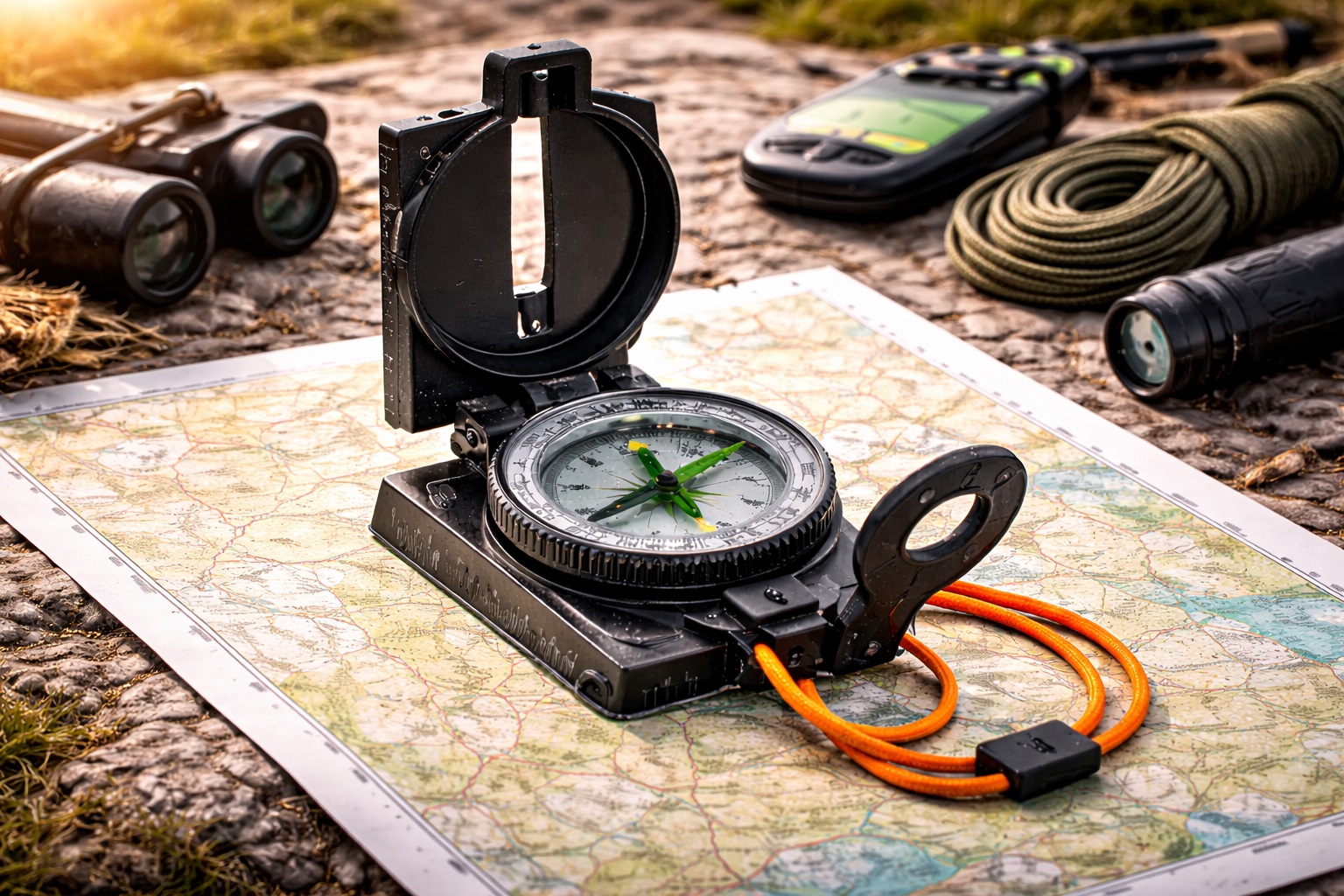
The Cammenga 3H Tritium is built around a lensatic design with self-luminous tritium markings, so the dial and sighting line remain readable without a flashlight. At roughly $90, it carries the highest price in this lineup, reflecting both its military-inspired construction and the specialized tritium illumination that does not rely on batteries or charging. The lensatic sighting system it uses is the same general approach favored by military land navigation training, prized for its ability to hold a precise bearing over long, straight-line movement.
- Pros:
- Self-luminous tritium markings for night navigation
- Premier build quality with a rugged lensatic housing
- Reputable brand with a long military supply history
- Cons:
- Higher price point than baseplate alternatives
- Limited color options
Best For: Night hikers, hunters, and anyone who regularly navigates before dawn or after dusk without reliable ambient light.
Why We Recommend It: Battery-free tritium illumination means the dial stays legible for years without any maintenance, which is a genuine advantage over electronic backlights that eventually fail.
6. Silva Explorer – Best For Comfortable All-Day Carry
The Silva Explorer trades some of the Ranger's advanced sighting features for a more approachable, comfortable design built around a DryFlex grip. That soft-touch edge makes the compass easier to hold steady for extended periods, which matters on long orienteering courses or all-day map work. At around $30, it undercuts the premium Silva models while keeping the brand's core baseplate quality. It still includes the clear scale markings and rotating bezel expected of a serious navigation tool, just without the added mirror hinge that increases both bulk and price on the Ranger.
- Pros:
- DryFlex grip improves comfort during extended use
- Premier build quality at a more accessible price
- Reputable brand recognized in orienteering circles
- Cons:
- Higher price point than the most basic baseplate models
- Limited color options
Best For: Orienteering competitors and students who spend long hours holding a compass and need a grip that will not fatigue the hand.
Why We Recommend It: Comfort is easy to overlook until you are three hours into a course, and the DryFlex grip genuinely reduces hand strain during sustained use.
7. Suunto A-10 – Best For Beginners and Everyday Use
The Suunto A-10 strips navigation down to its essentials with an easy-to-use baseplate design intended for people just learning to read a bearing. At about $25, it is one of the more accessible options here, making it a sensible first compass for scouts, students, or casual hikers who want reliability without a steep learning curve. The dial and housing follow a straightforward layout, so new users can focus on learning bearings and declination rather than figuring out an unfamiliar interface.
- Pros:
- Easy-to-use baseplate design ideal for learning
- Premier build quality despite the lower price
- Reputable brand known for entry-level reliability
- Cons:
- Higher price point than the absolute cheapest imports
- Limited color options
Best For: First-time compass owners, scout groups, and students who are still learning the fundamentals of bearing and declination.
Why We Recommend It: A simple, uncluttered baseplate is genuinely easier to learn on than a feature-heavy model, and the A-10 keeps the essentials without unnecessary complexity.
8. Brunton 8010 – Best For Budget-Conscious Buyers
The Brunton 8010 is built around simple reliability for beginners, offering a no-frills baseplate that covers the fundamentals of bearing-taking without extra features to learn or break. At around $20, it is the most affordable compass in this roundup, aimed at buyers who want a dependable backup or an inexpensive way to try navigation before investing in a premium model. Many experienced hikers actually keep a compass like this as a spare in a first aid kit or vehicle glove box, since it costs little enough to leave in place indefinitely.
- Pros:
- Simple reliability for beginners at a low price
- Premier build quality for its price tier
- Reputable brand backing a basic, dependable design
- Cons:
- Higher price point compared to no-name imports
- Limited color options
Best For: Budget-conscious buyers who want a reliable backup compass or a low-cost way to get started with navigation.
Why We Recommend It: Even at its entry price, the 8010 does not cut corners on the basics, which makes it a sensible backup to keep in a pack alongside a primary compass.
Buying Guide: How to Choose the Best Sighting Compass
Sighting compasses vary far more than their simple appearance suggests. The features below are the ones that actually separate a compass you can trust in the field from one that will frustrate you the first time precision matters.
1. Compass Type: Baseplate vs. Lensatic vs. Mirror Sighting
Baseplate compasses are the most common and easiest to learn on, pairing a clear plastic plate with a rotating bezel. Lensatic compasses, like military-style designs, use a rear sighting lens for highly accurate bearings. Mirror sighting compasses combine a hinged mirror with a sighting line so you can view the target and the dial at once. Choose based on how precise your bearings need to be and how much learning curve you are willing to accept. Many navigators eventually own more than one type, keeping a simple baseplate for everyday hikes and a mirror or lensatic model for trips where precision genuinely matters.
2. Sighting Mechanism and Bearing Accuracy
The sighting mechanism is what actually determines how accurately you can aim at a distant object. Mirror and lensatic systems allow you to line up a target and read the dial simultaneously, which reduces parallax error compared to simple baseplate sighting notches. If your use case involves triangulating your position or navigating long, featureless stretches, prioritize a compass with a genuine sighting system over a basic notch-and-dial design. Even a small improvement in sighting accuracy compounds over distance, so the benefit becomes more noticeable the farther you travel between checkpoints.
3. Declination Adjustment
Magnetic declination, the difference between magnetic north and true north, varies by location and changes slowly over time. A compass with adjustable declination correction lets you set this offset once so every bearing you take afterward is automatically accurate, rather than requiring manual math for every reading. This feature is especially valuable if you travel or hike across different regions, since manually correcting for declination on every single bearing is one of the easiest steps to forget or miscalculate under field conditions.
4. Rotating Bezel and Degree Markings
Look for a bezel that rotates smoothly with defined click stops or firm resistance, since a loose or overly stiff bezel makes fine bearing adjustments difficult. Clear, high-contrast degree markings in two-degree increments are the standard for precision work, while cheaper compasses sometimes use coarser five-degree graduations that reduce accuracy. Hold and rotate the bezel before buying if possible, since a gritty or loose action is a strong indicator of the overall build quality throughout the rest of the instrument.
5. Global Needle vs. Regional Needle
Standard magnetic needles are balanced for a specific hemisphere and can tilt or drag against the capsule housing when used far from where they were calibrated. A global needle is balanced to perform accurately across hemispheres, which matters if you travel internationally or live near the equator where standard needles are more prone to error. If your navigation stays within one region, a standard needle costs less and performs identically, so this is not a feature every buyer needs to pay for.
6. Baseplate Material and Scale Rulers
A rigid, transparent baseplate is essential for reading map features underneath it without distortion. Many baseplates also include ruler scales for common map ratios, letting you measure distance directly on a topographic map. Confirm the printed scales match the maps you typically use before assuming a compass covers your needs. A baseplate that has yellowed or warped over time can also throw off flat readings, so inspect the plate for warping if you are buying a used or older compass.
7. Size, Weight, and Portability
A sighting compass should be light enough to carry daily without a second thought, whether clipped to a pack strap or tucked in a pocket. Larger lensatic and mirror-sighting models offer more precision but add bulk, so weigh the accuracy benefit against how often you will actually be carrying the compass on your person. A compass left at home because it felt too bulky to carry is of no use at all, so honest self-assessment of your own habits matters more than any spec sheet.
8. Durability and Weatherproofing
Look for a sealed liquid-filled capsule that resists fogging and leaking, along with a housing material that can survive drops onto rock or being packed alongside heavier gear. A compass that develops bubbles in the capsule or a sticky bezel after a season of use will undermine your confidence in every reading it gives you afterward. Extreme temperature swings are usually the culprit behind capsule bubbling, so avoid leaving a compass in a hot car or freezing gear locker for extended periods.
9. Luminous or Tritium Illumination
For anyone navigating before dawn, after dusk, or in caves and dense forest, some form of illumination is worth paying for. Tritium markings glow continuously for years without batteries, while photoluminescent paint needs to be charged by light exposure first. Decide which trade-off fits your typical navigation conditions. Anyone who navigates almost exclusively during daylight hours can reasonably skip this feature entirely and put the savings toward a better sighting mechanism instead.
10. Clinometer and Additional Tools
Some compasses add a clinometer for measuring slope angle, useful for assessing avalanche terrain or estimating elevation gain on a route. Others include a signal mirror, magnifying lens, or ruler markings. These extras add real utility for specific activities but also add cost, so match the add-ons to tasks you will genuinely use. A signal mirror in particular can double as an emergency rescue tool, giving it value well beyond everyday navigation.
11. Lanyard and Carry Options
A sturdy lanyard keeps your compass around your neck or clipped to your pack, reducing the risk of dropping or losing it on the trail. Check that the lanyard attachment point is reinforced rather than a thin loop of plastic, since this is a common failure point on lower-quality compasses. A snapped attachment loop at the wrong moment can mean losing your only navigation tool in deep snow or fast water, so it is worth inspecting closely before you rely on it.
12. Price vs. Feature Trade-offs
Precision features like mirror sighting, global needles, and tritium illumination all add to the price. Decide honestly how often you will use advanced features versus how often a simple, accurate baseplate compass would serve you just as well, and let that guide how much you spend. It is easy to over-buy on features that sound impressive in a product listing but rarely come into play during your actual navigation habits.
13. Matching the Compass to Your Activity
A weekend day hiker has very different needs from a backcountry navigator plotting bearings across unmarked terrain. Match the sighting mechanism, ruggedness, and extra features to how demanding your typical outings actually are, rather than buying the most feature-packed model available. If in doubt, it is usually smarter to start with a solid mid-range baseplate and upgrade later once you have a clearer sense of which advanced features you actually reach for in the field.
Frequently Asked Questions
What makes a sighting compass different from a basic compass?
A sighting compass adds a mirror, lens, or sighting line that lets you aim precisely at a distant landmark while simultaneously reading the bearing on the dial, which improves accuracy over compasses that require looking at the target and the dial separately. This distinction becomes especially noticeable when the landmark is small or far away, where any shift in your line of sight can throw off the bearing.
Is a premium sighting compass worth the extra cost?
For anyone doing serious route planning or navigating in low-visibility conditions, yes. Premium models offer more accurate sighting mechanisms, sturdier housings, and features like declination adjustment that reduce cumulative error over long distances. Casual walkers on well-marked trails, however, can usually get by fine with a basic baseplate model.
How do I adjust for magnetic declination?
Look up the declination value for your area, then use the small adjustment screw or dial on compasses with built-in declination correction to set the offset once, so every bearing afterward is automatically corrected for true north. Declination values are typically printed on topographic maps or available from national mapping agencies for your specific area.
Can I use a sighting compass without a map?
Yes, a sighting compass can be used on its own to take a bearing toward a visible landmark and walk a straight line, though pairing it with a topographic map allows for full route planning and position triangulation. Many experienced navigators still carry both, using the compass alone for quick directional checks.
How do I maintain my sighting compass?
Keep the capsule clean and avoid exposing it to extreme heat, which can cause the liquid fill to bubble. Store it away from strong magnets or electronics, and periodically check that the bezel still rotates smoothly. If you ever notice a bubble forming inside the capsule, it is usually a sign the compass has been exposed to a temperature extreme and may need replacing.
What is a global needle and do I need one?
A global needle is balanced to remain level across both the northern and southern hemispheres. If you only navigate in one region, a standard needle works fine, but frequent international travelers benefit from a global needle's consistency. Without it, a needle balanced for the northern hemisphere can drag noticeably against the capsule glass when used well south of the equator.
Do I need a clinometer on my compass?
A clinometer is useful for measuring slope angle, which matters for assessing avalanche risk or estimating elevation change on a route. Casual hikers on marked trails typically do not need this feature, since trail signage and gentle grades rarely require slope calculations.
How accurate should a good sighting compass be?
Most quality sighting compasses allow bearing readings accurate to within one or two degrees when used correctly, which is precise enough for cross-country navigation over several miles. That level of precision assumes the user is holding the compass level and away from metal objects or electronics that can interfere with the reading.
Are tritium compasses safe?
Tritium illumination is sealed inside small glass vials and is considered safe for consumer use, emitting a very low level of radiation that is well within recognized safety standards for this type of self-luminous marking. The sealed vials are designed to remain intact under normal use and simply lose brightness gradually over many years.
What is the difference between true north and magnetic north?
True north refers to the geographic North Pole, while magnetic north is the direction a compass needle points due to the Earth's magnetic field, which shifts slightly over time and differs by location, hence the need for declination correction. Ignoring this difference can lead you noticeably off course over a long enough distance.
Can a sighting compass replace a GPS device?
A sighting compass does not need batteries and works anywhere, making it an excellent backup or primary tool, but it requires map-reading skill and does not provide the exact coordinate positioning that GPS devices offer. Many navigators treat the two as complementary tools rather than substitutes for one another.
How do I choose between a baseplate and a lensatic compass?
Baseplate compasses are easier to learn and pair well with map work, while lensatic compasses often provide more precise sighting for long-distance bearings. Choose based on your experience level and how much of your navigation happens off established trails, since both types achieve accurate results once you are comfortable with the technique.
What should I look for in a beginner's sighting compass?
Beginners should prioritize a simple, clearly marked baseplate design with an easy-to-read bezel over advanced features like clinometers or tritium illumination, which can be added later as skills develop. Starting simple also helps build confidence in fundamental skills like taking a bearing and following it, which remain useful no matter how advanced a compass you eventually move up to.
Final Verdict
- Top Pick: Silva Ranger for its mirror sighting precision and dependable build.
- Budget Choice: Brunton 8010 for reliable basics at the lowest price.
- Premium Choice: Cammenga 3H Tritium for advanced low-light navigation.
Whichever model you choose, the most important factor is practicing with your compass before you need it in a real emergency. A sighting compass rewards familiarity, and the small time investment in learning declination adjustment and bearing-taking pays off the moment you actually need to navigate without a trail or a signal. Take a new compass out on a familiar trail first, comparing its readings against known landmarks, so you understand exactly how it behaves before you ever depend on it somewhere unfamiliar.