Best Resistance Bands for Home Workouts: Portable, Versatile & Effective
Resistance bands are one of the few pieces of fitness equipment that genuinely earn a permanent spot in a home gym bag, a closet shelf, or a desk drawer. They cost a fraction of a rack of dumbbells, weigh almost nothing, and yet they can load nearly every major muscle group through a full range of motion. The catch is that "resistance band" is not one product — it is a category that spans thick rubber loops used by powerlifters to add band tension to squats, paper-thin fabric loops used for glute activation, long tube bands with handles that mimic cable machine exercises, and flat latex sheets used in physical therapy clinics. Picking the wrong style for your goal is the most common mistake buyers make.
This guide breaks down six practical band styles that consistently come up in home workout, rehab, and strength-supplement contexts, explains where each one shines and where it falls short, and walks through the specific factors — resistance range, material, comfort, and accessories — that actually determine whether a set of bands gets used for years or ends up forgotten in a drawer after a month. None of these categories is universally "best." The right pick depends on whether you're rebuilding strength after an injury, adding accommodating resistance to barbell lifts, or simply trying to get a full-body workout done in a small apartment without any other equipment.
Throughout the reviews below, pay close attention to the Best For and Why We Recommend It notes. Resistance bands are inexpensive enough that many people end up owning more than one style over time, and understanding the distinct role each type plays will save you from buying a set that duplicates what you already have while leaving an actual gap in your training unaddressed.
It also helps to think about resistance bands the way you'd think about a small toolkit rather than a single tool. A carpenter doesn't buy one screwdriver and expect it to handle every job, and the same logic applies here: a band built for barbell squats is the wrong tool for post-surgery shoulder rehab, and a band built for gentle rehab work will feel almost pointless to someone chasing a heavier deadlift. The reviews and buying guide below are organized so you can quickly identify which category actually matches your training goal, rather than defaulting to whichever set has the most reviews or the flashiest packaging.
Top 6 Resistance Bands for Home Workouts (Detailed Reviews)
1. Heavy Resistance Loop Bands – Best For Advanced Strength Training
Heavy loop bands are continuous rubber loops, usually rated from around 40 to well over 150 pounds of tension at full stretch, designed to be looped around a barbell, pull-up bar, or squat rack. Lifters use them to add accommodating resistance to compound lifts, meaning the band gets tighter — and harder to move — the further you extend through the lift, which builds explosive strength and helps iron out sticking points that a fixed barbell load can't address on its own.
- Pros:
- Provides accommodating resistance that increases through the range of motion, useful for strength and power work
- Extremely durable rubber construction built to handle repeated high-tension stretching
- Doubles as a pull-up assistance tool by looping it over a bar and stepping into the bottom of the loop
- Cons:
- Overkill for beginners or anyone doing rehab-style, low-load movements
- Requires a rack, bar, or sturdy anchor point to use for most exercises
Best For: Lifters who already train with a barbell and want to add variable resistance to squats, deadlifts, bench presses, or assisted pull-ups.
Why We Recommend It: No other band style in this list can meaningfully load a barbell squat or add resistance to a heavy compound lift. For anyone training with weights at home, a heavy loop band unlocks training methods that simply aren't possible with tube bands or fabric loops.
It's worth noting that heavy loop bands are also useful outside of barbell contexts — anchored to a sturdy post or door frame, they work well for high-tension rows, presses, and sprint-resistance drills. The tradeoff is that this category rewards experience; a lifter unfamiliar with band tension curves can misjudge the effort required at the top of a movement, so it's a better fit for someone who already has a baseline of strength training under their belt.
2. Light Therapy Bands – Best For Rehab and Physical Therapy
Light therapy bands are thin, flat latex or non-latex strips, typically color-coded by tension level, that physical therapists have relied on for decades for post-injury rehabilitation and mobility work. Because the resistance at this end of the spectrum is measured in single-digit pounds rather than tens of pounds, they're built for control and precision rather than raw load.
- Pros:
- Gentle, gradual resistance levels appropriate for recovering joints and weakened muscles
- Flat, wide design reduces pinching and is comfortable against skin during slow, controlled reps
- Color-coded tension levels make it easy to follow a therapist's prescribed progression
- Cons:
- Too light for general strength training once you're past the early rehab stage
- Flat latex strips can be less durable than tubular designs if knotted or anchored under sharp edges
Best For: Anyone recovering from surgery or injury, older adults building baseline strength, or physical therapy patients following a home exercise program.
Why We Recommend It: This is the style clinicians actually issue to patients, and for good reason — the low, controllable tension lets you isolate small stabilizing muscles without risking re-injury, which heavier bands simply aren't designed for.
Beyond formal rehab, this band style is also a sensible everyday choice for older adults or anyone returning to exercise after a long break, since the low resistance ceiling makes it difficult to overdo a movement even without close supervision. Many patients continue using the same bands well after their prescribed program ends, incorporating them into ongoing mobility and warm-up routines.
3. Tube Bands With Handles – Best For Full-Body Gym-Style Workouts
Tube bands with molded foam or rubber handles on each end are the closest resistance band equivalent to a cable machine. Because the handles let you grip securely and the tubes are usually sold as a set of graduated resistance levels, they're built around variety — rows, presses, curls, and lateral raises are all straightforward with the right attachment.
- Pros:
- Ergonomic handles make gripping secure during pressing, pulling, and rotational movements
- Usually sold in graduated sets, so resistance can be swapped without buying separate bands
- Door anchors included in most sets extend the exercise library well beyond what loop bands allow
- Cons:
- Handles and connection points are common failure spots if the tubing is lower quality
- Bulkier to store and travel with compared to flat or loop-style bands
Best For: People who want a cable-machine-style, full-body strength routine at home without buying separate equipment for every muscle group.
Why We Recommend It: The combination of secure handles, a door anchor, and multiple resistance levels means a single set can realistically replace a large portion of a commercial gym's cable station, which is a meaningfully different value proposition than a single loop band.
This category is also the most beginner-friendly for people who feel intimidated by free weights but still want a structured strength program. Because the handles standardize grip across every exercise, new exercisers can focus on learning proper movement patterns — rows, presses, curls — without simultaneously fighting an awkward grip, which is a common issue with plain loop bands used for upper-body work.
4. Fabric Resistance Bands – Best For Glute and Hip Activation
Fabric bands are short, wide loops woven from cotton or polyester blends rather than pure rubber. They've become closely associated with glute and hip work because the wide, non-slip fabric stays in place around the thighs during lateral walks, hip thrusts, and clamshells far better than a thin rubber loop, which tends to roll or dig in.
- Pros:
- Wide, woven design grips skin and clothing without rolling up during lateral and rotational movement
- More comfortable than rubber loops for bare-skin use around the thighs
- Machine washable, which matters for a piece of equipment that sits directly against sweaty skin
- Cons:
- Fixed, non-adjustable resistance per band means you'll likely need multiple bands for progression
- Less suited to upper-body or full-range strength exercises compared to tube or loop bands
Best For: Anyone focused on glute activation, hip stability, or warm-up work before lower-body training days.
Why We Recommend It: The no-roll, no-pinch design solves a specific, well-known annoyance with thin rubber loop bands during lateral movements, making it the more practical choice for this particular use case even though it's less versatile overall.
Fabric bands are also popular as a warm-up tool immediately before lower-body training days, since a few sets of banded lateral walks or monster walks activate the glutes and hips before heavier compound lifts. Many lifters keep a set specifically for this purpose even when the rest of their band collection is built around other styles.
5. Full Home Workout Band Set – Best For Building a Complete Home Gym
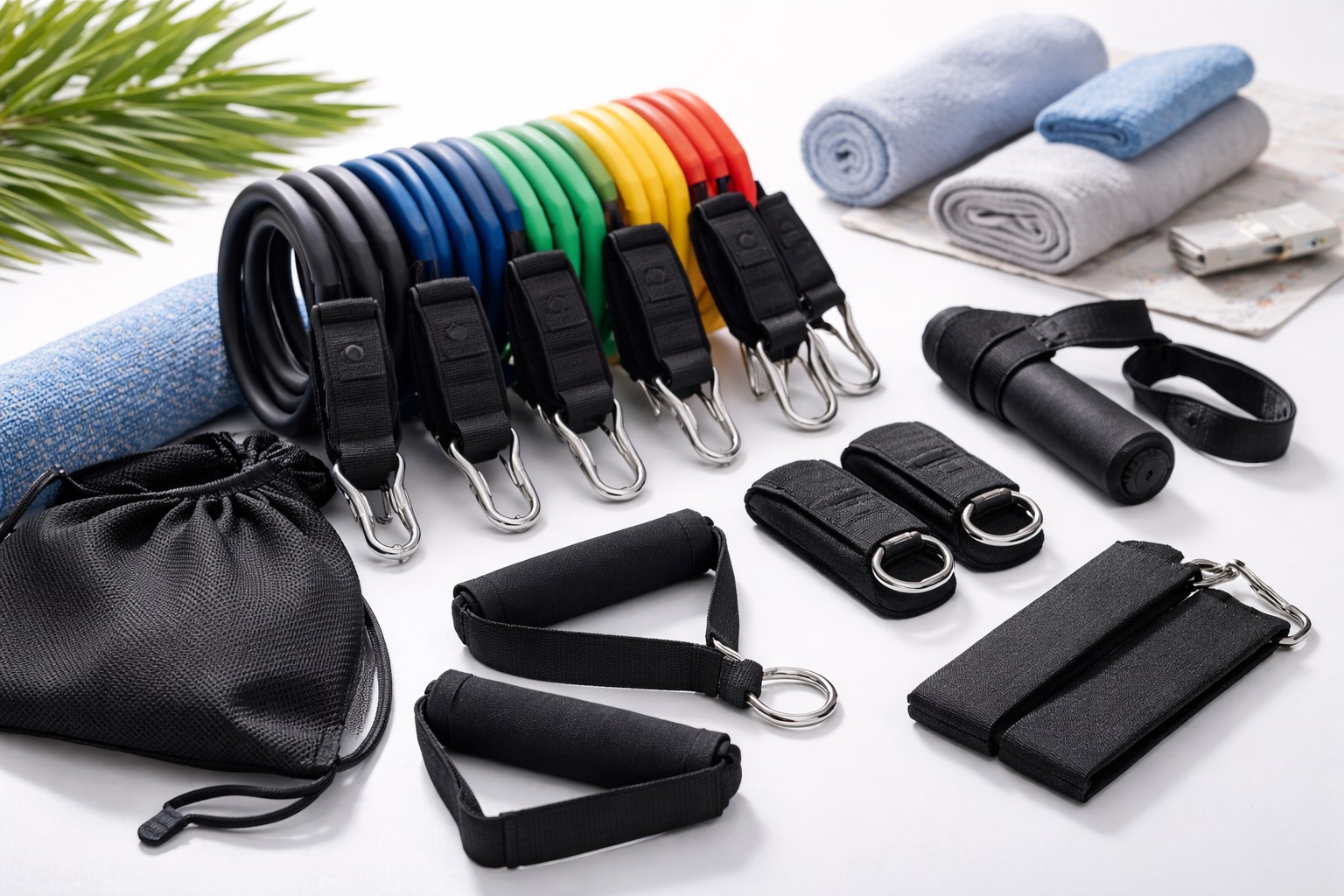
A full band set bundles several of the styles above — loop bands, tube bands with handles, a door anchor, ankle straps, and sometimes a light therapy band — into one package aimed at someone building an entire home training system rather than solving one specific problem.
- Pros:
- Covers a wide range of resistance levels and exercise types in a single purchase
- Included accessories like ankle straps and door anchors expand the usable exercise library significantly
- Generally better overall value than buying each band style separately over time
- Cons:
- Individual components are sometimes a step down in quality compared to a dedicated single-purpose band
- Carrying case and organization can become cluttered with this many pieces
Best For: Beginners or intermediate exercisers who want one purchase that covers strength, mobility, and accessory work without researching and buying multiple separate products.
Why We Recommend It: For someone starting from zero equipment, a well-curated set removes the guesswork of assembling a band collection piece by piece and typically costs less than buying the equivalent components individually.
The main thing to watch for with a bundled set is quality distribution — some manufacturers put most of their effort into the flagship pieces and less into smaller accessories like ankle straps or connector clips. Reading feedback on the individual components, not just the set as a whole, gives a clearer picture of where corners might have been cut.
6. Budget Starter Band Set – Best For Beginners Trying Resistance Training
Budget starter sets strip the category down to its essentials: a handful of flat or tube bands at low-to-moderate resistance, minimal accessories, and a price point aimed squarely at someone who isn't sure yet whether resistance training will become a regular habit.
- Pros:
- Low upfront cost removes the barrier to trying resistance training for the first time
- Lightweight and compact enough to store in a small drawer or travel bag
- Sufficient resistance range for most true beginner exercises
- Cons:
- Build quality and material consistency vary more at this price point than in mid-range sets
- Limited top-end resistance means dedicated lifters will outgrow the set relatively quickly
Best For: First-time buyers testing resistance training before committing to a larger investment in equipment.
Why We Recommend It: It answers the question "will I actually use this?" at the lowest possible cost, which is a legitimate and often underrated criterion — plenty of home gym equipment goes unused because someone overspent on a first attempt.
Buyers who stick with a budget set for a few months and find they genuinely enjoy resistance training typically know exactly what to upgrade next, whether that's a heavier loop band for added squat resistance or a full tube band system for more exercise variety. In that sense, a starter set doubles as a low-cost way to figure out your own preferences before spending more.
Buying Guide: How to Choose the Best Resistance Bands for Home Workouts
Before making a purchase decision, consider these key factors that separate a genuinely useful resistance band from one that looks good in a product photo but falls short in everyday use.
1. Resistance Level Range
Resistance bands are typically labeled light, medium, heavy, or by an approximate pound rating at maximum stretch. Buy based on the lightest exercise you'll do with a given band, not the heaviest — a band that's too strong for an exercise forces poor form, while one that's slightly too light is still usable and safer to progress from.
2. Material: Latex vs. Fabric vs. TPE
Natural latex bands offer the most consistent stretch and recoil but can degrade with prolonged sun exposure and cause reactions in people with latex sensitivities. Fabric bands resist rolling and are gentler on skin but don't stretch as far. TPE (a synthetic rubber alternative) splits the difference and is worth seeking out specifically if latex allergies are a concern.
3. Band Type: Loop, Tube, or Flat
Loop bands are best for lower-body and barbell-assisted work, tube bands with handles are best for upper-body pressing and pulling motions, and flat bands are best for rehab and mobility work where a wide, non-pinching surface matters. Most home users benefit from owning at least two of these three types rather than trying to force one style to do every job.
4. Comfort During Exercises
Thin rubber bands can pinch skin, especially around joints, and this is one of the most common reasons a band ends up unused. Wider, flatter designs and fabric loops largely solve this problem. If you have sensitive skin or plan to use bands directly against bare legs or arms, prioritize width and material over raw resistance rating.
5. Included Accessories: Handles, Anchors, and Straps
A door anchor alone dramatically increases how many exercises a tube band set can perform, since it opens up rows, presses, and rotational movements that aren't possible with a loop held only in the hands or feet. Ankle straps similarly expand leg and glute exercise options. Check what's actually included before assuming a set is exercise-complete.
6. Portability and Storage
One of the core appeals of resistance bands over dumbbells or a home gym machine is that they pack into a small bag. If travel or a small living space is a priority, favor loop and flat bands over bulkier handled sets, or at minimum check whether a carrying pouch is included.
7. Durability and Snap Risk
All rubber resistance bands degrade over time with UV exposure, extreme temperatures, and repeated max-tension stretching, and a snapped band under load is a genuine safety concern. Inspect bands regularly for small tears or discoloration, and replace them proactively rather than waiting for a visible failure, particularly with heavy loop bands used for barbell work.
8. Price and Value Relative to Use Case
A full multi-piece set is rarely the most expensive option per-band, but it is a larger total outlay than a single loop band or a pair of light therapy bands. Match the size of the purchase to how certain you are that you'll use the full range of included pieces, not just the resistance level you need on day one.
9. Skin Sensitivity and Latex Allergies
Anyone with a known latex allergy should specifically look for bands labeled latex-free or made from TPE rather than assuming all resistance bands are interchangeable in this respect. This is a genuine health consideration, not just a comfort preference.
10. Exercise Variety You Actually Plan to Do
Buyers frequently purchase a full set intending to use every included piece, then settle into using only one or two band types regularly. Before buying a large bundle, honestly assess whether your workout plan calls for upper-body pressing, lower-body activation, rehab-style mobility work, or barbell-assisted strength training, and weight the purchase toward what you'll actually repeat weekly.
11. Grip and Handle Quality
For tube bands specifically, the connection point between the rubber tubing and the handle is a common wear point. Molded, reinforced connections tend to outlast bands where the tubing is simply looped and clamped, so it's worth checking product descriptions or reviews for mentions of connection durability.
12. Suitability for Your Fitness Level
Heavy loop bands rated for barbell work are the wrong starting point for someone new to resistance training, just as a light therapy band will feel pointless to an experienced lifter. Be realistic about your current strength and training experience rather than buying based on what a more advanced friend or influencer uses.
Frequently Asked Questions
What resistance level should a beginner start with?
Most beginners do well starting with light to medium bands and a variety of exercises rather than a single heavy band. It's easier and safer to progress from light resistance with good form than to fight through reps with a band that's too strong.
Are fabric bands or rubber loop bands better for glute exercises?
Fabric bands generally perform better for lateral and rotational glute exercises like walks and clamshells because they don't roll up the leg the way thin rubber loops tend to. Rubber loops remain a reasonable choice for exercises where the band stays in a fixed position.
Can resistance bands actually replace dumbbells or a full home gym?
For many strength and hypertrophy goals, yes — a well-chosen band set can provide comparable muscular tension across a similar range of exercises. Where bands fall short is in providing a precise, fixed load for tracking progressive overload as exactly as a labeled dumbbell does.
How do I know which resistance level a band actually provides?
Manufacturers typically list an approximate pound rating measured at a specific stretch length, often printed on the band itself or in the color-coding system. These figures are useful for relative comparison between bands but shouldn't be treated as a precise, universal measurement since stretch technique varies.
Do resistance bands wear out, and how often should they be replaced?
Yes, rubber bands lose elasticity and can develop small tears with heavy or frequent use, especially under UV exposure. Inspect bands before each heavy session and replace them at the first sign of visible wear rather than waiting for a failure during use.
Is it safe to use heavy loop bands with a home barbell setup?
Heavy loop bands are commonly used this way, but they should always be anchored securely to a sturdy rack or bar rated to handle the tension, and inspected regularly, since a band failure under load at the top of a lift carries real injury risk.
What's the difference between latex and non-latex resistance bands?
Latex bands tend to offer more consistent stretch and snap-back but can cause skin reactions in people with latex sensitivities. Non-latex options, often made from TPE, are a safer choice for anyone with a known allergy, though the feel can differ slightly.
Are handled tube bands better than loop bands for a full-body workout?
Handled tube bands generally offer more exercise variety for upper-body pressing and pulling movements thanks to the secure grip and door anchor options, while loop bands are more efficient for lower-body and barbell-assisted work. Many home users benefit from owning both types.
How should resistance bands be stored to make them last longer?
Keep bands out of direct sunlight and away from extreme heat, store them lightly coiled rather than tightly folded at sharp angles, and avoid leaving them stretched under tension between uses, since sustained tension accelerates material fatigue.
Can resistance bands help with physical therapy and injury recovery?
Light, flat therapy bands are a standard tool in physical therapy programs precisely because their low, controllable resistance allows for gradual strengthening of injured or weakened muscles without the joint stress that free weights can introduce.
Do I need a door anchor, and is it included in most sets?
A door anchor significantly expands the range of exercises possible with tube bands, enabling rows, chest presses, and rotational movements that aren't possible when the band is only held in the hands or looped around the feet. Many full sets include one, but single loop bands typically do not, so check the listing before assuming it's included.
What's the most versatile single resistance band style to buy first?
If you can only buy one style, a set of tube bands with handles and a door anchor generally offers the widest range of usable exercises for a first-time buyer, covering upper-body pressing, pulling, and some lower-body work in a single purchase.
How many resistance bands does a well-rounded home setup actually need?
Most home exercisers get most of the benefit from two or three bands spanning a light, medium, and heavy resistance level, plus one style suited to their primary training goal, whether that's a fabric band for glute work or a loop band for barbell training. Beyond that point, additional bands mainly add convenience rather than new capability.
Can resistance bands be used for cardio-style workouts, not just strength training?
Yes. Fast-paced circuits combining banded squats, rows, and lateral steps can raise heart rate significantly, and many home workout routines built around resistance bands are structured more like circuit training than traditional slow-tempo strength work. The lightweight, portable nature of bands makes them well suited to this kind of higher-tempo session.
Final Verdict
The right resistance band purchase depends far more on your specific training goal than on finding a single "best" product across the entire category. Someone rehabbing a shoulder injury and someone adding band tension to a heavy barbell squat have almost nothing in common in terms of what they need from a band, even though both are shopping in the same general product category.
- For strength and barbell training: Heavy resistance loop bands provide the accommodating resistance serious lifters look for.
- For rehab and gentle strengthening: Light therapy bands offer the control and low load that recovery work requires.
- For a complete, general-purpose home setup: A full band set or a tube band set with handles and a door anchor covers the widest range of exercises.
Whichever style fits your situation, resistance bands remain one of the best value-for-money purchases in home fitness — inexpensive, compact, and capable of a genuinely full-body workout when matched correctly to your goals and experience level.