Best Lightweight Power Banks: Charge Without the Bulk
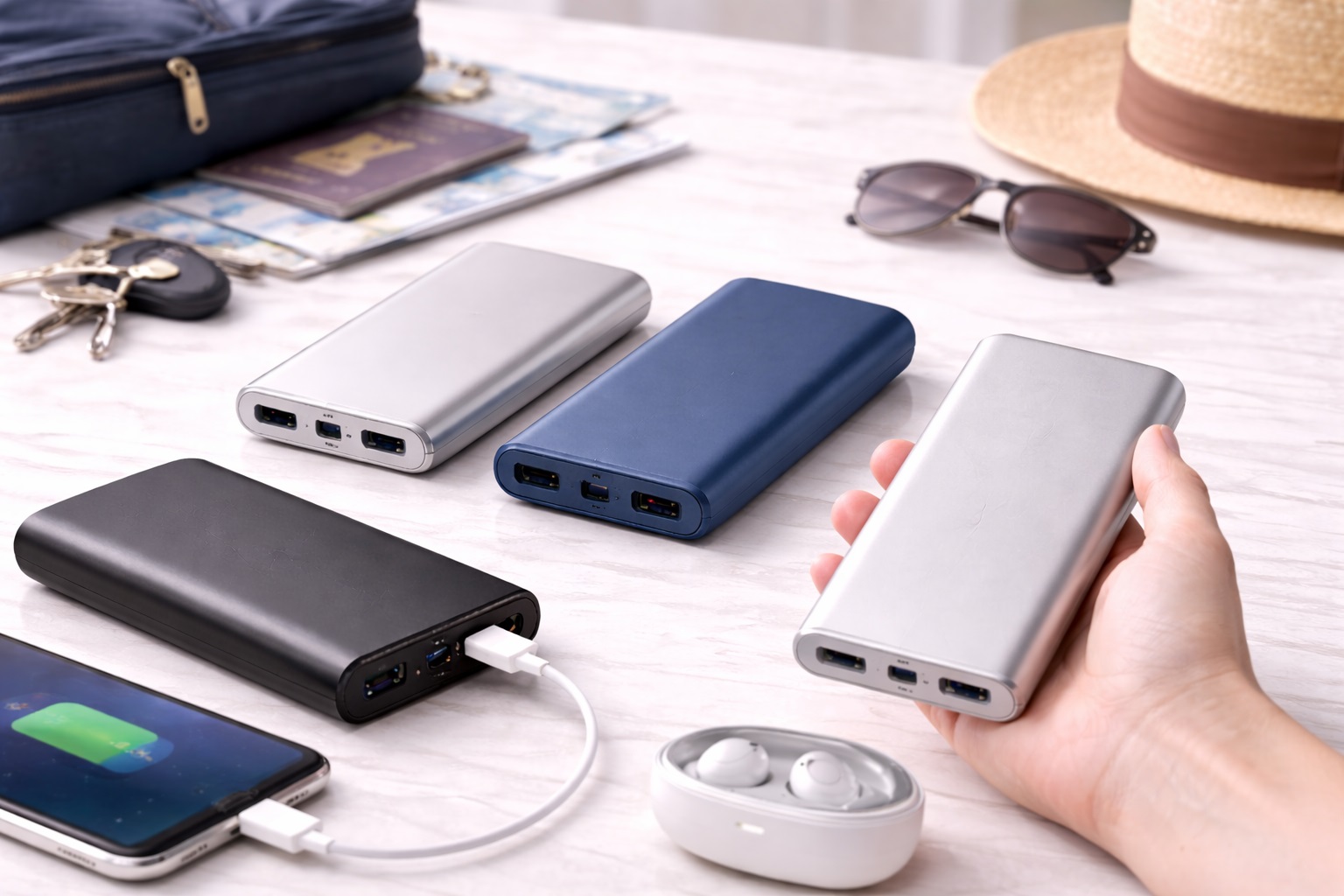
Every extra gram in a bag adds up over the course of a day, and a power bank is one of the few everyday-carry items where weight and usefulness are directly in tension — more capacity almost always means more mass. That relationship isn't perfectly linear, though, and small differences in cell chemistry, housing material, and internal circuitry mean two banks with identical capacity can still land at noticeably different weights on a scale. A lightweight power bank tries to resolve that tension as favorably as possible, squeezing out the most usable charge for the least added weight, rather than simply being the smallest bank available regardless of how little it actually delivers. The smallest bank on the shelf isn't automatically the best lightweight pick if it barely charges a phone halfway, since a slightly larger bank that reliably finishes the job is doing more useful work per gram in practice.
This guide focuses specifically on that capacity-to-weight relationship. Raw grams matter, but so does how much charge you actually get per gram carried, since a featherweight bank that only delivers a fraction of a phone charge isn't necessarily a better choice than a slightly heavier one that reliably gets you through a full day. We look at where that trade-off tends to land best across a few different use cases, from someone who just wants a backup charge in a pocket to someone who genuinely needs enough capacity for a laptop and is weighing that need against carrying multiple smaller banks instead.
Below you'll find a side-by-side comparison, detailed reviews of the models that consistently deliver strong capacity-to-weight performance, a buying guide covering every factor worth checking before you order, and answers to the questions weight-conscious buyers ask most often when shopping for lightweight charging. Treat the capacity-to-weight ratio introduced early in the buying guide as the throughline connecting all of it — nearly every other factor below either supports or works against that core number in some way.
Top 5 Lightweight Power Banks (Detailed Reviews)
1. 5,000mAh Ultra-Slim Power Bank – Best Weight-to-Charge Ratio
A 5,000mAh ultra-slim power bank provides one full smartphone charge in a form factor barely larger than a smartphone and typically weighing under 130g, which represents close to the best achievable ratio of usable charge to carried weight in the category. There's a physical floor to how light a bank can get while still storing meaningful capacity, and this size sits right at that floor without sacrificing enough capacity to become impractical for daily use. Manufacturers have pushed cell chemistry and housing design about as far as current technology allows at this size, so further weight reduction below this point tends to come at the direct cost of the one full charge that makes the bank worth carrying in the first place.
- Pros:
- Under 130g — among the lightest options that still deliver a full phone charge
- Credit-card slim or smartphone-sized footprint
- Fast USB-C input for quick overnight recharging
- Genuinely disappears into a pocket rather than just a bag
- Cons:
- Only one full phone charge, insufficient for heavy daily use
- Not suitable for tablets or laptops
Best For: Buyers whose absolute top priority is minimizing carried weight, even at the cost of some capacity.
Why We Recommend It: This is close to the practical minimum weight for a bank that still delivers a genuinely useful full charge, which makes it the benchmark the rest of the lightweight category gets measured against. Any bank claiming to be lighter while offering the same one-charge capacity is worth comparing directly against this size before assuming it's actually an improvement.
2. 10,000mAh Slim Fast-Charge Power Bank – Best Balance of Weight and Capacity
A 10,000mAh slim power bank weighs around 200–250g and delivers two to three full smartphone charges, which is a meaningfully better capacity-to-weight ratio than doubling down on an ultra-slim 5,000mAh model for genuinely heavy phone use. USB-C Power Delivery in the 18W–30W range adds fast charging on top of the improved capacity, so the modest weight increase buys considerably more usable charge rather than just more bulk. For anyone who has found a 5,000mAh bank running out earlier in the day than they'd like, this size is usually the more sensible next step up rather than jumping straight to a bulky high-capacity model.
- Pros:
- Roughly double the capacity of an ultra-slim bank for a proportionally smaller weight increase
- Slim enough for a jacket pocket or small bag
- USB-C PD fast charging in well under an hour
- Strong capacity-per-gram value overall
- Cons:
- Noticeably heavier than the smallest ultra-slim options
- Not enough capacity for laptop charging
Best For: Buyers who want meaningfully more capacity than an ultra-slim bank without jumping to a heavy high-capacity model.
Why We Recommend It: The jump from 5,000mAh to 10,000mAh roughly doubles usable capacity while only adding around 100g, which is one of the best weight-for-capacity trades in the entire category. Very few upgrades in any product category deliver that much additional real-world benefit for that little added cost in weight.
3. Graphene or Advanced-Cell Slim Power Bank – Best Density for Its Size
Power banks built around newer graphene-enhanced or high-density lithium-polymer cells pack more capacity into the same physical volume than older cell chemistry, meaning a bank in this category can offer a slightly higher mAh rating than a same-sized older-generation bank without adding weight. This density improvement is one of the more genuine recent advances for buyers who specifically prioritize a low weight-to-capacity ratio, rather than a marketing label applied to an otherwise ordinary cell with no measurable difference in performance.
- Pros:
- Higher energy density than older cell types in a comparable footprint
- Often runs cooler during fast charging than older cell chemistry
- Slim, lightweight housing typical of the category
- Represents genuine forward progress in capacity-to-weight ratio
- Cons:
- Usually priced at a premium over standard lithium-polymer equivalents
- Less widely available than standard-cell alternatives
Best For: Buyers willing to pay a premium for the best available capacity-to-weight ratio the current market offers.
Why We Recommend It: For anyone who has already optimized every other part of their carry weight, this is one of the few remaining ways to meaningfully improve on standard-cell capacity-to-weight numbers, even though the improvement over a well-chosen standard-cell bank is measured in a handful of grams rather than a dramatic difference.
4. Power Bank with Built-In Cable – Best for Reducing Total Carried Weight
A power bank with an integrated charging cable removes the need to carry a separate cable, which — while individually light — adds up alongside a case, a second cable for a different device, and other small accessories that accumulate in a bag over time. Folding the cable into the housing reduces total carried weight across your whole charging kit, not just the bank itself. Weighed as a complete kit — bank, cable, and any case — the built-in-cable design often comes out lighter overall than a separately-carried bank and cable combination even when the bank itself weighs marginally more.
- Pros:
- Eliminates the weight and bulk of a separate charging cable
- Reduces total accessories carried, not just the bank's own weight
- Compact and pocket-friendly
- Often includes more than one connector type built in
- Cons:
- Built-in cable can't be replaced individually if damaged
- Capacity is typically modest compared to dedicated high-capacity banks
Best For: Buyers optimizing their entire carry weight, not just the power bank in isolation.
Why We Recommend It: True weight-conscious packing accounts for every accessory, and this design quietly removes one of them from the equation entirely, which is a detail easy to overlook when comparing bank specifications side by side rather than thinking about the whole kit.
5. 20,000mAh High-Capacity Power Bank – Best for High-Capacity Needs Despite the Weight
A 20,000mAh power bank weighs roughly 400–500g and delivers four to six full smartphone charges plus laptop-charging capability at 65W, which is meaningfully heavier than the rest of this list but still represents reasonable capacity-per-gram efficiency for buyers who genuinely need that much charge. Included here as the honest upper bound of the category — for buyers whose actual need is high capacity, this is still lighter than carrying two smaller banks to reach the same total charge. Two 10,000mAh banks together weigh more than one 20,000mAh unit and take up more physical space in a bag, which is easy to overlook when comparing single-unit weight figures side by side.
- Pros:
- Four to six full smartphone charges plus laptop charging in one unit
- Lighter overall than carrying multiple smaller banks for equivalent capacity
- Reasonable capacity-per-gram efficiency despite the higher total weight
- Reduces the total number of items carried for high-capacity needs
- Cons:
- The heaviest option on this list by a meaningful margin
- Not a genuine lightweight pick in absolute terms, only in per-charge efficiency
Best For: Buyers who need genuinely high capacity and are comparing this against carrying multiple smaller banks rather than against ultra-slim options.
Why We Recommend It: When the honest requirement is high total capacity, one 20,000mAh bank is lighter and simpler than the alternative of carrying two or three smaller banks to match it, and it also avoids the hassle of juggling multiple devices, multiple charge levels, and multiple cables to track at once.
Buying Guide: How to Choose the Best Lightweight Power Bank
Use these factors to judge lightweight power banks on the metric that actually matters — usable charge per gram carried — rather than on weight alone. Reading through all twelve before shortlisting a model helps separate genuine weight-saving engineering from a bank that's simply small and underpowered.
1. Capacity-to-Weight Ratio Benchmarks
The most useful single number for a weight-conscious buyer is capacity in mAh divided by weight in grams, which reveals how efficiently a bank converts mass into usable charge. Current ultra-slim banks average roughly 35–40mAh per gram, while some high-density cell designs push past 45mAh per gram, a gap that sounds small on paper but compounds noticeably across a bank's total capacity; use this ratio to compare banks of different sizes on equal footing rather than comparing weight or capacity in isolation. Two banks can list wildly different weights and capacities yet land on a nearly identical ratio, which is a useful way to recognize that neither is objectively better without knowing what you actually value more.
2. Capacity and Actual Output
Stated capacity in mAh is measured at 3.7V battery voltage, but output happens at 5V through USB, so real-world usable capacity is typically 60–70% of the printed number. A 10,000mAh bank realistically delivers closer to 6,000–7,000mAh to your device, which matters when calculating true capacity-to-weight ratio using real-world rather than advertised capacity. Using the printed mAh figure without this adjustment will consistently make every bank look more efficient than it actually performs in daily use.
3. Charging Speed: Input and Output
Output speed determines how quickly your device charges; input speed determines how quickly the bank recharges. USB-C Power Delivery at 18W or higher provides meaningful fast charging without adding weight, since charging speed is determined by internal circuitry rather than bulk. A lightweight bank doesn't have to mean a slow one — check the wattage independently of the weight and capacity figures. It's a common assumption that small equals slow, but the charging chipset responsible for speed is a tiny component that adds virtually nothing to overall bank weight.
4. Port Selection and Cable Compatibility
USB-C has become the standard connector for most current phones and many laptops, while USB-A remains relevant for older accessories. A single USB-C port keeps a bank as light as possible, while adding a second port for simultaneous charging adds only marginal weight — a reasonable trade-off if you regularly charge two devices at once. If you almost always charge just one device, a single-port design keeps weight at its genuine minimum without any real loss of practical function.
5. Safety Certifications
Look for CE, FCC, or UL certification markings on the bank and its packaging, confirming the product passed basic electrical safety testing. Ultra-light designs sometimes cut corners on internal protection circuitry to save weight, so certification matters even more for a bank optimized aggressively for minimal mass. A missing certification on an unusually light listing is a reasonable signal that weight was saved by removing safety components rather than through genuine engineering improvement.
6. Recharge Time for the Bank
A 10,000mAh bank typically takes three to four hours to recharge at 18W input, while a 5,000mAh ultra-slim model recharges faster given its smaller capacity. Faster input speed (30W or higher, where available on lightweight models) shortens this further, which matters if the bank needs to be ready again the same day rather than only overnight. A lightweight bank you can quickly top up during a lunch break stays useful even on days when an overnight charge wasn't possible.
7. Pass-Through Charging
Pass-through charging lets a bank charge a connected device while it is itself being recharged from a wall outlet. Not every lightweight bank supports this safely, so check the specification explicitly if you plan to rely on it — it's a genuinely useful feature that has no bearing on the bank's weight either way, so there's no trade-off to weigh here beyond confirming the bank actually supports it.
8. Weight and Physical Dimensions
Beyond the headline weight figure, check the bank's exact dimensions — a bank can be light but still awkwardly shaped, with sharp corners or an unusually wide profile that makes it less comfortable to carry than its weight alone suggests. A well-designed lightweight bank optimizes both mass and shape for comfortable everyday carry. Rounded edges and a slightly thicker but narrower profile often feel more comfortable in a pocket than a wider, flatter bank of identical weight.
9. Display and Status Indication
Basic LED indicators show remaining charge in rough 25% increments and add negligible weight. A numeric percentage display, where available, gives a clearer read on remaining charge without meaningfully affecting the bank's overall mass, so there's little reason to sacrifice this feature purely to save weight. Weighing two otherwise identical banks with and without a numeric display typically shows a difference too small to matter for everyday carry.
10. Heat Management
Lighter housings, particularly plastic-bodied designs built to save weight, can run warmer during fast charging than metal-bodied alternatives, since metal dissipates heat more effectively but adds mass. A bank that becomes uncomfortably hot during normal use is operating beyond its intended thermal margin regardless of how light it is. If a genuinely lightweight bank runs noticeably hotter than expected, it's worth checking reviews for whether that's a known trait of the specific model rather than a one-off defect.
11. Wireless Charging Compatibility
A built-in wireless charging pad adds noticeable bulk and weight relative to a purely wired bank of the same capacity, which makes it a poor fit for a genuinely weight-optimized pick. If minimizing weight is the top priority, skip wireless charging and rely on a wired connection instead, since the coil and supporting circuitry needed for wireless charging add real, measurable mass that a wired-only design simply doesn't carry.
12. Battery Chemistry and Cycle Life
Most modern power banks use lithium-polymer cells, which are lighter per unit of capacity than older lithium-ion designs — one of the reasons lithium-polymer has become the standard for lightweight banks specifically. Cycle life, typically several hundred full charges before capacity noticeably degrades, is a fair proxy for how long a bank will maintain its weight-to-capacity advantage over years of regular use. A bank that loses capacity quickly effectively gets heavier per usable charge over time, even though its physical weight never changes.
Frequently Asked Questions
1. What's the lightest power bank that still charges a phone fully?
Ultra-slim 5,000mAh banks weighing under 130g typically deliver one full smartphone charge, which represents close to the practical floor for weight while still being genuinely useful. Going lighter than this usually means sacrificing a full charge, which defeats the purpose for most buyers. A handful of specialty ultralight banks go smaller still, but they're aimed at niche use cases like backup emergency charging rather than everyday reliable use.
2. Does a lightweight power bank charge slower than a heavier one?
Not necessarily. Charging speed depends on internal circuitry and wattage rating, not on physical weight, so a lightweight bank can still offer fast charging if the manufacturer prioritizes it. Check the wattage specification independently of the weight figure, since assuming small equals slow is one of the most common — and most easily avoided — mistakes when shopping in this category.
3. How do I know when to replace my power bank?
Replace it once it no longer holds the charge it used to, typically noticeable after two to three years of regular use. If the bank runs unusually hot, develops a swollen shape, or stops charging altogether, replace it immediately for safety, and don't assume a lightweight design is inherently more fragile — quality construction matters more than mass here.
4. Is capacity-to-weight ratio more important than total capacity?
It depends on your use case. For a buyer prioritizing minimal carry weight above all else, ratio matters most. For a buyer who genuinely needs high total capacity, such as laptop charging, total capacity matters more even at a worse per-gram ratio — the two priorities can point toward different products, so it's worth deciding in advance which one matters more for your typical trip or workday before comparing listings.
5. Do premium materials always mean a lighter power bank?
Not always. Some premium materials, like machined aluminum housings, actually add weight compared to plastic while improving heat dissipation and durability. The lightest banks typically use simple plastic housings, which is a genuine trade-off between weight and other qualities like heat management and perceived build quality. Neither material is objectively correct — it depends on whether you value the lowest possible weight or the most robust housing.
6. Does a lighter power bank mean lower build quality?
Not inherently. Weight and build quality are separate specifications — a well-engineered lightweight bank from a reputable manufacturer can be just as durable as a heavier model. Look at certifications and reviews rather than assuming lighter automatically means flimsier, since some of the most durable banks on the market today are also among the lightest in their capacity class.
7. Is the most expensive lightweight power bank always the best?
Not always. Price reflects features, cell technology, and brand reputation, but many mid-range lightweight options perform very close to premium alternatives for everyday needs. Match the product to your actual use case rather than assuming higher price guarantees a better capacity-to-weight ratio, since the ratio is mostly determined by cell technology rather than brand positioning.
8. How long should a quality lightweight power bank last?
A well-built lightweight power bank from a reputable manufacturer typically lasts two to five years with reasonable care. Warranty length is a useful indicator of manufacturer confidence in durability, and lightweight banks generally hold up just as well over time as standard-weight models when built by a reputable maker.
9. Can I return a lightweight power bank if it doesn't suit me?
Most retailers offer a fifteen- to thirty-day return window. Weigh the bank yourself against the listed specification and test real-world charging performance before the window closes, since a mismatch between advertised and actual weight is worth flagging directly with the retailer.
10. What should I prioritize when buying a lightweight power bank?
Start by calculating capacity-to-weight ratio across your shortlisted options rather than comparing weight or capacity separately. The bank with the best ratio for your actual daily charging needs is usually the smarter buy over the one that's simply the lightest in isolation, since the lightest bank available is sometimes too small to be practical for your actual usage pattern.
11. Does brand name matter for lightweight power banks?
Established brands typically offer more consistent quality control and more reliable warranty support. Newer brands, particularly those specializing in high-density cell technology, can offer genuinely competitive capacity-to-weight ratios, so weigh verified purchase reviews carefully before choosing, particularly ones that mention weight and real-world charge counts together rather than reviewing them separately.
12. Are graphene or advanced-cell power banks worth the extra cost?
For buyers who have already optimized every other aspect of their carry weight and specifically want the best available capacity-to-weight ratio, yes. For typical everyday use, a standard lithium-polymer bank in the 5,000–10,000mAh range delivers nearly as good a ratio at a lower price, making the premium cell technology a marginal, not essential, upgrade for most buyers.
Final Verdict
- Best Weight-to-Charge Ratio: 5,000mAh Ultra-Slim Power Bank — close to the practical floor for weight while still fully useful.
- Best Balance of Weight and Capacity: 10,000mAh Slim Fast-Charge Power Bank — the best weight-for-capacity trade in the category.
- Best Density for Its Size: Graphene or Advanced-Cell Slim Power Bank — genuine forward progress in capacity-to-weight ratio.
- Best for Reducing Total Carried Weight: Power Bank with Built-In Cable — optimizes your whole charging kit, not just the bank.
- Best for High-Capacity Needs Despite the Weight: 20,000mAh High-Capacity Power Bank — lighter than carrying multiple smaller banks for the same total charge.
The right lightweight power bank comes down to judging capacity against weight together rather than chasing the lowest number on the scale in isolation. Use the comparisons and buying guide above to find the bank that delivers the most usable charge for the weight you're actually willing to carry every day. A bank that earns a permanent place in your bag because it's genuinely easy to carry will always beat one that's technically lighter but gets left behind on the days you need it most.