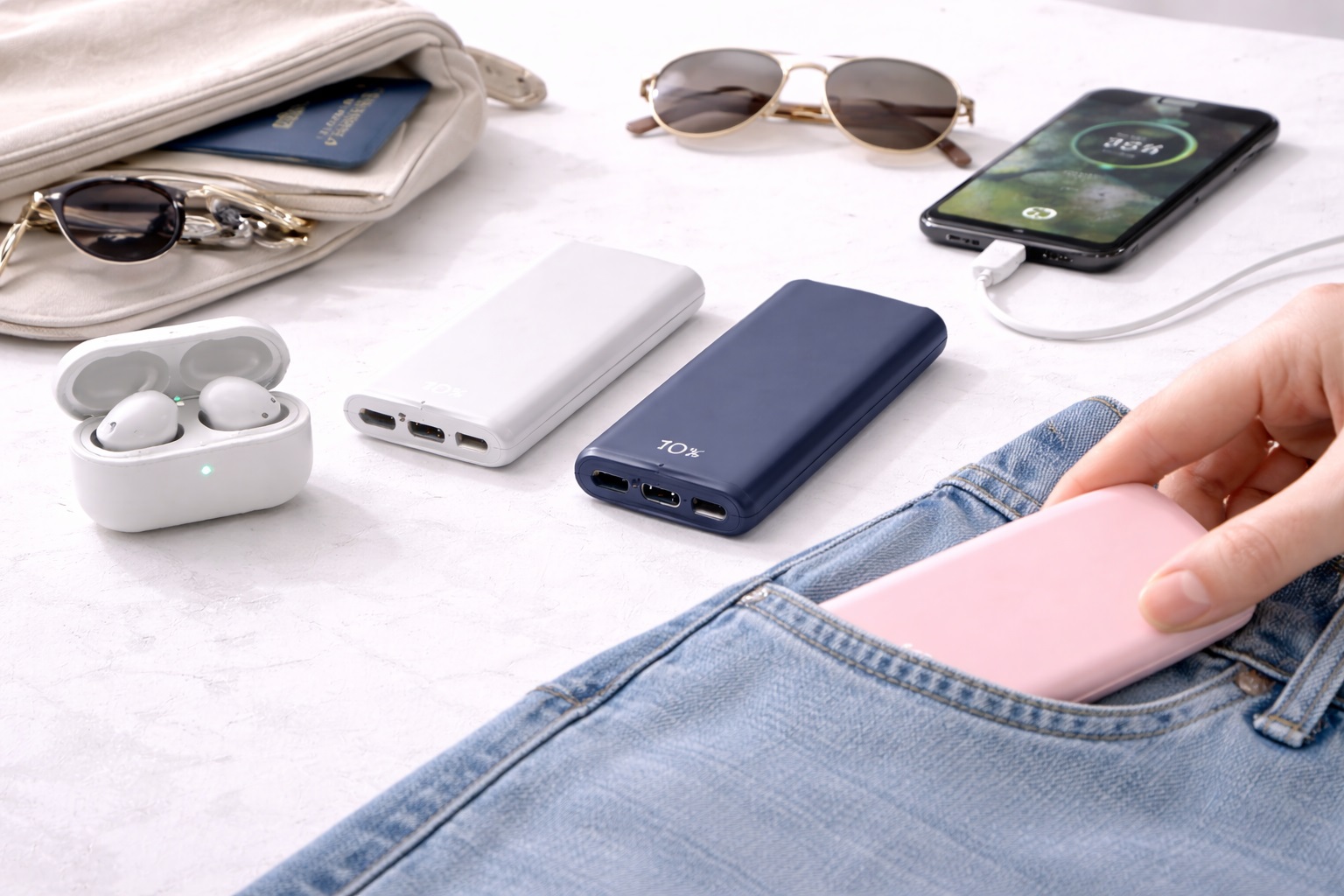
Best Lightweight Power Banks: Feather-Light Charging for Every Pocket
The moment a power bank stops feeling worth carrying is usually the moment it gets left in a drawer. A backup battery that adds noticeable heft to a pocket, bag, or jacket lining tends to get left behind on the days it's needed most, which defeats the entire purpose of owning one. A genuinely lightweight power bank solves this by disappearing into daily carry rather than announcing itself every time you move.
The lightweight category isn't just about shaving grams off a spec sheet. It's about a different design philosophy altogether — one that accepts a smaller total capacity in exchange for something people will actually reach for and carry every single day. That tradeoff shows up differently depending on the specific product: some options go for the thinnest possible profile, others chase the lowest possible weight, and others try to balance both against a slightly larger capacity.
This guide breaks down six distinct approaches to lightweight charging, each aimed at a different kind of daily-carry habit, followed by a detailed buying framework and answers to the most common questions people ask before choosing one. Rather than crowning a single universal winner, the goal is to match the option to how you actually move through your day.
It's worth noting upfront that "lightweight" isn't a single fixed standard across the industry — one manufacturer's idea of a slim power bank might weigh noticeably more than another's, even at similar capacities. That's part of why this category rewards a closer look at the actual numbers rather than trusting a marketing label alone. A bank described as ultra-portable in one listing might be nearly identical in weight to a standard model from a different brand, so comparing spec sheets directly tends to be more useful than comparing product names.
Top Picks Reviewed
Ultra-Slim 5000mAh Bank – Best For Slipping Into a Pocket
A 5000mAh capacity sits at the lighter end of the spectrum, generally enough for roughly one full phone charge plus a partial top-up. The appeal of this category isn't raw capacity — it's the profile. An ultra-slim bank is built to slide into a jacket pocket, a small bag pouch, or even a back pocket without printing an obvious rectangular outline. For someone who wants backup charge available at all times without thinking about it, this is often the most realistic option, since it's genuinely easy to forget you're carrying it. The absence of extra bulk also means it tends to survive the daily "do I really need to bring this" filter that heavier accessories often fail.
- Pros:
- Thin profile that fits easily into tight pockets and small bag compartments
- Low enough weight that it doesn't register as an extra item being carried
- Enough capacity for a meaningful single-charge top-up in a pinch
- Cons:
- Limited capacity means it won't cover a full day of heavy phone use on its own
- Slim internal design can mean fewer or smaller physical ports
Best For: Anyone who wants an always-on-hand backup charge without the bulk of a traditional power bank.
Why We Recommend It: It solves the actual problem of "will I bother carrying this" by making the physical presence of the bank almost unnoticeable, which means it actually gets carried on the days it matters.
Credit Card Power Bank – Best For Minimalist Carry
Sized and shaped closer to a stack of cards than a traditional power bank, this category takes minimalism to its logical extreme. It's designed to slide into a wallet, a card slot in a phone case, or a slim bag pocket alongside actual cards. The capacity is modest by design, but the entire point is that it travels with you the way a wallet does — automatically, without a second thought. Because it lives alongside cards you already check constantly, the odds of leaving it behind at home are far lower than with any bag-based accessory.
- Pros:
- Extremely compact, comparable in size to a wallet or card holder
- Easy to keep in a place you already check daily, like a wallet or card slot
- Genuinely unobtrusive for minimalist carry preferences
- Cons:
- Lowest capacity of any category here, often good for a partial charge only
- Small size can make ports and buttons fiddly to use
Best For: Minimalists who already carry as little as possible and want charging backup that fits that philosophy exactly.
Why We Recommend It: For someone who has already decided that a slim wallet and a single card holder is the extent of what they carry, this format adds charging capability without breaking that discipline.
Stick-Style Slim Bank – Best For One-Handed Grip
Shaped like a tube or stick rather than a flat rectangle, this format is designed to be held comfortably in one hand while a phone charges in the other, or to roll into a bag pocket without taking up flat surface area. The cylindrical shape distributes weight differently than a flat slab, which many people find more comfortable to hold during use. It also tends to slip into the narrow side pockets found on backpacks and gym bags, where a flat rectangular bank might not fit as naturally.
- Pros:
- Comfortable, ergonomic grip during active use
- Rolls into loose bag pockets rather than needing a flat dedicated slot
- Often has a rounded, pocket-friendly shape that avoids sharp edges
- Cons:
- Cylindrical shape doesn't stack or store as neatly as flat designs
- Can roll around loosely in a bag if not stored in a dedicated pocket
Best For: People who charge their phone while holding it in one hand and want an ergonomic shape to hold in the other.
Why We Recommend It: The stick format solves a genuine ergonomic complaint some people have with flat power banks — it's simply more comfortable to hold for extended periods while a device charges.
10000mAh Lightweight Bank – Best For Multi-Day Backup Without Bulk
This category pushes the definition of "lightweight" a bit further by keeping the weight and dimensions in check while still packing in double the capacity of the ultra-slim options. Manufacturers achieve this through denser battery cell technology and more efficient internal layouts, letting the bank cover a phone for a full day or two without matching the bulk of a traditional 10000mAh unit. It's a category worth considering for anyone who has tried a smaller lightweight bank and found themselves recharging it more often than they'd like.
- Pros:
- Meaningfully higher capacity than most lightweight categories, without a proportional weight increase
- Covers multi-day trips or heavier phone use without needing a recharge
- A reasonable middle ground between pure minimalism and practical capacity
- Cons:
- Still noticeably larger and heavier than ultra-slim or credit-card formats
- Often priced higher due to the denser cell technology involved
Best For: Travelers or heavy phone users who want real capacity but still want to avoid a bulky traditional power bank.
Why We Recommend It: It's the category to consider when a credit-card or ultra-slim bank simply won't hold enough charge for your actual usage pattern, without forcing a jump to a genuinely bulky power bank.
Budget Light Power Bank – Best For Occasional Backup
Not every buyer needs a premium slim design with dense cell technology. A budget-oriented lightweight bank keeps things simple: a reasonably light, reasonably compact unit at a lower price point, without the engineering premium that goes into the thinnest or most advanced options. For occasional use, this is often more than sufficient. It's a practical entry point for anyone testing whether a lightweight power bank fits their routine at all before investing in a pricier option.
- Pros:
- Lower price makes it an easy, low-risk purchase
- Still meaningfully lighter than a full-size traditional power bank
- Reasonable option for backup charge that isn't needed daily
- Cons:
- Not as thin or light as premium ultra-slim options
- Build quality can vary more at this price point
Best For: Occasional users who want a lighter option than a standard power bank without paying for premium slimness.
Why We Recommend It: It offers a genuine step up in portability over a standard power bank while keeping cost reasonable, making it a sensible choice for anyone unsure how often they'll actually use it.
Lightweight Bank With Built-In Cable – Best For Cable-Free Convenience
This category folds a charging cable directly into the power bank itself, removing the need to carry a separate cable at all. For minimalist carry, this can be more valuable than shaving off a few extra grams of weight, since a lost or forgotten cable can make even the lightest power bank useless in the moment it's needed. It's a small design change that addresses a surprisingly common real-world failure point rather than an incremental spec improvement.
- Pros:
- No separate cable to pack, lose, or forget
- Genuinely reduces the total number of items you need to carry
- Built-in cable is less likely to be misplaced than a loose one
- Cons:
- Built-in cable limits you to whichever connector type is integrated
- A damaged built-in cable can be harder to replace than a separate one
Best For: Anyone who has been caught without a charging cable despite carrying a power bank and wants to eliminate that specific failure point.
Why We Recommend It: It solves a subtly different problem than pure weight or size — the risk of carrying a power bank with no way to actually connect it to your phone.
Buying Guide: How to Choose the Best Lightweight Power Bank
Before making a purchase decision, it's worth separating the factors that genuinely affect day-to-day usefulness from the ones that sound impressive in marketing copy but rarely matter once the bank is actually in your pocket or bag.
1. Weight Under 200 Grams
Weight is the single defining factor of this entire category. Anything meaningfully over 200 grams starts to feel like a standard power bank rather than a lightweight one, so it's worth checking the exact figure rather than trusting a "lightweight" label alone, since the term isn't standardized across brands. A difference of even 50 grams can be surprisingly noticeable after a full day of carrying something in a pocket.
2. Slim, Card-Like, or Stick Profile
Physical shape affects how naturally a power bank fits into your existing carry habits. A flat, card-like profile suits a wallet or slim bag pocket, while a stick shape suits a loose pocket or a hand-held grip during use. Consider where you'll actually store it day to day before choosing a shape, since the "best" profile is really the one that matches a spot you already use.
3. Capacity Suitable for One to Two Full Charges
Since lightweight designs sacrifice some capacity for portability, it's worth being realistic about how much charge you actually need on a typical day. A bank that covers one to two full phone charges is usually enough for daily backup use, though heavier users may need to look toward the higher end of the lightweight category rather than the smallest, lightest option available.
4. Fast Input for Quick Recharging
A lightweight bank that's genuinely useful for daily carry needs to recharge quickly overnight or during a short window at a desk. Check the bank's input charging speed, since a slow-charging unit can end up sitting half-empty exactly when you need it most, undermining the entire reason for carrying it in the first place.
5. Durability Despite Light Construction
Lighter materials can sometimes mean a less rugged build. Look for information on drop resistance or overall build quality, especially if the bank will be tossed loosely into a bag or pocket alongside keys and other hard objects on a daily basis, where scuffs and minor impacts are essentially unavoidable over time.
6. Port Placement and Usability
Smaller, slimmer designs sometimes compromise on port placement, making cables awkward to plug in or unplug in tight spaces. Check whether the port sits somewhere accessible even when the bank is in a pocket or bag pouch, since an awkwardly placed port becomes a daily minor annoyance rather than a one-time inconvenience.
7. Compatibility With Your Primary Device
Confirm the bank's output connector and charging protocol match your phone or accessories. A beautifully compact bank is far less useful if it needs an adapter or a cable you don't normally carry, since that extra item defeats much of the portability advantage you were trying to gain.
8. Price Versus Capacity Tradeoff
Because lightweight designs generally cost more per unit of capacity than standard power banks, it helps to decide upfront how much of a premium you're willing to pay for portability specifically, rather than comparing price purely against capacity as you would with a standard power bank.
9. Brand Reliability and Battery Safety
Battery safety matters for any power bank, but it's worth extra attention in ultra-compact designs where components are packed more tightly. Favor established brands with a track record of safe, reliable lithium battery products, since compact designs leave less margin for error in thermal management.
10. Warranty and Support
A warranty offers a reasonable signal of manufacturer confidence, and it's worth checking before buying, especially for pricier ultra-slim or built-in-cable designs where a defect would be more costly to replace than a basic entry-level unit.
11. Real-World User Feedback
Because lightweight designs often involve tradeoffs that aren't obvious from a spec sheet alone, reading verified user reviews can reveal practical issues, such as a port that's awkward to access or a bank that feels flimsier than expected in daily use, well before you commit to a purchase.
12. How It Fits Your Actual Daily Carry
Ultimately, the best lightweight power bank is the one you'll actually carry every day. Consider your existing bag, pockets, and habits honestly, and choose the shape and size that fits naturally into that routine rather than one that looks ideal only in a product photo but gets left behind in practice.
Frequently Asked Questions
How much charge can I expect from a lightweight power bank?
This depends heavily on capacity, which varies widely across the lightweight category. Smaller options like credit-card-style banks typically offer a partial charge, while ultra-slim 5000mAh units cover roughly one full phone charge, and higher-capacity lightweight banks can stretch to one and a half or two charges.
Is a lightweight power bank as durable as a standard one?
Durability varies by product rather than by category alone. Some lightweight designs use denser, more compact internals that can be more delicate, while others are built specifically to withstand daily pocket and bag use. Checking build quality and user feedback for a specific product is more useful than assuming based on size alone.
Why do lightweight power banks often cost more per unit of capacity?
Achieving a slim, light profile without sacrificing too much capacity typically requires more advanced battery cell technology and tighter manufacturing tolerances, both of which add to production cost. You're generally paying a premium for portability engineering rather than for raw capacity.
Can a credit-card-sized power bank really charge a phone?
Yes, though typically only partially rather than a full charge from empty. These are designed as emergency backup for a modest boost rather than a primary charging solution, and they're most useful for getting through the last stretch of a day rather than a full recharge cycle. Think of it less as a replacement for a full-size power bank and more as insurance against the specific scenario of a phone dying at the worst possible moment.
Will a built-in cable wear out faster than a separate cable?
It depends on the specific design and how often the cable is folded, bent, or flexed during storage and use. Some built-in cable designs are engineered for repeated folding, while cheaper implementations may show wear sooner. Reading feedback on cable durability for a specific product is worth the extra few minutes before buying.
Is it safe to carry a power bank in a pocket every day?
Yes, this is a common and generally safe way to carry a power bank, provided it's from a reputable manufacturer with proper safety certifications. It's sensible to avoid extreme heat exposure, such as leaving it in direct sun in a hot car, since excessive heat is one of the more common stressors on lithium battery packs.
How long should a lightweight power bank last before its capacity noticeably declines?
Most well-built lithium power banks maintain solid performance for a couple of years of regular daily use before capacity begins to decline meaningfully. Frequency of use, charging habits, and exposure to heat all affect this timeline, and checking warranty length is a reasonable way to gauge expected lifespan.
What's the most common mistake people make buying a lightweight power bank?
Choosing based purely on weight or thinness without checking whether the capacity actually covers a typical day's use is one of the most common mistakes. It's worth being realistic about how much charge you actually need before optimizing purely for portability. The second most common mistake is assuming every product labeled "slim" or "compact" is comparable, when actual weight and dimensions can vary substantially between listings that use similar marketing language.
Can I return a lightweight power bank if the capacity doesn't meet my expectations?
Most retailers offer a return window, commonly between 15 and 30 days. It's worth checking the specific policy before purchasing and retaining original packaging during your evaluation period in case a return becomes necessary.
Do lightweight power banks support fast charging?
Some do, though fast-charge support varies significantly across this category since the components needed for rapid charging add size and weight that work against the core goal of a lightweight design. If fast charging matters to you, check the specific product's supported protocols rather than assuming.
Is it worth owning both a lightweight power bank and a larger one?
For many people, yes. A lightweight bank covers daily backup needs without adding bulk, while a larger power bank can be reserved for travel, camping, or situations where extended time away from an outlet is expected. Owning both lets you match the tool to the situation rather than compromising on either.
How do I clean or maintain a lightweight power bank over time?
Wiping the exterior with a dry or slightly damp cloth is usually sufficient, avoiding moisture near the charging port. Keeping the bank out of extreme heat, such as a hot car dashboard, and avoiding letting it sit fully depleted for long stretches are simple habits that help preserve battery health over its lifespan.
Does carrying a power bank in a pocket affect phone signal or wireless performance?
Generally no, standard lithium power banks don't meaningfully interfere with cellular or Wi-Fi signal. The main exception worth being aware of is a wireless-charging-enabled power bank actively charging a phone, which can occasionally cause minor, temporary interference with very close-range wireless accessories, though this is uncommon with standard lightweight designs.
Does a slim or stick-shaped design affect charging speed?
Not inherently. Charging speed depends primarily on the internal components and supported charging protocols rather than the external shape. However, smaller designs sometimes have less room for advanced fast-charging circuitry, so it's worth checking specifications rather than assuming shape and speed are unrelated.
Can I check a lightweight power bank as luggage or bring it in a carry-on?
Most lightweight power banks fall well within standard airline limits for carry-on electronics, since their smaller capacity generally keeps them under typical watt-hour restrictions. It's still worth checking the specific capacity rating against your airline's policy before flying, as rules can vary and larger lightweight banks may approach stricter limits.
Do lightweight power banks lose capacity faster than standard-sized ones?
Not necessarily due to size alone. Capacity degradation over time depends more on charge cycles, heat exposure, and overall build quality than on the physical dimensions of the unit. A well-built lightweight bank can hold up just as well over time as a well-built standard-sized one.
Final Verdict
The best lightweight power bank isn't necessarily the thinnest or the lightest one on the shelf — it's the one that actually earns a permanent spot in your pocket, bag, or wallet because it doesn't feel like a burden to carry. Getting there means being honest about your capacity needs and your actual daily habits, rather than optimizing for the most impressive spec sheet.
- For everyday minimalist carry: an ultra-slim or credit-card-style bank disappears into a pocket or wallet without adding noticeable weight.
- For heavier daily use or travel: a higher-capacity lightweight bank offers real backup power without matching the bulk of a traditional unit.
- For simplicity and reduced failure points: a bank with a built-in cable removes the risk of being caught without a way to actually charge your device.
Choose based on how you actually move through your day rather than chasing the smallest possible number on a spec sheet. A lightweight power bank that fits naturally into your existing carry habits is one you'll actually have on hand the day it matters most — and that reliability is the entire point of buying one in the first place.
It's also reasonable to accept that this is a category where trial and error plays a role. A shape or capacity that sounds ideal on paper can feel different once it's actually riding around in a pocket or bag for a few weeks. Because most options in this category are relatively inexpensive, treating the first purchase as a starting point rather than a final decision is a sensible way to approach it, adjusting toward a different shape or capacity once you have a clearer sense of your own daily carry patterns.