Best Lightweight Monitors: A Full Display Without the Bulk
Anyone who has carried a monitor between a home office and a coworking desk, or packed one into a car for a LAN party, knows that weight and footprint matter just as much as resolution and color accuracy. A lightweight monitor needs to survive being picked up, repositioned, and occasionally shipped without losing the display quality that made it worth buying in the first place. That balance — a real working screen that doesn't feel like a chore to move — is harder to find than it sounds, because manufacturers rarely optimize for portability and image quality at the same time.
Shoppers searching for a lightweight monitor usually fall into a few overlapping groups: people who reposition a screen between a desk and a couch, hybrid workers who shuttle a display between an office and home, and anyone tight on desk space who wants a screen they can lift out of the way without a two-person job. The right pick depends heavily on what you already own, how far you'll be carrying it, and whether raw image quality or sheer portability matters more to your daily routine.
This guide breaks down three practical display categories that suit different lightweight-monitor priorities, followed by a detailed buying guide and answers to the questions we hear most often from people shopping in this category. None of the advice here assumes you need the most expensive option — it's built around matching the display to how you'll actually use it.
It also helps to think about the whole setup, not just the panel itself. A lightweight monitor is often paired with a laptop dock, a compact desk, or a stand that gets folded down and stashed away between sessions, so cabling, stand design, and port selection end up mattering almost as much as the screen technology. Getting those details right upfront saves you from discovering, after the return window closes, that the monitor you chose is technically excellent but awkward to actually live with day to day.
Top Lightweight Monitors (Detailed Reviews)
1. IPS 1080p 24-Inch Monitor – Best Overall Lightweight Monitor
A 24-inch IPS monitor running at 1080p is the most common starting point for anyone who wants a dependable, easy-to-live-with screen without stepping into premium pricing. IPS panel technology means color reproduction stays accurate and consistent even when you're viewing the screen from an angle — a genuinely useful trait if you're repositioning the monitor throughout the day or letting someone glance at it from the side. At 24 inches, the 1080p resolution produces a pixel density that stays sharp for text and everyday browsing without needing a powerful graphics card to drive it. Slimmer 24-inch panels in this class also tend to use lighter frames and thinner bezels than larger alternatives, which makes the whole unit easier to lift, angle, and move between spaces compared with bulkier professional displays.
Because this size and resolution combination is so common, competition keeps prices reasonable while build quality has generally improved across the category. Most 24-inch IPS monitors include a basic tilt-adjustable stand, which is enough for casual repositioning, and many support VESA mounting if you later want to swap to a wall arm. For anyone who isn't sure exactly what they need yet, this category is the safest place to start, since it rarely feels like a compromise even after you've lived with it for a while.
- Pros:
- Accurate, consistent color thanks to IPS panel technology
- Wide viewing angles that hold up when the screen is repositioned or shared
- 1080p at 24 inches delivers comfortable, legible pixel density
- Slim 24-inch chassis is easier to lift and carry than larger panels
- Runs smoothly on integrated graphics without demanding a discrete GPU
- Cons:
- 1080p starts to show individual pixels once you move past roughly 27 inches
- IPS panels can lag slightly behind TN alternatives on raw response time
Best For: Home office workers, students, and anyone who wants one dependable, easy-to-move display for everyday productivity, browsing, and media use.
Why We Recommend It: The 24-inch IPS 1080p combination has earned its reputation as the safe, versatile default for a reason. It's light enough to reposition without a fuss, color-accurate enough for everyday creative work, and priced well below the point where portability usually starts costing you image quality.
2. 27-Inch 1440p Monitor – Best for Detail-Heavy Work
Stepping up to a 27-inch 1440p (QHD) panel buys you noticeably crisper text and imagery than a 1080p screen of the same size, which matters if your day involves reading dense code, editing photos, or juggling several document windows at once. The larger, sharper canvas reduces how often you need to rely on window-snapping shortcuts, since there's simply more legible space to work with. While a 27-inch panel is naturally a bit heavier and larger than a 24-inch model, many 1440p monitors in this class still use slim-profile designs with reasonably light stands, so moving one between rooms or desks remains manageable — it's a modest tradeoff in exchange for a real jump in visual clarity.
The extra pixels also make a real difference for anyone doing precise work, since fine UI elements, small fonts, and detailed images render with noticeably less fuzziness than on a 1080p panel stretched to the same size. If you're moving between a home setup and a shared workspace, it's worth checking that the panel's stand detaches or folds down easily, since 27-inch monitors are a bit less forgiving to carry one-handed than their 24-inch counterparts.
- Pros:
- 1440p resolution delivers a clear sharpness upgrade over 1080p
- 27-inch canvas suits multi-window and detail-oriented workflows
- IPS variants maintain the same reliable color accuracy as smaller panels
- Slim-profile designs keep the unit reasonably portable despite the larger size
- Strong fit for creative work, coding, and document-heavy tasks
- Cons:
- Costs more upfront than an equivalent 1080p monitor
- Benefits from a more capable GPU to run smoothly at full resolution
Best For: Developers, designers, editors, and multitaskers who need sharper detail and more workspace but still want a display they can reposition without much effort.
Why We Recommend It: The jump from 1080p to 1440p at 27 inches is one of the most noticeable quality-of-life upgrades available at a moderate cost increase. For anyone staring at text or fine detail for hours a day, that sharpness difference shows up immediately — and it doesn't require sacrificing much in terms of how easily the monitor can be moved.
3. Ultrawide Curved Monitor – Best for Replacing a Multi-Monitor Setup
Ultrawide monitors use a 21:9 aspect ratio, giving you roughly a third more horizontal screen space than a standard 16:9 display of the same height. The gentle curve wraps the edges of the screen slightly toward you, which cuts down on how far you need to turn your head to see content at the far edges. For anyone currently running two separate monitors, a single ultrawide often replaces that setup entirely — one power cable, one stand, and no bezel gap splitting your view down the middle. That consolidation can actually make an ultrawide the more practical lightweight choice for a shared or frequently-rearranged desk, since you're moving one lighter footprint instead of two separate monitors and their cabling.
It's worth noting that ultrawide panels are naturally larger overall than a single standard monitor, so this pick suits situations where you're consolidating rather than minimizing footprint entirely. For a desk that hosts one main workstation and only occasionally gets rearranged, trading two monitors for one wide screen and stand is often a net reduction in clutter and total weight moved, even if the single panel itself isn't the lightest item in this lineup.
- Pros:
- Delivers significantly more horizontal space than a standard 16:9 display
- Replaces a two-monitor setup with a single seamless screen
- Curved design reduces head and eye movement across the full width
- Consolidates cabling and desk footprint compared with running dual monitors
- Genuinely immersive for video, creative work, and wide-timeline editing
- Cons:
- Priced higher than standard-width monitors of similar panel quality
- Needs a more powerful GPU to run comfortably at full native resolution
Best For: Professionals, editors, and multitaskers who want maximum usable screen space in one display rather than juggling two separate monitors and stands.
Why We Recommend It: An ultrawide genuinely changes the way you interact with a computer. Removing the bezel gap and adding that extra horizontal canvas makes window management feel natural instead of forced, and for anyone tired of shuffling two monitors around a desk, consolidating into one screen is its own kind of lightweight upgrade.
Buying Guide: How to Choose the Best Lightweight Monitor
Use these factors to match a purchase to how you'll actually use the display, rather than defaulting to whichever option has the most reviews.
1. Panel Technology (IPS vs. VA vs. TN)
IPS panels deliver the best color accuracy and the widest viewing angles, which matters most if you're repositioning the screen or sharing it with someone beside you. VA panels offer strong contrast and solid color performance, which suits media-heavy use. TN panels have the fastest response times but the narrowest viewing angles. For general office work and everyday portability, IPS remains the safest starting point.
2. Resolution and Pixel Density
1080p at 24 inches gives most users comfortable sharpness for day-to-day tasks. 1440p at 27 inches noticeably sharpens text and fine detail. 4K at 27 inches looks excellent but asks more of your graphics hardware. Try to match resolution to screen size — a 4K 24-inch panel looks razor-sharp, while a 1080p panel stretched to 32 inches will look noticeably soft by comparison. If you're unsure which combination fits your habits, picturing the text size in your everyday applications at each resolution and screen size is a more reliable gut check than comparing raw pixel counts alone.
3. Weight and Chassis Design
Slimmer bezels and thinner overall chassis designs generally translate to a lighter monitor that's easier to lift, tilt, and carry between rooms. Larger panels and built-in speakers or extra ports typically add weight, so if portability is your top priority, a smaller panel with a minimal chassis will usually be easier to live with than a larger, feature-loaded alternative.
4. Stand and Mounting Flexibility
A lightweight monitor is only as portable as its stand allows. Look for a stand that detaches cleanly or folds flat for transport, and check VESA mount compatibility if you plan to switch to a wall mount or portable monitor arm later. A stand that's awkward to remove can make an otherwise light panel feel much harder to move than it should be, so it's worth test-fitting the release mechanism, if a retailer allows it, rather than assuming every quick-release design works the same way.
5. Refresh Rate
For office work and general productivity, 60Hz is perfectly adequate. For gaming or video content, 75Hz or higher noticeably reduces motion blur. 144Hz and above is mainly relevant for gaming and makes little practical difference for document work or video calls, so there's no need to pay a premium for refresh rate you won't use. Buyers who split time between office tasks and casual gaming often find that a mid-range 75Hz to 100Hz panel offers a sensible middle ground without the added cost of a dedicated high-refresh gaming display.
6. Response Time
Response time, typically somewhere between 1ms and 8ms, describes how quickly pixels change from one color to the next. For office and productivity use, 5ms or below is enough to avoid noticeable blur while scrolling. Gamers should look for 1ms GTG. For static document work, response time barely matters at all.
7. Connectivity Ports
Check that the monitor includes the ports your devices actually use before buying. HDMI 2.0 supports 4K at 60Hz. DisplayPort 1.2 and 1.4 support higher resolutions and refresh rates. USB-C with power delivery lets you connect a laptop with a single cable, which is especially convenient if you're moving the monitor between a laptop docking setup and a desktop tower regularly.
8. Eye Care Features
Flicker-free backlighting and blue light reduction modes reduce eye strain during long sessions. These are worth prioritizing if you spend six or more hours a day in front of the screen. Blue light modes shift color temperature warmer, which some people find distracting for color-accurate work, so check whether the feature can be toggled off or adjusted.
9. Screen Coating
Matte coatings diffuse reflections and work well in bright rooms with windows nearby. Glossy coatings produce more vibrant colors but create distracting reflections in well-lit spaces. Most office and home-office monitors use matte finishes for this reason, and it's a sensible default unless you're working in a carefully controlled lighting setup.
10. Size Relative to Your Desk Depth
Monitor size recommendations generally assume a viewing distance of 50 to 70 centimeters. On a shallow desk, a 27-inch monitor can feel oversized and force uncomfortable eye adjustments. A 24-inch monitor at around 55 centimeters provides a comfortable field of view for most desk setups, which is worth considering before sizing up just because a larger panel seems like better value.
11. Portability Extras Worth Checking
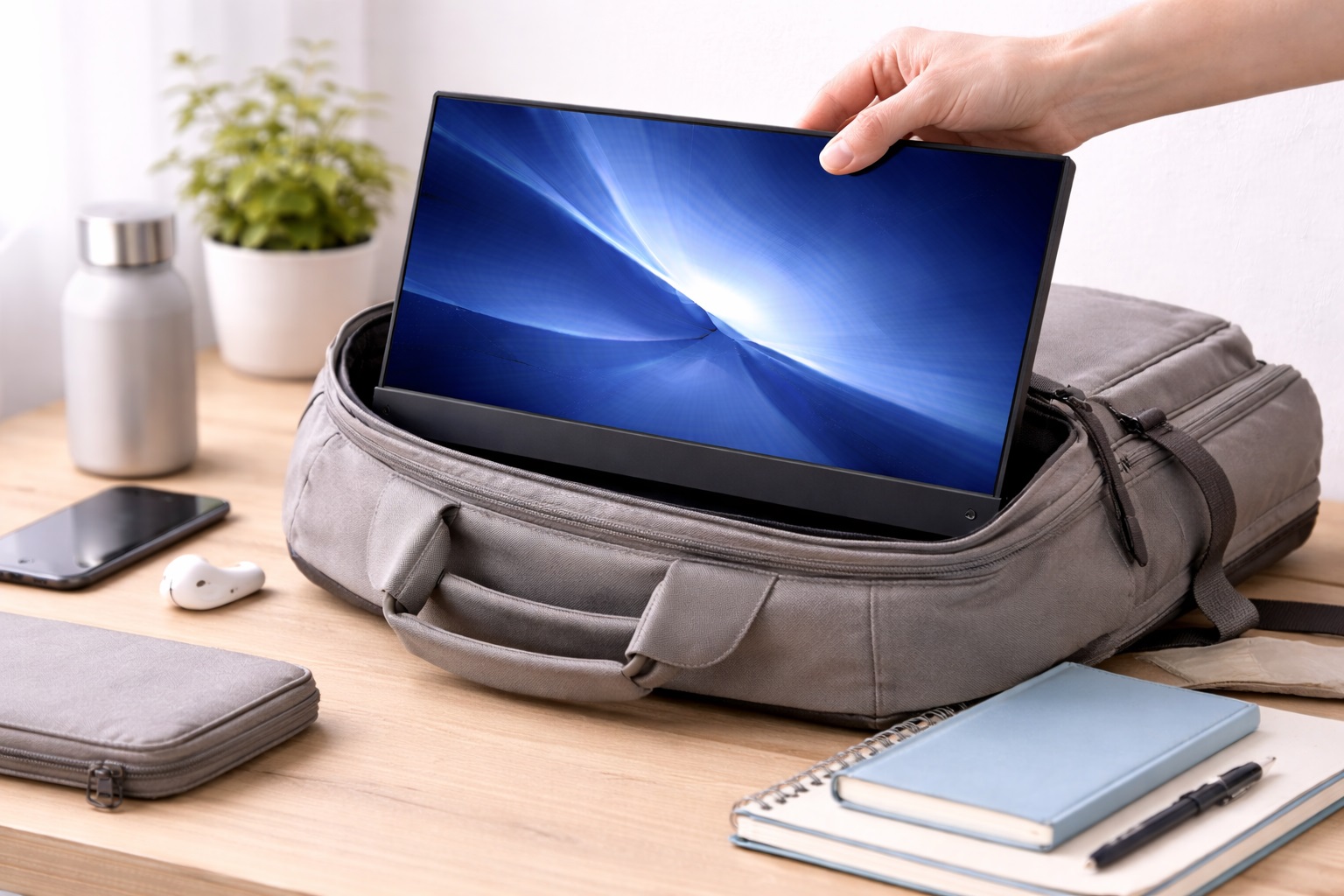
Some lightweight-friendly monitors ship with a carrying sleeve, a fold-flat stand, or a built-in handle — small details that make a real difference if you're regularly moving the screen between locations. None of these are essential, but they're worth checking for if frequent transport is a core part of how you'll use the display.
12. HDR Specification Quality
Monitor HDR certifications vary enormously. DisplayHDR 400, the most common certification, provides only a minimal true HDR benefit. DisplayHDR 600 and 1000 deliver noticeably improved contrast and highlight detail. For office use, HDR is largely irrelevant. For media consumption, check the actual certification level rather than assuming any HDR label means the same thing.
13. Power Consumption and Adapter Bulk
Monitors with an external power brick add extra bulk and another item to pack when you're moving the display between locations. Panels with an internal power supply are usually more convenient for frequent transport, since there's one less cable and adapter to track down. It's a minor detail on paper, but anyone who has hunted for a misplaced power brick before a meeting knows it's worth checking before you buy.
14. Warranty and Support Coverage
A monitor that travels between locations is exposed to more bumps and knocks than one that sits in a single spot permanently. A manufacturer offering at least a one to three year warranty with accessible support is a reasonable baseline for a display you plan to move regularly. Reading the fine print on physical damage coverage is particularly useful if the monitor will be riding in a bag or car trunk on a regular basis.
15. Bundled Accessories
Some lightweight monitor packages include a padded sleeve, a folding stand, or an integrated cable-management clip, while others ship with only the bare panel and a basic stand. These extras rarely change the core buying decision, but they can meaningfully improve the day-to-day experience of transporting the display, so it's worth factoring them in when comparing two otherwise similar options.
Frequently Asked Questions
1. How far should I sit from a lightweight monitor?
Roughly 50 to 70 centimeters — about an arm's length from a seated position — is the recommended distance for most screen sizes. Sitting too close causes eye strain from excessive focusing effort, while sitting too far forces you to squint at small text. If reading comfortably is a struggle, adjust the operating system's text size before assuming you need to move closer.
2. Is a curved lightweight monitor worth it?
Curved displays reduce head and eye movement across the full screen width, and that benefit is most noticeable on ultrawide formats around 34 inches and above. On standard 24 to 27-inch monitors, the curvature effect is much subtler. It's worth considering for immersive, ultrawide use, but less impactful at typical monitor sizes.
3. Does a pricier lightweight monitor always mean better color?
Panel quality affects color accuracy more than price alone. An IPS panel at a modest price point typically outperforms a TN panel at the same cost. sRGB coverage and factory color calibration are more reliable indicators of color quality than price tier, and dedicated color-accurate monitors for photo or video work will outperform general-use displays regardless of what they cost.
4. Is a 4K lightweight monitor worth the extra cost?
For 27-inch screens and above viewed at a close distance, 4K delivers a clearly noticeable sharpness improvement for text and detail work. At 24 inches, the difference from 1080p is much subtler. 4K monitors also demand more from your GPU, so if you're on integrated graphics, 1440p at 27 inches usually offers the best balance of sharpness and practicality.
5. Can I run two lightweight monitors off one laptop?
Whether you can drive two external displays depends on your laptop's graphics hardware and port configuration. Many modern laptops support dual external displays through Thunderbolt/USB-C combined with HDMI or DisplayPort. Check your laptop's technical specifications for its maximum supported display output count before assuming a dual setup will work.
6. How much do lightweight monitors typically weigh?
Weight varies by panel size and chassis design, but smaller, slimmer-bezel panels with minimal built-in extras are generally the lightest options in any given size class. If weight is your top priority, comparing chassis specifications across similarly sized monitors is more useful than comparing by resolution or refresh rate alone.
7. Is the most expensive lightweight monitor always the best choice?
Not necessarily. A higher price often buys extra features, but plenty of mid-range monitors deliver excellent everyday performance. It's worth focusing on the specific features — panel type, resolution, and portability — that actually matter for how you'll use the screen.
8. How long should a quality lightweight monitor last?
A well-built monitor from a reputable brand typically lasts two to five years or longer with reasonable care, including careful handling if you're moving it frequently. Checking the warranty terms is a useful way to gauge a manufacturer's confidence in long-term durability.
9. Can I return a lightweight monitor if it doesn't suit my setup?
Most retailers offer a 15 to 30 day return window. It's worth keeping the original packaging during your evaluation period, since that packaging is often the easiest way to transport the monitor back safely if a return becomes necessary.
10. What's the best lightweight monitor for someone who moves their screen often?
The right choice depends on your specific priorities — whether that's raw portability, sharper detail work, or replacing a multi-monitor setup. Reviewing the buying guide factors above and weighing them against how often and how far you'll be moving the display is the most reliable way to land on the right pick.
11. Does brand name matter when choosing a lightweight monitor?
Established brands generally offer more consistent quality control, better customer support, and more reliable warranty service. That said, newer or lesser-known brands sometimes offer strong value in this category, so it's worth reading verified reviews carefully rather than ruling out a monitor purely because of its brand recognition.
12. Do lightweight monitors sacrifice image quality for portability?
Not inherently. A slim chassis and light stand don't require compromising on panel technology — IPS panels are common across both compact and larger monitors. The tradeoffs to watch for are more about screen size, resolution, and extra features like built-in speakers, rather than the fundamental image quality of the panel itself.
13. Do lightweight monitors need a special carrying case?
A dedicated case isn't strictly necessary, but a padded sleeve or a soft bag protects the panel and stand from scratches and impact during transport. If the monitor doesn't come with one, a generic padded laptop or tablet sleeve sized appropriately often works as a reasonable substitute for occasional moves.
14. Will moving a monitor frequently shorten its lifespan?
Occasional careful transport shouldn't meaningfully shorten a monitor's lifespan, since the internal components aren't especially sensitive to being moved when handled properly. The bigger risk is physical damage from drops or impacts during transit, which is why a stable stand, a protective sleeve, and careful packing matter more than the frequency of moves itself.
15. Is it better to buy a smaller monitor purely for portability?
Not always. A smaller panel is generally lighter and easier to carry, but if your work genuinely benefits from more screen space or sharper resolution, a slightly larger monitor with a good stand and detachable base can still be manageable to transport. It's worth weighing the productivity cost of downsizing against the modest portability gain before defaulting to the smallest available option.
Final Verdict
- Best Overall Lightweight Monitor: IPS 1080p 24-Inch Monitor – the reliable, easy-to-carry all-rounder for home office and student use.
- Best for Detail-Heavy Work: 27-Inch 1440p Monitor – a noticeable quality upgrade for detail-oriented tasks that's still reasonably portable.
- Best for Replacing a Multi-Monitor Setup: Ultrawide Curved Monitor – maximum usable screen space in a single display and stand.
The right lightweight monitor comes down to how often you'll be moving it and what you need most from the screen once it's set up. A 24-inch IPS panel covers the widest range of everyday needs with the least hassle, a 27-inch 1440p display rewards anyone doing detail-heavy work, and an ultrawide is worth considering if you'd rather carry one lighter setup than two separate monitors. Match the category to your actual routine rather than chasing the highest spec sheet, and the display will earn its keep on your desk for years.
Before finalizing a purchase, it's worth double-checking the practical details that don't always show up in a spec sheet comparison: how the stand folds or detaches, whether the power supply is internal or an external brick you'll need to pack separately, and how the monitor's actual dimensions compare to the space you'll be moving it through. These small logistics are easy to overlook when comparing panels side by side, but they end up shaping the day-to-day experience of owning a lightweight monitor just as much as resolution or panel type. A screen that's technically excellent but awkward to detach from its stand will get moved less often than one that's slightly less impressive on paper but genuinely easy to live with, and that everyday convenience is often the difference between a monitor you actually reposition and one that quietly stays put after the first few uses.