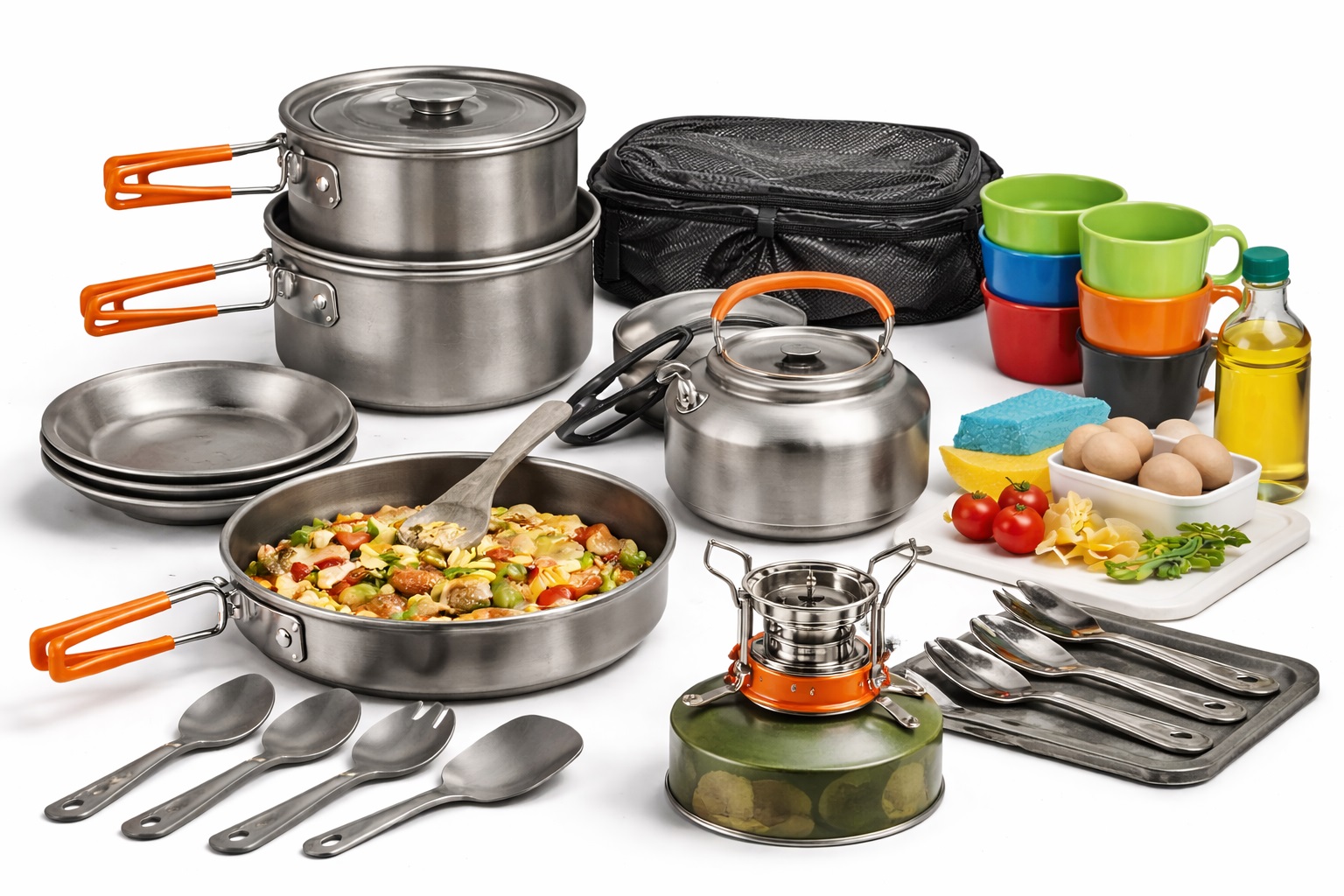
Best Durable Camping Cookware in 2026
Cookware that only survives a season or two ends up costing more than a pricier set built to last, which is why long term use deserves as much attention as weight or price when shopping for camping cookware. This guide looks at eight widely available sets through the lens of durability, examining materials, construction, and everyday wear patterns rather than just initial impressions out of the box.
Durability in camping cookware comes down to a combination of factors: the base material, how thick the metal is, how well handles and lids are attached, and how the surface holds up to repeated heating, cooling, and cleaning. A set that looks similar to another on a store shelf can behave very differently after three or four seasons of regular use, and those differences are the focus of this comparison.
None of this means the most expensive option is automatically the most durable, or that budget cookware always wears out quickly. Some inexpensive aluminum kits hold up admirably with basic care, while certain premium sets include delicate coatings that require more careful handling than their price tag might suggest. The reviews below aim to give a realistic picture of how each set is likely to perform over years of use, not just its first few trips.
It is also worth remembering that durability is not just about the base material. How a set is stored between trips, how it is cleaned, and how carefully it is packed all play a meaningful role in how long it ultimately lasts. Keep that broader context in mind as you weigh the strengths and weaknesses of each pick below.
Top 8 Best camping cookware Picks (Detailed Reviews)
1. MSR Alpine 2 Pot Set – Best For Everyday Group Durability
The MSR Alpine 2 Pot Set is built from hard-anodized aluminum, a treatment specifically designed to increase surface hardness and resist the scratching that ordinary aluminum is prone to over time. For a set that sees frequent group use, that added surface toughness translates directly into a longer usable life before dents and scratches start affecting cooking performance.
The two-pot nesting design also means less strain on any single component, since cooking duties can be split between vessels rather than repeatedly working one pot hard. Owners who use this set regularly for car camping and group trips tend to report that it holds its shape and finish well across many seasons. The strainer-lid design also reduces wear on the pot rims themselves, since food and liquid are drained without scraping utensils directly against the edges.
- Pros:
- Hard-anodized aluminum resists scratching better than standard aluminum
- Two nesting pots distribute wear across more cooking capacity
- Reputable brand with a long track record in durable cookware
- Cons:
- Priced higher than basic single-pot sets
- Only available in one color scheme
Best For: Groups and families who cook together often and want cookware that can handle years of regular use.
Why We Recommend It: Hard-anodized aluminum is one of the more scratch- and wear-resistant treatments available at this price point, making this set a dependable long-term choice for frequent group cooking.
2. GSI Outdoors Pinnacle – Best For Long-Lasting Nonstick Performance
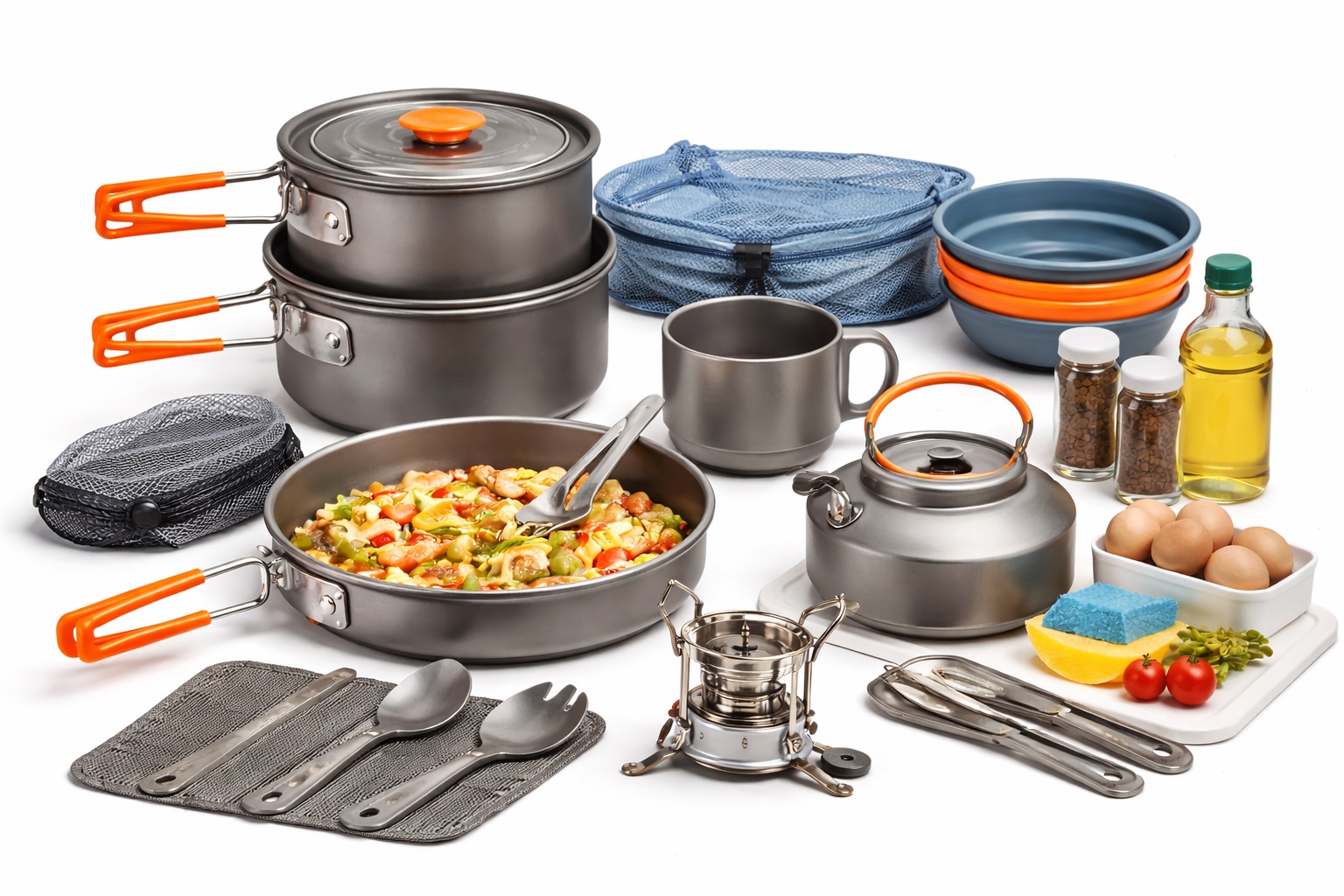
The GSI Outdoors Pinnacle pairs a durable aluminum body with a Teflon nonstick coating, a combination that holds up well as long as it is cared for with the right utensils and cleaning approach. The set's nested design, which includes a mug and folding utensils, also means fewer loose parts get lost or damaged between trips.
Nonstick coatings generally have a finite lifespan compared to bare metal, but with reasonable care, this set's coating tends to outlast the coatings found on cheaper nonstick cookware, which matters if you plan to keep it for many camping seasons. The insulated mug included in the set also tends to hold up well to repeated hot and cold cycles without losing its seal over time.
- Pros:
- Teflon coating remains effective for years with proper care
- Well-organized nesting design protects included accessories
- Reputable brand known for thoughtfully engineered camp kitchen gear
- Cons:
- The highest price point in this roundup
- Nonstick coatings need gentler utensils and careful cleaning to last
Best For: Campers who want long-lasting nonstick convenience and are willing to follow basic care guidelines to protect it.
Why We Recommend It: With reasonable care, this set's nonstick coating and sturdy construction offer years of reliable performance, making the higher upfront cost easier to justify over time.
3. Odoland Camping Cookware – Best For A Durable Complete Kit
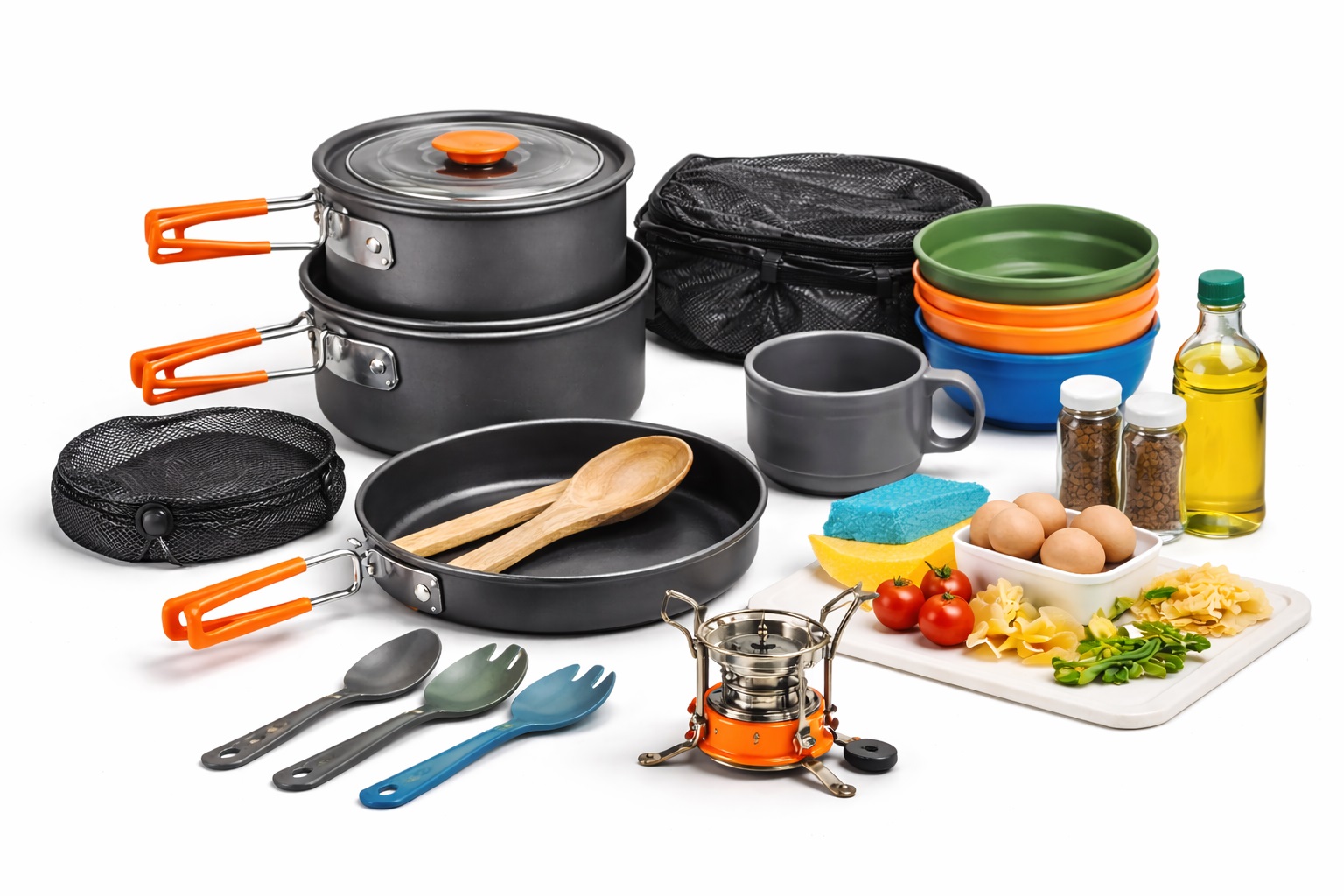
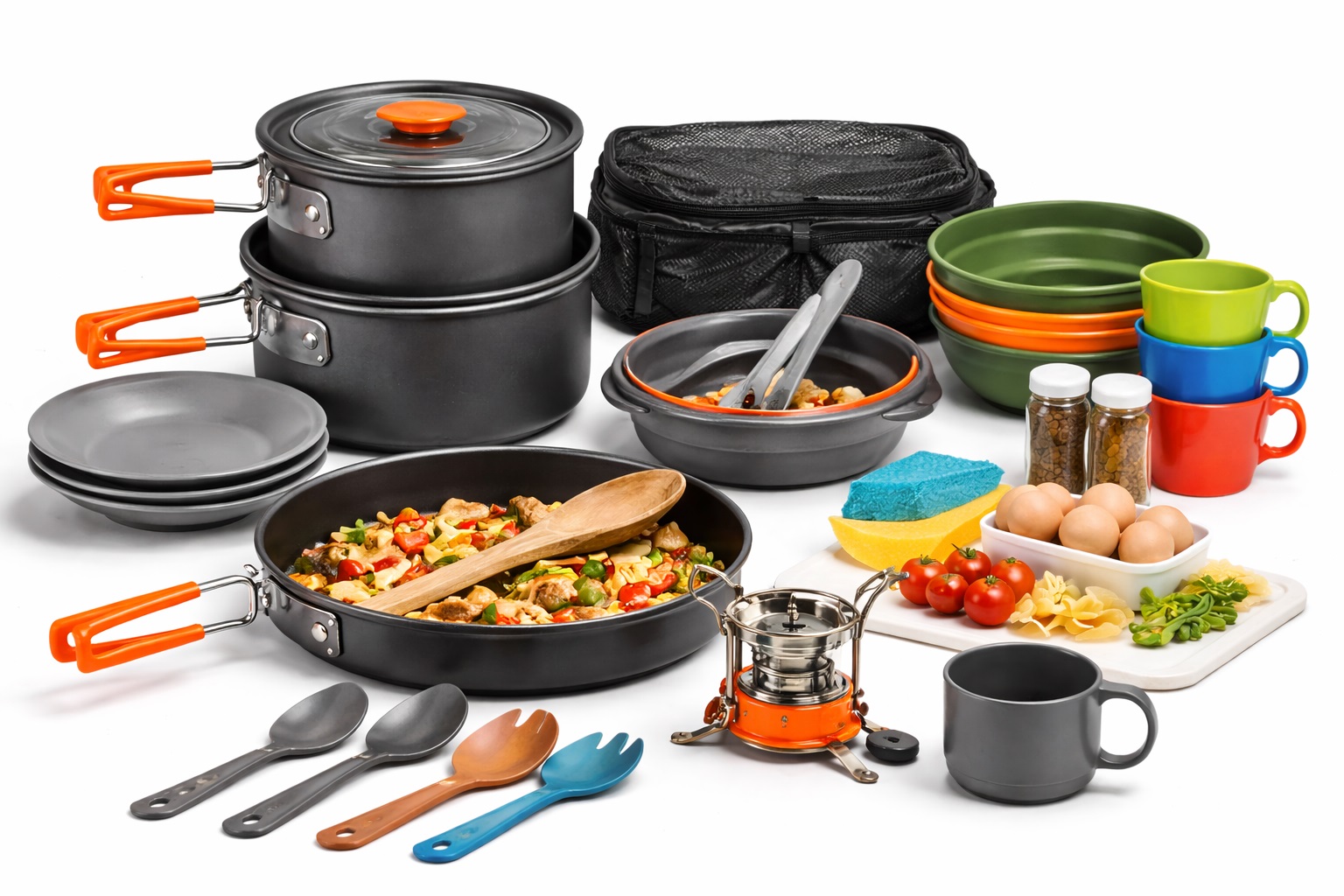
The Odoland Camping Cookware set includes ten pieces, pots, a pan, plates, and utensils, all built to nest together into one carrying bag. While individual pieces use a thinner gauge of metal than dedicated single-pot sets, the overall design holds up reasonably well for a complete kit at this price point.
Because the set includes spares in the form of multiple pots and plates, minor damage to one piece does not necessarily put the whole kitchen setup out of commission, which is a practical advantage for long-term reliability. It also means replacing a single scratched plate or bent utensil does not require buying an entirely new set.
- Pros:
- Complete 10-piece set means built-in redundancy if one piece wears out
- Nests into a single, organized carry bag
- Strong value for the number of durable pieces included
- Cons:
- Thinner gauge metal than dedicated single-pot durability sets
- Limited color and finish options
Best For: Families or groups who want a complete kitchen setup that holds up reasonably well over repeated use.
Why We Recommend It: Having multiple pieces of similar function built into one set provides a practical buffer against the natural wear that affects any piece of cookware used often over the years.
4. Coleman Aluminum Mess Kit – Best For Budget Longevity
The Coleman Aluminum Mess Kit is a simple, no-frills design: a pot, a pan, and basic utensils. Its straightforward construction, with few moving parts or delicate coatings, means there is relatively little that can fail or wear out compared to more feature-heavy cookware.
While the aluminum used here is thinner than in premium sets, many owners find that a simple design with fewer failure points ends up lasting a surprisingly long time with basic care, making it a smart choice for buyers who do not want to gamble on more complex gear. Its uncomplicated shape also makes it easy to inspect for wear, since there are no hidden hinges or coatings to check.
- Pros:
- Simple design with few components that can break
- Lightweight aluminum that is easy to maintain
- Lowest price point of any set in this comparison
- Cons:
- Thinner gauge aluminum than hard-anodized or titanium options
- Fewer premium features like nonstick coating
Best For: Budget-conscious campers who want dependable basics that hold up reasonably well without a large upfront investment.
Why We Recommend It: Its simple construction avoids many of the wear points that affect more complicated cookware, giving it a longer practical lifespan than its low price might suggest.
5. Stanley Adventure Camp – Best For Maximum Long-Term Durability
The Stanley Adventure Camp set uses stainless steel, a material well known for resisting dents, scratches, and corrosion far better than aluminum or even titanium in many real-world conditions. It is the heaviest set in this comparison, but that added weight comes with a corresponding boost in toughness that suits campers planning to use the same set for many years.
Stainless steel also tolerates rough handling, high heat, and repeated cleaning cycles better than most other cookware materials, which is why this set is frequently mentioned by campers looking for gear that can be passed down or handed roughly between family members without much concern. Many owners describe it as the kind of set that outlasts several tents and sleeping bags before it ever shows serious signs of age.
- Pros:
- Stainless steel resists dents, scratches, and corrosion exceptionally well
- Simple, rugged construction with few failure points
- Reputable brand with a long history in long-lasting outdoor gear
- Cons:
- Heavier than titanium or aluminum equivalents
- Limited color options compared to newer product lines
Best For: Campers who want cookware built to last decades rather than seasons, even at the cost of extra weight.
Why We Recommend It: Stainless steel's exceptional resistance to wear, corrosion, and rough handling makes this set one of the most dependable long-term investments in this entire comparison.
6. Snow Peak Trek 1400 – Best For Titanium That Lasts
The Snow Peak Trek 1400 combines titanium's natural corrosion resistance with a folding handle system built for repeated use. Titanium does not rust or corrode the way some metals can, and its inherent strength means the pot itself tends to outlast lighter aluminum equivalents even under regular use.
The set's simple, well-engineered folding hardware is designed to withstand years of opening and closing without loosening, which is often the first point of failure on lower-quality folding cookware. That attention to hardware detail is part of why this set is frequently recommended for campers planning to use the same pot season after season.
- Pros:
- Titanium resists corrosion and holds its shape over many years
- Well-engineered folding handle built for repeated use
- Backed by a well-established, reputable outdoor brand
- Cons:
- Priced higher than aluminum or steel alternatives
- Available in a single finish option
Best For: Campers who want titanium's long-term durability without sacrificing packability.
Why We Recommend It: Titanium's corrosion resistance and structural strength give this set genuine staying power, and the reinforced handle design holds up notably well to years of regular folding and unfolding.
7. Toaks Titanium 750ml – Best For Lightweight Long-Term Reliability
The Toaks Titanium 750ml keeps its design deliberately simple: one pot, one lid, one wire handle. That simplicity is part of what makes it so durable over time, since there are very few parts that can loosen, corrode, or fail after years of regular use.
Titanium's resistance to corrosion and denting means this pot tends to look and perform much the same after years of trail use as it did when new, aside from cosmetic discoloration from direct flame contact. That discoloration is purely cosmetic and does not affect the pot's structural integrity or cooking performance in any meaningful way.
- Pros:
- Minimal, simple design with very few points of failure
- Titanium resists corrosion and denting over years of use
- Lightweight without sacrificing long-term structural integrity
- Cons:
- Costs more per liter of capacity than aluminum options
- Small capacity limits use to one or two people
Best For: Solo campers who want a long-lasting set without carrying any unnecessary weight.
Why We Recommend It: Its minimalist design leaves little room for parts to wear out, and titanium's inherent durability means this pot is built to remain functional for many years of regular use.
8. Sea to Summit X-Pot – Best For Durable Packability
The Sea to Summit X-Pot uses a collapsible silicone body around a reinforced metal base, a design that requires somewhat more careful handling than a fully rigid pot but is engineered specifically to withstand repeated folding and unfolding over many trips.
The reinforced base handles direct heat well, and the silicone used in the collapsible walls is designed to resist cracking or losing its shape after repeated compression, which is the main durability concern with this style of cookware. Owners who use it regularly report that the collapsing mechanism continues to work smoothly well beyond its first season of use.
- Pros:
- Reinforced base engineered for repeated direct-flame use
- Silicone body designed to resist cracking after repeated folding
- Reputable brand focused on long-lasting packable outdoor gear
- Cons:
- Requires more careful handling than fully rigid metal pots
- Priced above comparable rigid aluminum pots
Best For: Campers who want a collapsible design that still holds up to years of regular folding and packing.
Why We Recommend It: Its reinforced construction is specifically engineered to survive the repeated compression cycles that would degrade a less carefully designed collapsible pot.
Buying Guide: How to Choose the Most Durable Camping Cookware
1. What Makes Cookware Durable Over Time
Durability comes down to material strength, wall thickness, and how well individual components like handles and lids are attached to the main body. A set can look sturdy on a store shelf but still develop problems at weak joints after repeated use.
Consider the whole system rather than just the pot itself, since hinges, latches, and seams are often the first parts to fail, even on cookware made from a durable base material. A quick inspection of these joints before buying, or after a return period, can reveal a lot about expected longevity.
2. Material Longevity: Titanium vs Aluminum vs Steel
Titanium resists corrosion extremely well and holds its shape over many years, though it is pricier than the alternatives. Stainless steel is the toughest against dents and scratches but is also the heaviest option. Aluminum is lighter and more affordable but more prone to denting unless it is hard-anodized.
Each material ages differently, so consider which type of wear, denting, corrosion, or scratching, is most likely given how and where you camp. Coastal or humid climates, for instance, tend to be harder on untreated metals than dry inland conditions.
3. Coatings and How They Age
Nonstick coatings improve convenience but generally have a finite lifespan compared to bare metal, gradually losing effectiveness with repeated use and cleaning. Higher-quality coatings paired with careful use tend to last considerably longer than budget nonstick surfaces.
Using only silicone, wood, or plastic utensils on coated cookware, and avoiding abrasive scrubbers, meaningfully extends how long a nonstick surface stays effective. Storing coated pieces with a soft liner between them also prevents scratching during transport.
4. Handle and Hinge Longevity
Folding handles are convenient for packing but introduce a mechanical hinge that can loosen over years of use. Look for reinforced hinge designs and check reviews specifically for complaints about handles becoming wobbly after extended use.
Fixed handles avoid this particular failure point entirely, though they add bulk, so there is a genuine trade-off between packability and long-term hinge reliability. Testing a folding handle's action in the store or right after unboxing helps you gauge its build quality before it sees real use.
5. Seams, Joints, and Weak Points
Welded or riveted seams are common failure points on lower-quality cookware, particularly where a handle attaches to the pot body. Inspecting how a product is assembled, when photos or reviews are available, can reveal whether reinforcement was used at these stress points.
Simpler designs with fewer seams and joints overall tend to have fewer potential failure points, which is part of why minimalist cookware often proves surprisingly long-lived.
6. How Storage Habits Affect Lifespan
Storing cookware wet, or nesting pieces together without protection between metal surfaces, can accelerate scratching and, in the case of untreated steel, corrosion. Drying cookware fully before packing it away between trips meaningfully extends its useful life.
A dedicated storage bag or protective sleeve also reduces the scuffing that happens when cookware bounces around loosely in a garage or gear closet between camping seasons.
7. Cleaning Practices That Extend Life
Harsh abrasive scrubbers can damage coatings and polished finishes over time, even on otherwise durable materials. Using appropriately gentle cleaning tools matched to your cookware's surface, whether that is bare titanium, hard-anodized aluminum, or a nonstick coating, helps preserve both appearance and function.
Hand washing is generally recommended over dishwashers for most camping cookware, since dishwasher detergents and prolonged heat can degrade coatings and anodized finishes faster than expected.
8. Signs of Wear to Watch For
Warping, flaking coatings, loose handles, and pitting or discoloration on steel are all signs that cookware is nearing the end of its useful life. Catching these signs early lets you retire or repair a piece before it fails during an actual trip.
Regularly inspecting your gear before each camping season, rather than assuming everything is fine, is a simple habit that catches most developing problems early.
9. Warranty and Manufacturer Support
Some outdoor cookware brands offer meaningful warranties against manufacturing defects, which can be a useful signal of how confident a manufacturer is in their product's long-term durability. Checking warranty terms before buying is a worthwhile step, particularly for pricier sets.
Even without a formal warranty, brands with responsive customer service can make replacing a single damaged part far easier than starting over with an entirely new set.
10. Cost Per Year of Use
A pricier set that lasts twice as long as a budget alternative may actually cost less per year of ownership. Thinking in terms of expected lifespan, rather than just upfront price, gives a clearer picture of genuine long-term value.
This calculation matters most for frequent campers, since occasional users may never put enough wear on a budget set to make the more durable option worth the extra cost.
11. Repairability
Simple designs with widely available replacement parts, such as standard-sized lids or handles, are generally easier to keep in service for longer. Highly proprietary designs can be harder to repair if a single component fails.
Checking whether a manufacturer sells individual replacement parts is worth doing before you buy, especially for more complex, multi-piece sets.
12. Matching Durability to How Often You Camp
Frequent campers put considerably more cumulative wear on cookware than occasional weekend users, which justifies investing more in materials known for long-term durability. Infrequent campers may reasonably prioritize cost over maximum toughness.
Consider not just how often you camp today, but how your camping habits might change over the next several years, since durable cookware bought now can serve you well into the future.
13. Brand Reputation for Long-Term Quality
Brands with a long history in outdoor cookware often have more refined manufacturing processes and more consistent quality control than newer entrants to the market. A strong reputation built over years is a reasonable, if imperfect, signal of durability.
Reading reviews specifically focused on multi-year ownership, rather than first impressions, gives the most reliable picture of how a set actually performs over the long term.
Frequently Asked Questions
How long should camping cookware last?
With reasonable care, quality camping cookware made from titanium or stainless steel can last many years, often a decade or more, while lighter aluminum pieces may show cosmetic wear sooner but often remain functional for a long time. How often you use and clean your cookware also plays a large role in how quickly it shows its age.
Does titanium or stainless steel last longer?
Both materials are known for excellent long-term durability. Titanium resists corrosion exceptionally well and stays lighter, while stainless steel is generally more resistant to dents and scratches but adds noticeable weight.
What causes camping cookware to wear out?
Common causes include repeated denting from rough handling, coating degradation from abrasive cleaning tools, loosening handles or hinges, and corrosion on untreated metal surfaces stored while still damp.
Can I extend the life of nonstick cookware?
Yes, using only silicone, wood, or plastic utensils, avoiding abrasive scrubbers, and not exposing the coating to excessive high heat all meaningfully extend how long a nonstick surface remains effective.
Is it worth buying a more expensive set for durability?
For frequent campers, a pricier, more durable set often works out cheaper over time than repeatedly replacing budget cookware. Occasional campers may find a less expensive set perfectly adequate for their needs, since infrequent use puts far less cumulative strain on any material.
How do I know when to replace cookware?
Watch for warping, flaking nonstick coatings, loose or wobbly handles, and any pitting or significant discoloration on steel surfaces. Any of these signs suggest a piece is nearing the end of its reliable service life.
Do camping pots rust?
Titanium and properly treated stainless steel do not rust. Untreated or lower-grade steel components can corrode if stored wet, which is why drying cookware fully before packing it away matters for long-term durability.
How should I clean cookware to make it last?
Hand washing with mild soap and a soft sponge is generally recommended over dishwashers, particularly for anodized aluminum and nonstick-coated pieces, since dishwasher detergents and heat can degrade coatings and finishes faster than expected.
Does frequent use shorten a set's lifespan?
Frequent use does add cumulative wear, but well-built cookware made from durable materials is designed to handle regular use for many years. Proper cleaning and storage habits matter more than raw frequency of use in most cases.
Can dents affect cookware performance long term?
Minor cosmetic dents usually do not affect cooking performance, but significant dents can affect how a pot sits on a stove burner or how evenly it heats, which is worth considering if durability is a priority. Checking that a pot still sits flat on a flame after a hard knock is a simple, practical test worth doing periodically.
What warranty should I look for?
Look for a manufacturer warranty covering defects in materials and workmanship, ideally for at least a year or more. A responsive customer service history is also a good sign, even when a formal long-term warranty is not offered.
Is stainless steel worth the extra weight for durability?
For campers who prioritize toughness over pack weight, such as car campers or those camping in rough conditions, stainless steel's exceptional resistance to dents and corrosion often justifies the added weight.
How do I store cookware between camping seasons?
Clean and fully dry all pieces before storing them, ideally in a breathable bag rather than a fully sealed plastic container, to avoid trapping moisture that can lead to odors or, on untreated steel, corrosion over time.
Final Verdict
- Top Pick: Stanley Adventure Camp for the best overall long-term durability.
- Budget Choice: Coleman Aluminum Mess Kit for simple, dependable basics at the lowest price.
- Premium Choice: GSI Outdoors Pinnacle for durable nonstick performance backed by thoughtful design.
When long-term durability is the priority, stainless steel's resistance to dents, scratches, and corrosion makes the Stanley Adventure Camp the standout choice for campers who want gear built to last many seasons without babying it. Budget-conscious buyers still get a reasonably long-lived set with the simple, low-part-count Coleman kit, while campers willing to invest more for lasting nonstick convenience will find the GSI Outdoors Pinnacle a worthwhile long-term purchase. Whichever set you choose, proper cleaning and dry storage will do as much for its lifespan as the material it is made from. Treat durability as a combination of the material you buy and the habits you build around using it, and almost any set on this list can serve you well for years to come.