Best Titanium Camping Cookware in 2026
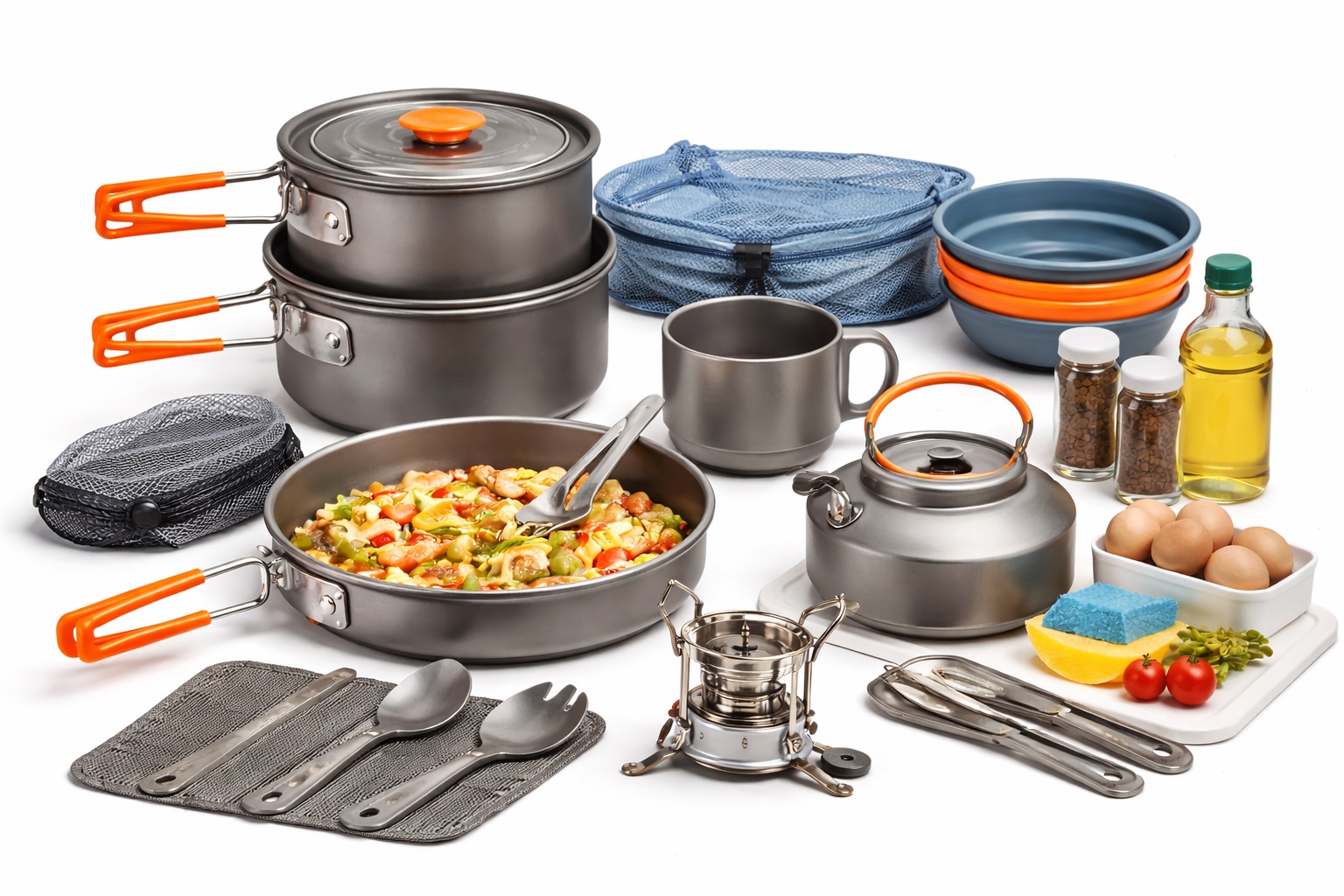
Shaving weight from a pack without sacrificing durability is the central trade-off of ultralight backpacking, and camping cookware is one of the easiest places to make real gains. A set chosen for ultralight strength needs to survive years of drops, scrapes, and rough handling while adding as little weight as possible to your load. This guide compares eight widely used camping cookware sets, focusing on how each one balances low weight against real-world toughness.
Not every ultralight product delivers on both fronts. Some pots shave weight by using thinner walls that dent easily, while others rely on stronger but heavier materials that hold up better over time. Understanding where each set on this list lands on that spectrum will help you choose cookware that survives your specific style of camping, rather than one that only looks impressive on a gear scale.
Titanium is often treated as the default answer for strength-to-weight performance, and for good reason, but it is not automatically the right choice for every camper. Aluminum, steel, and even collapsible silicone designs each offer their own version of the weight-versus-durability trade-off, and the right pick depends heavily on how you actually cook and how roughly your gear gets handled on the trail.
Price is another part of this equation that is easy to overlook. Ultralight materials, and titanium in particular, typically command a premium over standard aluminum or steel cookware of similar capacity. Deciding how much that weight savings is worth to you, given your trip frequency and distance, is just as important as comparing raw specifications between products.
Top 8 Best camping cookware Picks (Detailed Reviews)
1. Coleman Aluminum Mess Kit – Best For Budget-Friendly Basics
The Coleman Aluminum Mess Kit keeps things simple: a lightweight aluminum pot, pan, and basic utensils that nest together for easy carrying. It is not marketed as an ultralight specialty product, but its aluminum construction still keeps overall weight reasonable for campers who are not chasing the lightest gram count on the market. For weekend trips where a few extra ounces will not make or break your hike, this remains a perfectly serviceable option that will not strain a beginner's budget.
- Pros:
- Lightweight aluminum keeps the kit easy to carry
- Simple, reliable design with no complicated parts
- Lowest price point in this comparison
- Cons:
- Thinner gauge aluminum is more prone to denting than titanium
- Limited color and finish options
Best For: New campers who want a functional, affordable set before investing in specialty ultralight materials.
Why We Recommend It: It is a sensible low-cost entry point into camp cooking, and while it will not match titanium's strength-to-weight ratio, it remains light enough for casual use at a fraction of the price.
2. MSR Alpine 2 Pot Set – Best For Multi-Person Ultralight Trips
MSR's Alpine 2 Pot Set uses hard-anodized aluminum, a treatment that meaningfully increases surface hardness and scratch resistance compared to untreated aluminum. The two nesting pots let small groups split the weight of cooking gear between packs while still traveling in one compact bundle. Splitting the set between two hikers means neither person carries the full weight of a group kitchen alone, which is a common strategy on multi-day ultralight trips.
- Pros:
- Hard-anodized surface resists scratching better than standard aluminum
- Two-pot capacity without a large weight penalty
- Reputable brand with a long history in backcountry cookware
- Cons:
- Heavier overall than single-pot titanium options
- Priced higher than basic aluminum mess kits
Best For: Pairs or small groups who want to split ultralight cooking gear across two packs.
Why We Recommend It: Hard-anodized aluminum offers a meaningful durability upgrade over plain aluminum without the price jump of full titanium, making it a solid middle ground for group trips.
3. Stanley Adventure Camp – Best For Rugged Long-Lasting Strength
The Stanley Adventure Camp set is built from stainless steel, prioritizing raw toughness over minimal weight. It is the heaviest set in this list, but it is also among the most resistant to dents, drops, and years of rough handling, which matters for campers who value durability as much as pack weight. It is a set well suited to being tossed in a truck bed or handed roughly between family members without much worry about damaging it.
- Pros:
- Stainless steel withstands drops and rough handling exceptionally well
- Simple construction with few parts that can fail
- Reputable brand known for rugged outdoor gear
- Cons:
- Noticeably heavier than titanium or aluminum sets
- Limited color options
Best For: Campers who prioritize maximum toughness over the lightest possible pack weight.
Why We Recommend It: If strength and longevity matter more to you than gram counting, stainless steel's resistance to dents and wear makes this set one of the most dependable long-term options available.
4. Sea to Summit X-Pot – Best For Minimal Packed Volume
The Sea to Summit X-Pot uses a collapsible silicone body around a reinforced base, folding down to a fraction of its cooking size. While its silicone walls are not as impact-resistant as solid metal, the reinforced base is built to handle direct flame contact and regular use. Once you get used to setting it up and folding it away, most owners find the routine becomes second nature within the first few trips.
- Pros:
- Collapsible design dramatically reduces packed volume
- Reinforced base tolerates direct stove or flame contact
- Reputable brand focused on packable outdoor gear
- Cons:
- Silicone walls need more careful handling than rigid metal
- Priced above comparable rigid aluminum pots
Best For: Hikers who want the smallest possible packed footprint and are willing to handle a semi-flexible pot with a bit more care.
Why We Recommend It: Its reinforced base gives it more real-world durability than its flexible design might suggest, and nothing else on this list collapses down as small.
5. GSI Outdoors Pinnacle – Best For Comfort-Focused Ultralight Cooking
The GSI Outdoors Pinnacle adds a nonstick coating and thoughtfully nested accessories, including a mug and folding utensils, to a lightweight cook set. It sits at the premium end of this comparison, aimed at campers who want convenience features alongside a reasonably light overall package. The insulated mug in particular sees frequent use for hot drinks in the morning and evening, adding practical value beyond just the core cooking pot.
- Pros:
- Nonstick coating simplifies cleanup on the trail
- Well-organized nesting keeps included accessories secure
- Reputable brand known for refined camp kitchen design
- Cons:
- The highest price point in this roundup
- Nonstick coating needs gentler utensils to preserve its lifespan
Best For: Campers who want ultralight-adjacent weight savings without giving up cooking comfort and easy cleanup.
Why We Recommend It: It strikes a workable balance between weight savings and everyday comfort, which matters for campers unwilling to sacrifice convenience entirely for gram counting.
6. Odoland Camping Cookware – Best For Complete Group Kits
The Odoland Camping Cookware set bundles ten pieces, including pots, a pan, plates, and utensils, into one nesting kit. It is not designed primarily around ultralight principles, but its efficient nesting keeps the overall bundle reasonably compact and manageable for a full group kitchen setup. Distributing the individual pieces across several packs, rather than one person carrying the whole set, is the practical way most groups make this kit work on longer trips.
- Pros:
- Complete 10-piece set covers cooking and serving for a group
- Nests into a single, manageable carry bag
- Strong value given the number of included pieces
- Cons:
- Thinner individual pieces than dedicated single-pot ultralight sets
- Limited finish options
Best For: Groups who want a full kitchen setup and are willing to trade some per-piece weight savings for completeness.
Why We Recommend It: Splitting ten pieces across several packs in a group keeps the per-person weight burden reasonable while still equipping the whole camp kitchen.
7. Toaks Titanium 750ml – Best For Maximum Strength-to-Weight Ratio
The Toaks Titanium 750ml is a single ultralight titanium pot built around a minimalist design with no unnecessary hardware. Titanium's strength-to-weight ratio is difficult to beat, which is why this style of pot remains a go-to choice for hikers who want maximum durability per gram carried. Its no-frills construction also means there is very little that can break, loosen, or wear out over years of regular trail use.
- Pros:
- Ultralight titanium construction minimizes base weight
- Strong resistance to denting relative to its low weight
- Simple single-pot design with fewer failure points
- Cons:
- Costs more per liter of capacity than aluminum options
- Small capacity limits use to one or two people
Best For: Solo ultralight hikers who want the best available balance of strength and low weight.
Why We Recommend It: Few materials match titanium's combination of light weight and dent resistance, making this pot one of the most efficient options here in terms of durability gained per gram carried.
8. Snow Peak Trek 1400 – Best For Everyday Ultralight Reliability
The Snow Peak Trek 1400 offers a larger titanium pot with a folding handle system, giving it more usable capacity than the smallest ultralight pots while still keeping weight low. It is built to handle frequent use without the wear and tear that can affect thinner budget cookware. Owners who camp several times a season often mention that this larger capacity makes it more versatile for both solo trips and cooking for a partner.
- Pros:
- Titanium build keeps weight low despite larger capacity
- Folding handle and stackable design save packed space
- Backed by a well-established, reputable outdoor brand
- Cons:
- Priced higher than aluminum or steel alternatives
- Available in a single finish option
Best For: Frequent campers who want titanium's strength-to-weight benefits in a slightly larger, more versatile size.
Why We Recommend It: It offers more usable capacity than the smallest ultralight pots while retaining most of titanium's weight and durability advantages, making it a dependable everyday choice.
Buying Guide: How to Choose the Best Ultralight Camping Cookware
1. Understanding Strength-to-Weight Ratio
Strength-to-weight ratio describes how much durability a material offers relative to how much it weighs, and it is the single most useful concept for comparing ultralight cookware. A thin, heavy steel pot may resist dents well but adds unnecessary weight, while a poorly designed thin aluminum pot may be light but dent easily.
Titanium consistently scores well on this measure, which is why it dominates the ultralight segment, but hard-anodized aluminum and reinforced silicone designs can also offer a reasonable strength-to-weight trade-off at a lower price. When comparing two products, look past the listed total weight alone and consider how that weight is distributed, since a slightly heavier pot with a sturdier handle may outlast a lighter one that fails at a weak joint.
2. Titanium vs Aluminum vs Steel
Titanium offers the best combination of low weight and dent resistance but costs more and can heat unevenly. Aluminum is cheaper and heats more evenly but is softer and more prone to denting unless it is hard-anodized. Stainless steel is the toughest of the three but also the heaviest.
None of the three materials is universally correct; the right choice depends on how much weight you are willing to carry in exchange for durability or cooking performance. Many experienced backpackers end up owning more than one material over time, choosing whichever set best fits a given trip's length, group size, and terrain.
3. Wall Thickness and Dent Resistance
Two pots made from the same material can still differ in durability based on wall thickness. Thicker walls resist dents better but add weight, so manufacturers must balance gauge thickness carefully to hit a target weight without making the cookware fragile.
Checking a product's listed wall thickness or gauge, when available, can give you a more precise sense of durability than the material name alone. A slightly thicker pot at the base, where most direct heat and impact occur, can meaningfully extend the useful life of an otherwise thin-walled ultralight pot.
4. Weight Budgeting for Your Pack
Ultralight backpackers often set a target base weight for their entire pack and then allocate portions of that budget to categories like shelter, sleep system, and kitchen gear. Knowing roughly how much weight you can allocate to cookware helps you decide whether titanium's added cost is worth it for your trip style.
For occasional car campers, this kind of strict weight budgeting matters far less, since weight is rarely the limiting factor when driving to a campsite. Even so, keeping a rough sense of your kitchen gear's total weight can be useful if you ever transition into longer or more ambitious trips down the line.
5. Capacity Without Added Bulk
Larger pots naturally weigh more, so look for designs that add capacity efficiently, such as taller, narrower shapes rather than simply thicker metal. A well-designed larger pot can still weigh less than a poorly designed smaller one made from a heavier material.
Consider how much capacity you actually need before assuming that a bigger pot automatically means more weight to carry. Two similarly priced pots can differ meaningfully in usable volume per gram, so comparing capacity-to-weight ratios directly is often more useful than comparing weight alone.
6. Handle and Lid Reinforcement
Folding handles reduce packed size, but the hinge points are also common failure spots on lower-quality cookware. Look for reinforced hinge design, since a handle that loosens over time can become both an inconvenience and a minor safety issue when lifting hot liquid.
Lids that lock securely in place also help prevent spills, which matters more on backcountry trips where dropped fuel or food cannot easily be replaced.
7. Coatings and Their Weight Impact
Nonstick coatings add a small amount of weight but can significantly reduce cleanup time and water usage at camp. Weigh that convenience against your overall weight budget, since a few extra grams for easier cleanup may be worth it on longer trips.
Uncoated titanium and stainless steel remain the lightest options overall, since they avoid the added mass of a coating layer entirely. If cleanup speed matters more to you than shaving the last few grams, a coated pot is usually a worthwhile trade.
8. Stove and Fuel Pairing
Ultralight cookware performs best when paired with a compatible stove system. Narrow, tall pots suit canister stoves well, while wider pots are better matched to car-camping burners with larger flame spread. A mismatch can waste fuel and slow cooking times regardless of how light your cookware is.
Some ultralight pot and stove combinations are designed and sold together specifically to maximize fuel efficiency, which is worth considering if you are building a system from scratch. Wind can also significantly affect fuel efficiency, so a simple windscreen paired with a well-matched pot often saves more fuel weight than upgrading the pot alone.
9. Deciding What to Leave Behind
Ultralight strategy often comes down to deciding which accessories are truly necessary. A single pot with a lid that doubles as a bowl saves more weight than carrying a separate bowl, plate, and pot, even if it means slightly less convenience at mealtime.
Review what each cookware set includes and honestly assess whether you will use every piece, since unused accessories are simply extra weight in your pack. Many experienced hikers keep a running gear list after each trip, crossing off anything they never touched to refine their kit over time.
10. Testing Durability Before a Big Trip
Before relying on new cookware for a major trip, use it on a few shorter outings first. Check how handles hold up, whether lids seal well, and how the surface responds to normal cooking and cleaning, since minor issues are much easier to catch close to home.
This kind of shakedown process is standard practice among experienced backpackers for every piece of gear, not just cookware, and it applies just as well here. Catching a loose handle rivet or a lid that does not seal well on a short local trip is far less costly than discovering it deep into a remote multi-day route.
11. Price Per Ounce Saved
Ultralight gear often carries a premium price for each ounce of weight saved compared to standard equivalents. Decide how much you are willing to pay per ounce saved, since the marginal cost of shaving the last few grams tends to rise steeply as gear gets lighter.
For many campers, a middle-ground option offers most of the weight savings of the lightest available gear at a meaningfully lower price. It is worth setting a personal budget ceiling before shopping so the pursuit of marginal weight savings does not spiral into diminishing returns.
12. Matching Strength Needs to Trip Type
Multi-week thru-hikes put more cumulative wear on cookware than occasional weekend trips, so consider how frequently and roughly you will actually use your set. Heavier use justifies investing in more durable materials even at a small weight penalty.
Casual or infrequent campers may find that a moderately priced aluminum set meets their needs just as well as pricier titanium alternatives. It can help to think in terms of total nights of use expected over the life of the product rather than the number of trips planned for this year alone.
13. Brand Track Record for Ultralight Gear
Established ultralight and backpacking brands typically have more experience balancing weight, strength, and price than newer or generalist cookware makers. Checking a brand's history in the ultralight space can be a useful tiebreaker between similarly specced products.
Owner reviews focused specifically on long-term durability, rather than just initial impressions, are especially useful when evaluating ultralight claims. Look for feedback that spans multiple seasons of use rather than reviews written immediately after unboxing.
Frequently Asked Questions
What actually makes cookware count as ultralight?
There is no strict industry definition, but cookware is generally considered ultralight when it uses thin-gauge titanium or aluminum and minimal hardware to reach a significantly lower weight than standard camping cookware of similar capacity. Manufacturers typically list per-item weight in grams or ounces, which makes direct comparisons between products straightforward.
Is titanium really stronger than aluminum for its weight?
Titanium generally offers a better strength-to-weight ratio than untreated aluminum, resisting dents better at a comparable weight. Hard-anodized aluminum narrows that gap somewhat but still typically weighs more than titanium for equivalent durability. Where titanium tends to fall short is even heat distribution, so some cooks notice more scorching if they are not stirring regularly.
How much weight can I realistically save switching to titanium?
Savings vary by product, but titanium pots are commonly lighter than comparable aluminum or steel pots of the same capacity, which adds up over a full cookware set, especially for multi-day trips. Over the course of a week-long hike, those savings can meaningfully reduce cumulative fatigue, even if the difference feels small when you first pick up each pot.
Does thinner cookware dent more easily?
Generally yes, thinner-gauge metal is more prone to denting regardless of material, though titanium's inherent strength means even thin-walled titanium pots often resist dents better than similarly thin aluminum.
Can ultralight cookware handle high heat?
Most ultralight titanium and aluminum cookware handles typical camp stove heat well, though titanium can develop hot spots at very high, uneven heat, so gentle stirring while cooking helps avoid scorching food.
Is a single ultralight pot enough for two people?
A larger single pot in the 1 to 1.4 liter range can work for two people eating simply, though many pairs prefer a slightly bigger pot or a two-pot set for more cooking flexibility, particularly if you like to cook side dishes separately rather than a single combined meal.
How do I balance strength and weight when choosing cookware?
Consider how roughly you handle gear and how many trips you expect the cookware to survive. Frequent, rugged use justifies prioritizing strength even at a small weight cost, while occasional gentle use allows more weight savings. Reflecting honestly on past gear failures, rather than hypothetical worst cases, is usually the most reliable guide.
Are collapsible pots durable enough for regular use?
Collapsible pots with reinforced metal bases can handle regular use over a flame, though their silicone walls require more careful packing and handling than fully rigid metal pots, and they benefit from being stored away from sharp-edged gear inside a pack.
What is the lightest reliable material for a camping pot?
Titanium is generally considered the lightest widely available material that still offers solid durability, which is why it remains the standard choice for ultralight-focused cookware.
Do ultralight pots wear out faster than heavier ones?
Not necessarily. While thinner metal can be more prone to cosmetic dents, titanium's inherent strength means quality ultralight pots often last just as long as heavier alternatives with proper care.
How should I pack ultralight cookware to avoid damage?
Nest smaller items inside your pot rather than packing them loosely, and avoid placing heavy gear directly on top of thin-walled cookware inside your pack to reduce the risk of dents. A thin fabric sleeve or the set's included stuff sack also helps prevent scratches from rubbing against other gear.
Is it worth paying more for ultralight strength?
For frequent backpackers who count every gram, the added cost of titanium or reinforced designs is often worth it. Occasional campers may find a heavier, cheaper set delivers similar practical value.
Can ultralight cookware be used directly on a campfire, not just a stove?
Some titanium and stainless steel pots can tolerate direct campfire use, but this can discolor or stress thin-walled cookware over time, so check manufacturer guidance before regularly cooking over an open flame. Campfire heat is also far less controllable than a stove, which makes scorching and uneven cooking more likely regardless of material.
Final Verdict
- Top Pick: Toaks Titanium 750ml for the best overall strength-to-weight ratio.
- Budget Choice: Coleman Aluminum Mess Kit for reliable basics at the lowest price.
- Premium Choice: GSI Outdoors Pinnacle for added comfort features at a higher cost.
When strength-to-weight ratio is the deciding factor, titanium remains difficult to beat, and the Toaks Titanium 750ml delivers that balance in one of the most focused, minimalist packages available. Campers on a tighter budget still get solid, workable performance from the Coleman set, while those willing to pay more for a nonstick surface and thoughtful accessory design will find the GSI Outdoors Pinnacle a worthwhile upgrade. Whichever set you choose, weigh durability needs against your actual trip style rather than chasing the lowest gram count for its own sake. Frequent long-distance hikers tend to benefit most from titanium's advantages, while occasional weekend campers may find that a heavier, less expensive set serves them just as reliably for considerably less money.