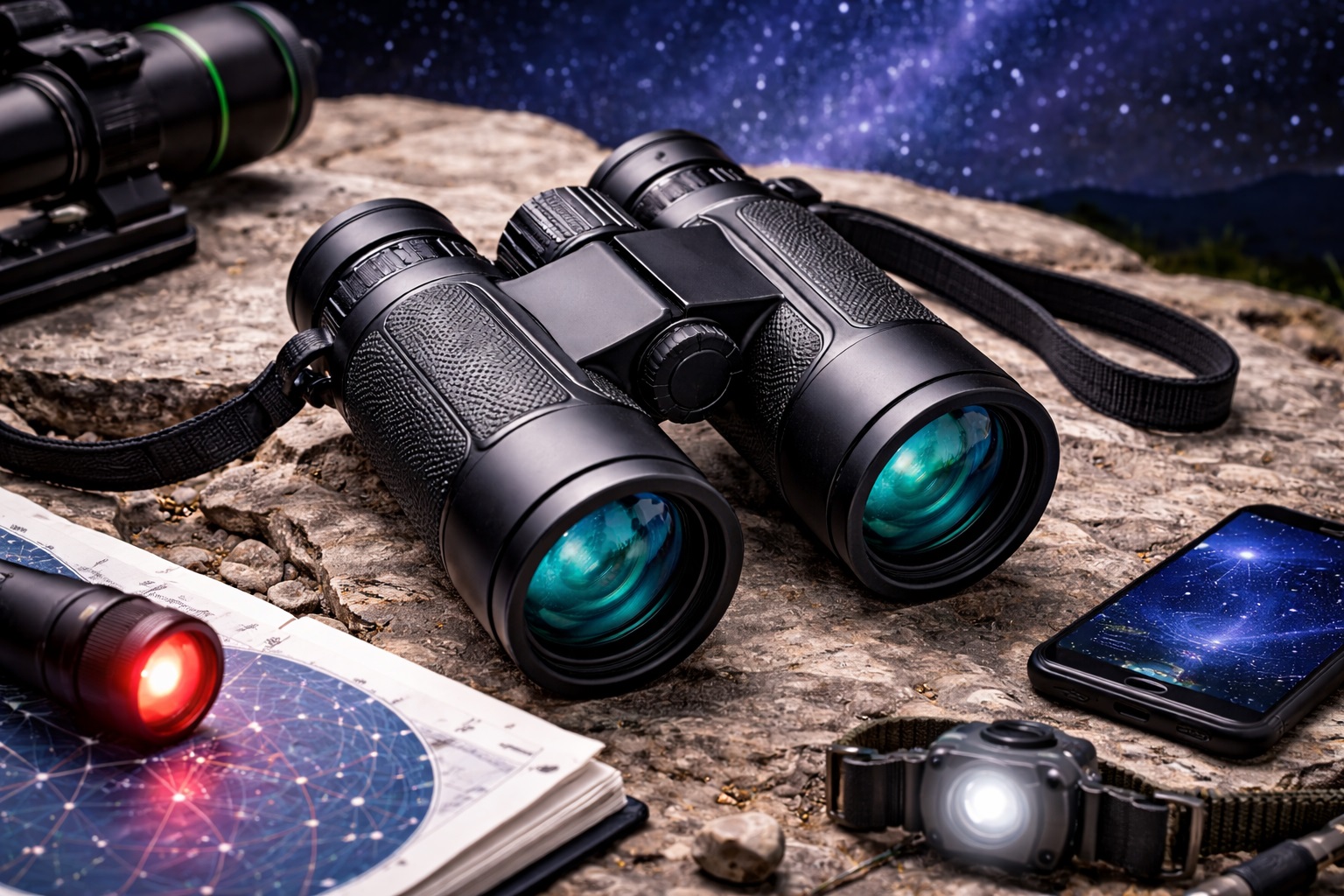
Best Binoculars for Stargazing in 2026
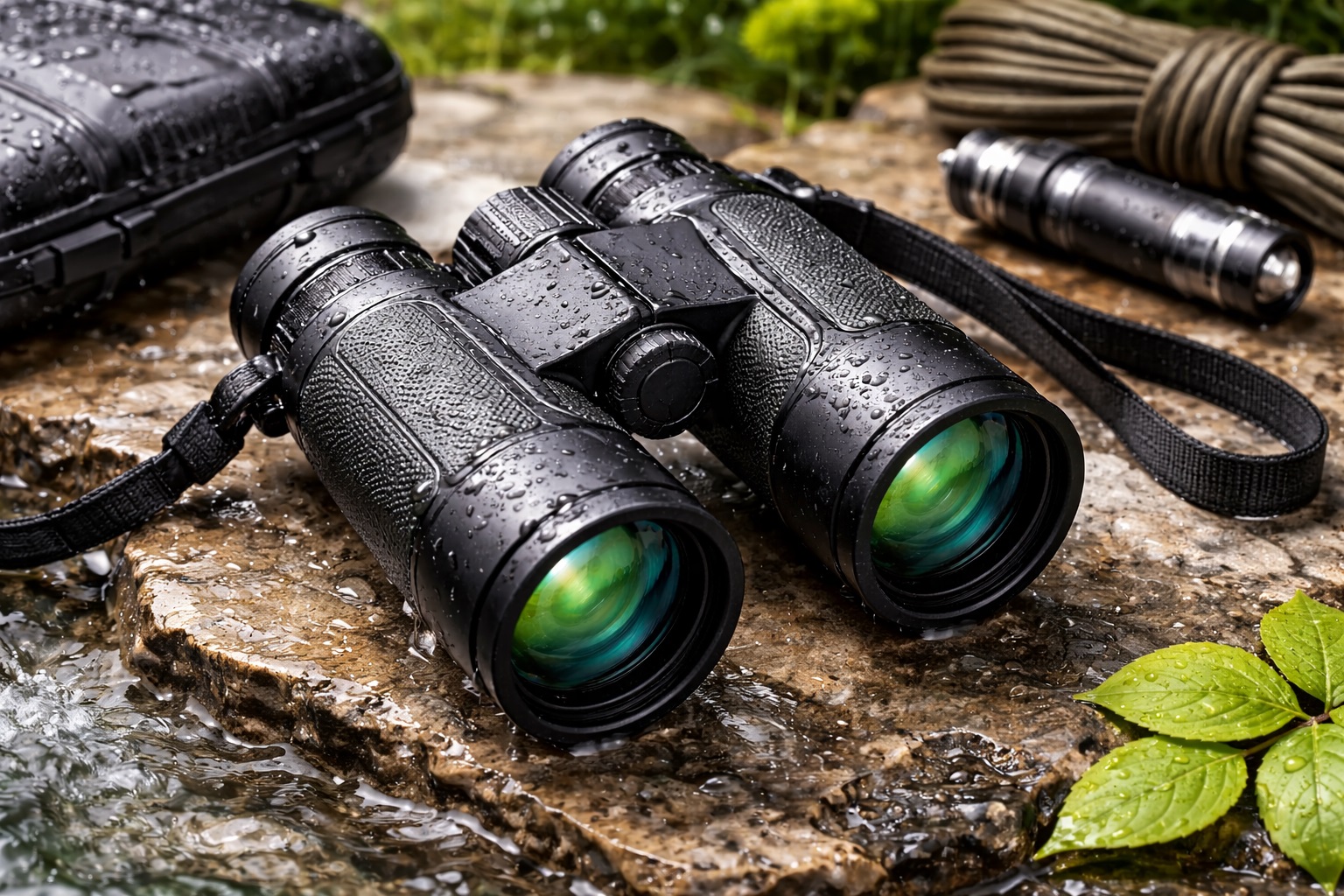
A telescope is not always the most practical way to start exploring the night sky. A good pair of binoculars built for astronomy offers a wide field of view, quick setup, and enough light-gathering power to reveal star clusters, the moons of Jupiter, and the texture of the Milky Way, all without the cost or bulk of a full telescope rig. For many newcomers, a good binocular is also a more forgiving way to learn the night sky, since the wide, upright, correctly oriented view makes star-hopping between landmarks far more intuitive than through a telescope eyepiece. This guide compares eight well-regarded binocular models suited to stargazing, weighing aperture size, glass quality, and how comfortably each one performs during long sessions under a dark sky, since even the sharpest optic will see little use if it proves too heavy or awkward to hold up for more than a few minutes at a time.
Stargazing places a different set of demands on an optic than daytime observation. Because you are gathering as much dim light as possible from distant objects, aperture size and coating quality tend to matter more than they do for general-purpose binoculars, while portability and price still play a meaningful role for most casual and intermediate astronomy enthusiasts. Understanding this tradeoff early on will save you from buying an optic that looks impressive on a spec sheet but proves impractical for how you actually plan to use it.
Many committed amateur astronomers, in fact, keep both a large-aperture pair for dedicated deep-sky sessions and a lighter, general-purpose pair for spontaneous evenings, using each for the situation it suits best.
The models below span a wide range, from large-aperture optics purpose-built for astronomy to lighter, more general-purpose binoculars that still perform admirably once the sun goes down. Whichever category fits your budget and habits, understanding what actually drives low-light performance will help you choose with confidence, rather than relying on magnification alone, which is a common and costly mistake for newcomers to binocular astronomy, who sometimes assume a higher magnification number automatically means a better view, when in practice it often makes the image harder to hold steady and narrower to boot.
Top 8 Best binoculars Picks (Detailed Reviews)
1. Bushnell Engage DX – Best For All-Around Night Sky Use
The Bushnell Engage DX brings fully multi-coated optics and a sealed, waterproof housing to casual stargazing, making it a reasonable all-around pick for anyone who wants to combine general outdoor use with the occasional night under the stars. At around $220, it offers dependable image quality without the bulk of dedicated astronomy binoculars, though its more modest aperture means it excels more at bright objects like the moon and planets than faint deep-sky targets, which is a completely reasonable limitation given how many other daytime uses it also handles well.
- Pros:
- Fully multi-coated optics deliver reasonably bright, clear night views
- Fully sealed, waterproof housing tolerates cold, dewy night air
- Premium build quality from a reputable, versatile brand
- Cons:
- Smaller aperture than dedicated astronomy binoculars
- Limited color options compared to some rivals
Best For: Casual stargazers who want one versatile optic for both daytime use and occasional night sky viewing.
Why We Recommend It: Its all-weather sealing and solid glass make it a sensible dual-purpose choice rather than a single-use astronomy tool.
Owners who already use this model for hiking or birding often find it a natural second use for spontaneous stargazing sessions, without needing to invest in a dedicated second optic just for the night sky. That kind of everyday versatility is a meaningful advantage for anyone not yet ready to commit to specialized astronomy gear.
2. Nikon Monarch M7 – Best For Sharp Lunar and Planetary Views
The Nikon Monarch M7 uses ED glass and dielectric high-reflective prism coatings to deliver sharp, high-contrast images, which translates well to crisp views of the moon's craters and terminator line, the boundary between the illuminated and shadowed portions of the lunar surface where shadows fall longest and detail stands out most clearly. At approximately $480, it is a strong mid-to-upper-tier pick for stargazers who split their time between bright targets like the moon and planets and general nighttime observation.
- Pros:
- ED glass and dielectric coatings produce sharp, high-contrast lunar detail
- Lightweight body makes extended handheld night viewing more comfortable
- Premium build quality from a well-established, reputable brand
- Cons:
- Aperture is more modest than dedicated large-objective astronomy binoculars
- Limited color options relative to some competing lines
Best For: Stargazers who prioritize sharpness on the moon and planets over raw light-gathering for faint deep-sky objects.
Why We Recommend It: The combination of ED glass and a comfortable, lightweight body makes extended lunar observation genuinely enjoyable rather than fatiguing.
Because it is light enough for extended handheld sessions, many owners use it for impromptu viewing sessions that a bulkier, tripod-dependent astronomy binocular would discourage. Keeping a lightweight optic within easy reach means you are far more likely to actually step outside on a clear, unplanned evening.
3. Swarovski EL 42 – Best For Premium Night Sky Clarity
The Swarovski EL 42 applies its SWAROVISION field-flattener technology to deliver edge-to-edge sharpness across a wide field of view, which is a genuine advantage when scanning star fields for clusters and asterisms, since distortion toward the edge of a lesser optic's field of view can make faint stars appear smeared or elongated. At around $2,500, it is the aspirational pick on this list, aimed at enthusiasts who want the best possible glass for both daytime and nighttime use.
- Pros:
- SWAROVISION field-flattener technology delivers sharp stars edge-to-edge
- Exceptional, premium build quality from a top-tier optics brand
- Wide field of view suited to scanning star fields and constellations
- Cons:
- Significantly higher price point than every other model on this list
- Aperture still more modest than large dedicated astronomy binoculars
Best For: Serious enthusiasts who want the sharpest possible star field views and are prepared to invest accordingly.
Why We Recommend It: Few optics render pinpoint stars as cleanly across the entire field of view, which is a real difference for critical stargazing use.
Owners who already appreciate fine daytime optical detail tend to be the ones most rewarded by this model's night-sky performance, since the same field-flattening technology benefits both use cases equally. Enthusiasts who already own premium daytime optics from this brand often find the transition to night-sky use immediately familiar and rewarding.
4. Zeiss Terra ED – Best For Portable Night Sky Sessions
The Zeiss Terra ED pairs Schott ED glass with a compact, rubber-armored body, making it easy to grab for a spontaneous stargazing session without setting up a tripod or dedicated astronomy gear, which lowers the barrier to actually going outside on a whim when the sky happens to be clear. At around $500, it delivers respected Zeiss clarity in a genuinely portable package, though its modest aperture limits how much extremely faint detail it can reveal compared to larger astronomy-specific binoculars.
- Pros:
- Schott ED glass provides crisp, color-accurate star and lunar views
- Compact, lightweight design encourages spontaneous night sky use
- Premium build quality from a globally reputable optics brand
- Cons:
- Smaller aperture than dedicated astronomy binoculars
- Limited color options relative to some rival models
Best For: Stargazers who want a grab-and-go optic for quick sessions without hauling out dedicated astronomy gear.
Why We Recommend It: Its portability means it actually gets used on a clear night, rather than staying packed away because setup feels like too much effort.
Because it fits easily in a jacket pocket, this model tends to accompany owners on camping trips and travel far more often than bulkier astronomy-specific binoculars would. That habit of frequent, casual use often does more for developing genuine stargazing skill than owning a larger but rarely used instrument.
5. Vortex Diamondback HD – Best For Value-Driven Astronomy Use
The Vortex Diamondback HD combines HD extra-low dispersion glass and phase-correction coatings with a fully sealed, waterproof, fogproof body, all backed by Vortex's unconditional lifetime warranty, a detail that carries extra weight for an optic likely to spend many cold, damp nights outdoors over the years. At roughly $230, it offers strong optical value for stargazers who want dependable performance without paying for large-aperture, dedicated astronomy glass.
- Pros:
- HD glass and phase-correction coatings improve contrast on stars and planets
- Fully sealed, waterproof, and fogproof for cold, dewy night sessions
- Backed by an unconditional lifetime warranty from a reputable brand
- Cons:
- Aperture more modest than large dedicated astronomy binoculars
- Limited color options compared to some competitors
Best For: Budget-conscious stargazers who still want dependable optical performance and a strong warranty.
Why We Recommend It: The lifetime warranty and sealed housing make this a low-risk, practical entry point into casual astronomy use.
Its moderate weight also makes it comfortable to hold for the extended, motionless periods that stargazing often demands, without the strain of a bulkier optic, which matters considerably during a slow, patient session spent locating faint clusters or tracing constellation patterns.
6. Steiner Safari UltraSharp – Best For Quick Celestial Spotting
Steiner's Safari UltraSharp uses an auto-focus system that keeps objects reasonably sharp across a range of distances, which can be convenient for quickly locating and sharing a view of a bright celestial object like the moon with family or friends, since new users do not need any instruction on manual focus technique before getting a usable view. Its compact design and roughly $300 price point make it an approachable option for casual stargazers who prioritize convenience.
- Pros:
- Auto-focus system simplifies quickly locating bright celestial objects
- Compact, rugged design suited to casual outdoor night use
- Premium build quality from a reputable, outdoor-focused brand
- Cons:
- Auto-focus offers less fine control than manual focus for faint objects
- Limited color options compared to some competitors
Best For: Casual stargazers and families who want quick, low-effort views of the moon and bright planets.
Why We Recommend It: The auto-focus system lowers the barrier to entry for newcomers who are not yet comfortable fine-tuning manual focus in the dark.
That said, dedicated astronomy enthusiasts chasing faint deep-sky objects will likely prefer a model with full manual focus control for the fine adjustments critical detail requires, since auto-focus systems are generally optimized for convenience rather than the pinpoint precision serious astronomy work demands.
7. Leupold BX-4 Pro Guide HD – Best For Twilight and Dusk Astronomy
The Leupold BX-4 Pro Guide HD is built around Leupold's Twilight Max HD light-management system, which extends useful brightness into the low-light hours just after sunset, a useful window for observing bright planets before full darkness sets in, when Venus and Jupiter in particular are often visible well before the faintest stars emerge. At around $600, it is a strong upper-tier pick for stargazers who also value its sealed, argon-purged construction for extended cold-weather sessions.
- Pros:
- Twilight Max HD system extends useful brightness into dusk hours
- Argon-purged, fully sealed housing resists fog and cold-weather condensation
- Premium build quality backed by a reputable, established brand
- Cons:
- Higher price point than several competitors on this list
- Aperture more modest than large dedicated astronomy binoculars
Best For: Stargazers who often begin observing during dusk twilight before full darkness arrives.
Why We Recommend It: Few optics in this price range extend usable brightness as effectively into the transitional light of early evening.
The sealed, purged housing also means condensation from cold, dewy night air will not compromise the view during a long observation session, which is especially valuable once you have spent time letting your eyes adapt to the dark and do not want a fogged lens to interrupt that adaptation.
8. Celestron SkyMaster – Best For Deep-Sky and Wide-Field Astronomy
Celestron's SkyMaster is purpose-built for astronomy, using a large aperture to gather significantly more light than general-purpose binoculars, revealing star clusters, nebulae, and the texture of the Milky Way that smaller optics simply cannot show, a difference that becomes dramatic once you compare the same patch of sky through a smaller aperture side by side. At around $100, it is a remarkably affordable entry point into serious light-gathering performance, though its size and weight typically call for a tripod during extended sessions.
- Pros:
- Large aperture gathers significantly more light for faint deep-sky objects
- Very affordable way to add serious astronomy performance to a kit
- Reputable brand with a long track record in astronomy optics
- Cons:
- Bulkier and heavier than general-purpose binoculars, often requiring a tripod
- Limited color options and a more basic exterior finish
Best For: Dedicated stargazers who want maximum light-gathering ability for faint deep-sky targets.
Why We Recommend It: Few binoculars at this price deliver as much aperture and light-gathering capability for genuine deep-sky observation.
Pairing this model with even a basic tripod adapter dramatically improves the experience, since the added stability lets you actually resolve the faint detail the large aperture is capable of gathering. Without stabilization, much of that theoretical light-gathering advantage is wasted on a shaky, hard-to-focus image.
Buying Guide: How to Choose the Best Binoculars for Stargazing
Whether you are picking your very first pair or upgrading toward a more serious astronomy setup, the same handful of principles apply. Understanding them will help you evaluate any binocular model against your specific stargazing goals, not just the eight covered above.
Astronomy binoculars are judged by a different set of priorities than general-purpose optics, with light-gathering ability and image sharpness typically outweighing size and weight. The sections below cover what actually matters when choosing a pair for the night sky.
1. Aperture Size and Light-Gathering Power
Larger objective lenses gather significantly more light, which is essential for revealing faint stars, clusters, and deep-sky objects. This is generally the single most important spec for dedicated astronomy use, more so than for daytime binoculars, where a smaller aperture is far less of a limiting factor thanks to abundant ambient light. As a rough guideline, models in the 50mm objective range are often considered a practical sweet spot between light-gathering power and reasonable weight for handheld or lightly supported use.
2. Magnification Tradeoffs for Astronomy
Higher magnification reveals more detail but narrows the field of view and amplifies hand shake, which matters enormously when observing faint, dim objects, since a shaking image makes it nearly impossible to distinguish a genuine faint star from noise in your own vision. Many astronomy binoculars intentionally use moderate magnification paired with a large aperture, favoring a bright, steady, wide view over the narrower, dimmer image higher magnification would produce.
3. Exit Pupil and Night Vision
The exit pupil, calculated by dividing objective lens diameter by magnification, determines how bright an image appears to your eye in the dark. A larger exit pupil generally produces a brighter view under night sky conditions, though the eye's own pupil size, which naturally shrinks with age, also affects how much of that light is actually usable. This is one reason two people of different ages can perceive noticeably different brightness through the exact same pair of binoculars.
4. Lens Coatings for Astronomy
Fully multi-coated optics and high-quality prism coatings reduce light loss at every glass surface, which directly impacts how much of the light your aperture gathers actually reaches your eye. Cheaper optics with basic coatings can lose a surprising percentage of light before it ever reaches your retina, which is why two binoculars with identical aperture specifications can still produce noticeably different brightness in practice.
5. Tripod Compatibility for Larger Binoculars
Large-aperture astronomy binoculars are often too heavy to hold steady by hand for extended periods. A threaded tripod adapter socket is nearly essential for comfortable, fatigue-free deep-sky observation, and a simple adapter bracket is an inexpensive addition if your chosen model does not include a socket. Even a modest photo tripod is often sufficient to transform a shaky, frustrating view into a genuinely steady one.
6. Weight and Handheld Comfort
Smaller, lighter binoculars are easier to hold steady without support, making them better suited to casual, spontaneous stargazing sessions than heavier dedicated astronomy models, which often require deliberate setup time that discourages quick, unplanned viewing, and that friction is often the real reason a larger, more capable optic ends up used less often than a simpler one.
7. Eye Relief for Cold-Weather Comfort
Stargazing often means bundling up in cold weather, sometimes with glasses on, so generous eye relief and twist-up eyecups help maintain a full field of view in these conditions, a detail that becomes especially noticeable during long winter observation sessions.
8. Field of View for Star Field Scanning
A wide field of view makes it easier to locate constellations and star clusters without repeatedly repositioning the binoculars, which is especially useful for beginners still learning the night sky, since a wider view makes it easier to star-hop from a known bright star toward a fainter target.
9. Waterproofing Against Dew
Cold night air often produces heavy dew, and a sealed, fogproof housing prevents this moisture from compromising your view partway through an observation session, which can otherwise force an early end to an evening of stargazing.
10. Color Correction and Chromatic Aberration
Extra-low dispersion glass reduces chromatic aberration, the colored fringing that can appear around bright objects like the moon, resulting in a cleaner, more accurate view, which is particularly noticeable when observing the bright limb of the moon against a dark sky.
11. Budget vs. Frequency of Stargazing
Casual stargazers who observe occasionally may get excellent value from a smaller, general-purpose binocular, while dedicated enthusiasts observing regularly often justify investing in dedicated large-aperture astronomy glass, since the improved light-gathering ability compounds in value across dozens of nights under the stars, particularly for enthusiasts who track variable stars or search for faint comets as an ongoing hobby.
12. Portability for Dark-Sky Travel
Traveling to a genuinely dark-sky location often reveals far more detail than observing from a light-polluted backyard, so portability matters if you plan to travel for the best viewing conditions, particularly if your trip involves hiking or limited luggage space.
13. Warranty and Long-Term Value
A strong warranty matters for astronomy binoculars just as it does for any other optic, particularly for models used outdoors in cold, damp night conditions over many years, since repeated exposure to temperature swings and moisture gradually tests any optic's seals and coatings. A model with a strong track record of reliability among long-time owners is often a safer bet than one backed only by an impressive spec sheet.
Frequently Asked Questions
Below are the questions newcomers to binocular astronomy most often ask, covering everything from basic terminology to practical advice for your first night under a dark sky.
What is the best magnification for stargazing binoculars?
Many astronomy enthusiasts favor magnifications between 7x and 10x, since higher magnifications amplify hand shake and narrow the field of view, making it harder to locate objects without support.
Do I need a tripod for stargazing binoculars?
Larger, heavier astronomy binoculars generally benefit significantly from a tripod, while smaller, lighter models can often be used comfortably handheld for shorter sessions.
What does aperture mean for binoculars used in astronomy?
Aperture refers to the diameter of the objective lens, and a larger aperture gathers more light, which is essential for viewing faint stars and deep-sky objects.
Can regular binoculars be used for stargazing?
Yes, general-purpose binoculars can reveal the moon, bright planets, and some star clusters, though dedicated large-aperture astronomy binoculars will show significantly more faint detail.
What can I actually see through binoculars at night?
Depending on aperture and sky darkness, binoculars can reveal lunar craters, the four largest moons of Jupiter, star clusters, and the general texture of the Milky Way.
Are waterproof binoculars important for stargazing?
Yes, since cold night air frequently produces heavy dew, a sealed, fogproof design helps prevent moisture from compromising your view during an extended session.
How do I reduce hand shake when stargazing with binoculars?
Bracing your arms against a solid surface, using a tripod adapter, or choosing a lower magnification are all effective ways to reduce hand shake during observation.
What is exit pupil and why does it matter for astronomy?
Exit pupil is the diameter of the light beam exiting the eyepiece, calculated by dividing objective lens size by magnification, and a larger exit pupil generally produces a brighter image in dark conditions.
Do I need to travel to a dark-sky location for good binocular stargazing?
While binoculars work anywhere, traveling away from city light pollution dramatically improves visibility of faint stars, clusters, and the Milky Way.
How much should I spend on stargazing binoculars?
Solid options exist from around $100 for large-aperture, dedicated astronomy models to several hundred dollars or more for premium general-purpose glass with excellent low-light performance.
Can children use binoculars for stargazing?
Yes, lighter, auto-focus models are often easier for children to use, though supervision is recommended when using any optic outdoors at night. Choosing a lighter model with a comfortable strap also helps younger stargazers hold the view steady long enough to actually enjoy it.
Do I need image-stabilized binoculars for astronomy?
Image-stabilized binoculars can help at higher magnifications, though many astronomy enthusiasts achieve steady views with a standard tripod adapter instead. A tripod is also generally more affordable and versatile, since it can be reused across multiple optics rather than being built into a single pair.
How do I clean binoculars after a dewy night session?
Let the optic reach room temperature before wiping down, then use a proper lens cloth or brush on the glass surfaces, avoiding harsh chemicals on any coated lens.
Final Verdict
- Top Pick: Celestron SkyMaster for its unmatched light-gathering aperture at a genuinely affordable price.
- Budget Choice: Vortex Diamondback HD for dependable, sealed performance backed by a lifetime warranty.
- Premium Choice: Swarovski EL 42 for enthusiasts who want the sharpest possible star field views.
Choosing the right stargazing binocular ultimately comes down to how seriously you plan to pursue astronomy and how much light-gathering power you actually need. Casual stargazers who mostly want to enjoy the moon and bright planets on clear nights will do perfectly well with a lighter, more general-purpose optic, while dedicated enthusiasts chasing faint deep-sky objects should prioritize aperture above nearly everything else. Consider, too, how your interest might grow over time; many stargazers start with a modest, versatile pair and later add a larger, dedicated astronomy binocular once they have a clearer sense of how often they actually get outside on clear nights. Whichever path fits your interests, a dark, clear sky away from city lights will always matter more than any single spec on this list.