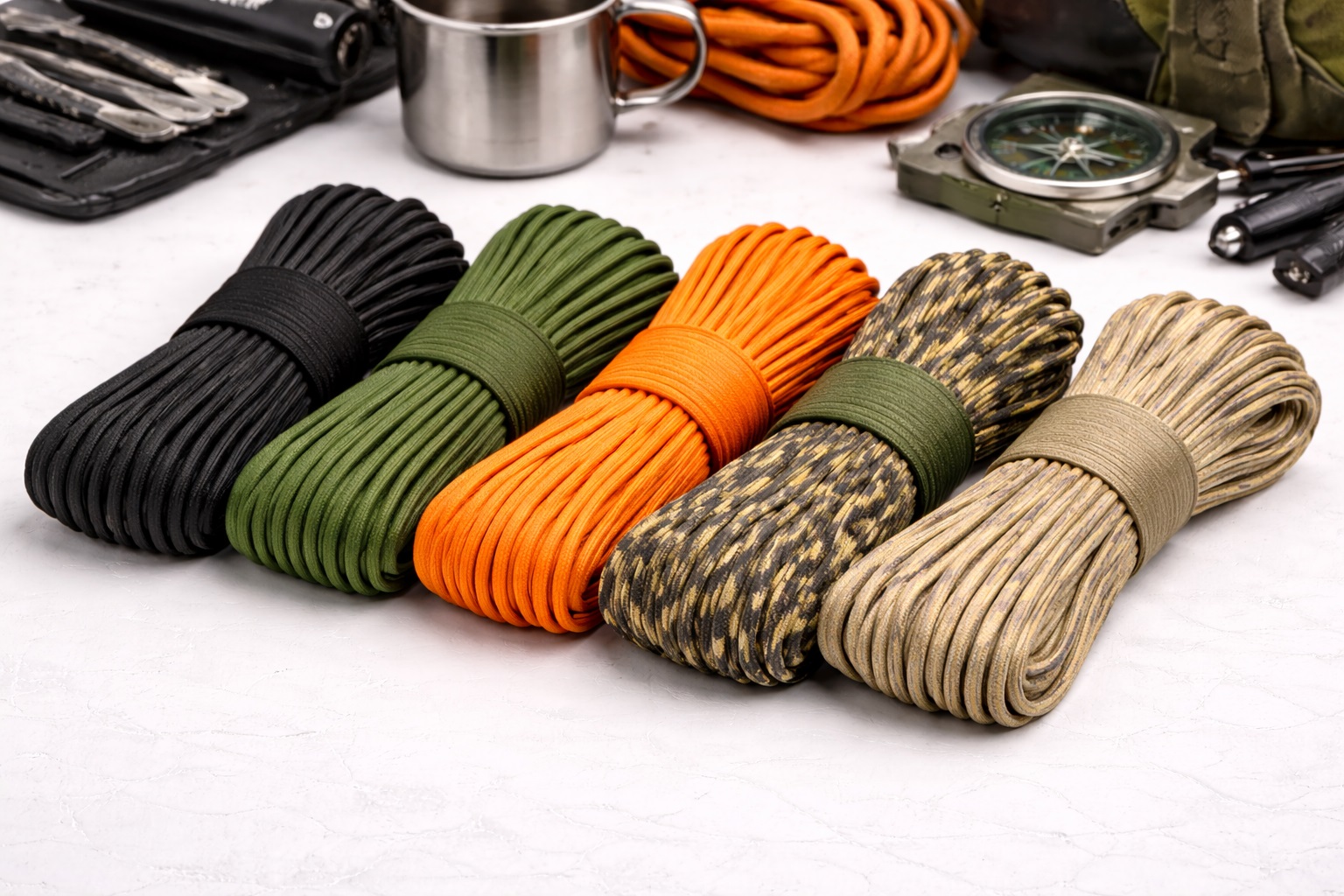
Best Budget Paracord in 2026
Paracord is one of the cheapest ways to add real utility to a camping kit, tool bag, or emergency supply box, but affordable does not have to mean unreliable. A well-made low-cost spool can handle tarp lines, gear repairs, and everyday knot-tying just as well as a premium option, as long as you know what to look for beyond the price tag on the shelf.
This guide rounds up the best budget paracord options available in 2026, focused on getting the most usable cord for your money without sacrificing basic construction quality. Each pick below balances low per-foot cost against strand count, brand reputation, and everyday handling, so you can stock up with confidence rather than gambling on unmarked bulk cord of unknown origin.
Value in paracord comes down to more than just the sticker price. A spool that costs a little more per foot but holds up to years of repeated use is often the better deal over time compared to the cheapest option that frays or weakens after a season. The picks and buying guide below are built around that distinction, helping you find genuinely affordable cord rather than cord that is simply cheap. It also helps to think about how paracord actually fails in the field: not usually through a sudden snap under load, but through slow fraying at the sheath, gradual weakening from repeated sun exposure, or a low-quality core that was never as strong as advertised in the first place. Keeping these failure modes in mind while comparing budget listings will steer you toward cord that holds up rather than cord that merely looks acceptable in a product photo.
Top 8 Budget Paracords in 2026 (Detailed Reviews)
1. Golberg 550 Paracord – Best For Overall Budget Value
Golberg 550 Paracord leads this list because it delivers the lowest price per foot of any option here, at around $7, while still offering solid general-purpose construction that holds up to everyday camp and household tasks. It is commonly sold in bulk spools, which makes it a natural first choice for anyone who wants a large amount of usable cord on hand without spending much to get there. For repairs, clotheslines, gear lashing, and other routine chores, it covers the basics without any unnecessary extras driving up the cost. Because the per-foot price is so low, buyers often purchase far more than a single project requires, keeping a reserve on hand at home, in a vehicle, and in a camping bag without feeling like they overspent on any one of them.
- Pros:
- Lowest price point among comparable bulk paracord
- Good option for high-volume, everyday use
- Straightforward general-purpose construction
- Cons:
- Fewer premium features than specialty cords
- Limited color and pattern selection
Best For: Budget-focused buyers who want the most usable cord for the least money without worrying about extra features.
Why We Recommend It: It offers dependable everyday performance at the lowest entry price on this list, making it the easiest starting point for anyone building a budget-conscious kit.
2. Paracord Planet 550 – Best For Colorful Budget Picks
Paracord Planet 550 keeps the price low, at roughly $8, while offering a noticeably wider range of colors and patterns than most other budget options. That variety matters more than it might seem, since color-coding cord by task makes it faster to grab the right length at camp or in a garage full of mixed gear. It remains an affordable choice even with the added color selection, so you are not paying a significant premium just for variety. Buyers who like to color-code cord by purpose, such as one shade for food-related tasks and another for repairs, tend to gravitate toward this option specifically because it makes that kind of organization easy without a big jump in price.
- Pros:
- Wide color and pattern selection at a low price
- Budget-friendly overall cost
- Long-standing, reliable catalog brand
- Cons:
- Standard strength rating without extra reinforcement
- Availability of specific colors can vary by length
Best For: Buyers who want an affordable cord but still care about color options for organization or appearance.
Why We Recommend It: It proves that budget paracord does not have to be visually plain, adding real organizational value without pushing the price much higher.
3. Atwood Rope MFG – Best For Trusted Mid-Range Quality
Atwood Rope MFG sits a little higher on the price scale, at around $12, but it remains a reasonable budget-conscious pick for buyers who want documented Made in USA manufacturing without stepping up to true premium pricing. Many buyers treat it as the point where spending a bit more clearly pays off in consistency and handling, without crossing into specialty survival-cord territory. It also tends to feel noticeably smoother in the hand during repeated knot-tying, which matters if you plan to set up and take down a shelter or gear lashing multiple times over a single trip.
- Pros:
- Consistent Made in USA manufacturing
- Comfortable, predictable handling for repeated knot-tying
- Backed by a well-established rope brand
- Cons:
- Priced higher than the cheapest bulk options
- Standard color selection
Best For: Budget shoppers willing to spend a little more for verified manufacturing quality and consistent handling.
Why We Recommend It: It offers a clear step up in consistency for a modest price increase, appealing to buyers who want reassurance without paying survival-cord prices.
4. West Coast Paracord – Best For Frequent Use on a Budget
West Coast Paracord uses commercial grade nylon and is priced around $11, making it a solid middle-ground option for anyone who plans to use their cord often rather than occasionally. Commercial grade construction tends to hold up well across repeated seasonal use, which matters for buyers who want their budget cord to actually last rather than needing frequent replacement. Its consistent quality across production runs also means a spool bought today should perform similarly to one bought a year later, which is not always true of lesser-known budget brands.
- Pros:
- Commercial grade nylon construction
- Reasonable mid-range pricing
- Consistent quality across production runs
- Cons:
- No certification paperwork like mil-spec options
- Limited specialty color runs
Best For: Frequent users who want budget-friendly cord that still holds up to repeated wear over time.
Why We Recommend It: Commercial-grade materials give it staying power that some cheaper cords lack, which is valuable for anyone using paracord regularly rather than occasionally.
5. Rothco 550 Paracord – Best For Tactical Style at Low Cost
Rothco 550 Paracord brings a long history of supplying tactical and military-style gear to a budget-friendly price point of around $10. Its 7-strand core construction delivers consistent performance, and the tactical-style color options appeal to buyers who already favor that aesthetic in the rest of their gear without wanting to pay tactical-brand prices. Since the brand has supplied surplus and outdoor gear for decades, its cord is also widely stocked and easy to reorder, which is convenient for buyers who like sticking with one trusted source for restocking their kit.
- Pros:
- 7-strand core construction for consistent strength
- Affordable, budget-friendly pricing
- Recognizable, established tactical gear brand
- Cons:
- Color options lean toward military-style patterns
- No specialty internal-strand features
Best For: Buyers who want tactical-style cord to match the rest of their gear without paying a premium.
Why We Recommend It: It combines a trusted tactical gear heritage with genuinely affordable pricing, which is a rare combination in this category.
6. Titan SurvivorCord – Best For Budget-Minded Survival Prep
Titan SurvivorCord costs more than the other options here, at around $20, because it builds additional emergency-use materials, including integrated fishing line and wire, directly into its core strands. It is included on this budget list because, relative to buying a separate fishing kit and wire on top of standard cord, it can actually work out to reasonable value for anyone who wants built-in emergency capability without assembling multiple separate items.
- Pros:
- Integrated fishing line and wire add emergency capability
- Consolidates multiple tools into one spool
- Strong build quality from a well-regarded brand
- Cons:
- Highest price point on this list
- Extra internal strands only add value if you actually use them
Best For: Budget-conscious buyers who still want built-in emergency features rather than assembling separate survival tools. Buyers who set aside even a short length of this cord specifically for emergencies often find it reassuring to know that fishing line and wire are already on hand without needing to pack anything extra.
Why We Recommend It: When you factor in what it would cost to buy fishing line, wire, and cord separately, the combined value looks more reasonable than the sticker price suggests on its own.
7. Bored Paracord 550 – Best For Certified Quality at a Fair Price
Bored Paracord 550 is mil-spec certified and priced at around $9, which is a compelling combination for budget shoppers who still want documented proof of quality rather than just a strength number on the label. Certification at this price point is relatively uncommon, making it a strong choice for anyone who has been burned by mislabeled cord before.
- Pros:
- Mil-spec certified construction
- Competitive, budget-friendly pricing
- Reputable brand within the paracord community
- Cons:
- Fewer novelty color patterns than hobby-focused brands
- No added internal-strand features beyond standard construction
Best For: Buyers who want documented mil-spec quality assurance without paying a significant premium for it.
Why We Recommend It: Certified construction at a below-average price is hard to find, and it removes much of the guesswork from buying bulk cord. For buyers who have previously purchased unmarked cord that turned out to be thinner or weaker than expected, this certification offers a documented baseline they can trust without needing to inspect every spool themselves.
8. TOUGH-GRID 750lb – Best For Stepping Up Without Overspending
TOUGH-GRID 750lb costs around $15, more than most of the other picks here, but it delivers a meaningfully higher strength rating in exchange. For budget shoppers who want extra strength margin for occasional heavier tasks, this is a reasonable place to spend a bit more without jumping all the way to specialty survival cord pricing.
- Pros:
- Extra strength rating beyond standard 550 cord
- Reassuring safety margin for occasional heavier tasks
- Reputable brand with a strong following
- Cons:
- Highest price point among the more budget-oriented picks
- Bulkier profile than lighter cords
Best For: Buyers who want extra strength margin and are willing to spend a little more than the cheapest options to get it.
Why We Recommend It: It offers a meaningful upgrade in strength rating without straying into premium survival-cord pricing, making it a sensible step up for occasional heavy-duty tasks. Keeping one length of this cord alongside a larger supply of standard-rated cord is a practical way to cover the rare situation that calls for extra strength without upgrading your entire supply.
Buying Guide: How to Choose the Best Budget Paracord
Buying paracord on a budget does not mean ignoring quality altogether. The following factors will help you separate genuinely good value from cord that is simply the cheapest option on the shelf.
1. Compare Price Per Foot, Not Just Spool Price
A larger spool at a higher total price can still be the better deal if the price per foot is lower than a smaller, cheaper-looking option. Always calculate cost per foot before assuming one listing is more affordable than another. Retailers often list total spool price prominently while burying the per-foot figure in fine print, so taking thirty seconds to do the math yourself can save real money over a large purchase.
2. Check the Core Strand Count
Genuine 550 paracord typically has seven inner strands wrapped in a woven nylon sheath. Some of the cheapest cord on the market cuts corners here, which reduces both strength and durability, so confirm strand count before buying based on price alone. Comparing the listed diameter against a known genuine spool is a quick way to sanity-check a suspiciously cheap listing before committing to a large order.
3. Look for Mil-Spec Certification When Possible
Certified cord offers documented proof of construction quality, and a few budget options on this list include that certification at a reasonable price. When two spools are priced similarly, certification is a useful tiebreaker. It is one of the few quality signals that does not rely on trusting marketing copy, since it points to a specific, documented manufacturing standard rather than a vague claim of durability.
4. Buy in Bulk to Lower Per-Foot Cost
Bulk spools almost always work out cheaper per foot than small pre-cut lengths. If you expect to use paracord regularly across multiple projects or seasons, buying more upfront is usually the more economical choice. It also means you are less likely to run short mid-project, which avoids the extra cost and delay of a rushed second order.
5. Avoid Unmarked or Vague Listings
Listings that do not specify strand count, material, or strength rating are a common source of disappointing budget cord. Favor listings that clearly state these details, even if the price is slightly higher than an unmarked alternative. A listing that only says paracord without further detail should generally be treated with more caution than one that spells out its construction clearly.
6. Consider Brand Reputation Over Lowest Price Alone
An established paracord brand with a track record of consistent manufacturing is generally a safer bet than an unfamiliar brand offering a slightly lower price. The savings from an unreliable spool rarely outweigh the frustration of cord that fails when you need it. Sticking with a small handful of established brands across your purchases also makes it easier to know what to expect each time you reorder.
7. Match Strength Rating to Actual Use
Standard 550-rated cord covers the vast majority of everyday and camping tasks, so there is rarely a need to pay more for a higher rating unless you have a specific heavy-duty use in mind. Overspending on strength you do not need is one of the easiest ways to blow a paracord budget. Save the higher-rated cord for the specific tasks that call for it, and let standard 550 cord handle everything else.
8. Skip Specialty Features You Will Not Use
Built-in fishing line, wire, or other survival features add cost and are only worth paying for if you genuinely plan to use them. For everyday tasks, standard construction is usually the more budget-friendly choice. Think honestly about whether you would actually deploy a built-in fishing line or wire before paying extra for it, since these features add cost whether or not you ever use them.
9. Check Color Availability at Your Price Point
Some budget brands offer surprisingly wide color selections without a significant price increase, while others charge more for anything beyond basic black or olive drab. Compare a few listings if color matters to you before settling on the cheapest option. Reading a few product photos closely, rather than just the thumbnail, often reveals a broader color range than the main listing image suggests.
10. Factor In Shipping Costs on Bulk Orders
A cheap per-foot price can be offset by high shipping costs on heavy bulk spools, so always check the total order cost rather than comparing unit price alone. Bundling a paracord purchase with other gear from the same retailer can sometimes reduce this impact. It is also worth checking whether a local outdoor or hardware store carries the same brand, since picking it up in person avoids shipping costs entirely.
11. Read Reviews From Other Budget-Focused Buyers
Reviews that specifically mention long-term use, fraying, or color fading tend to be more useful than general star ratings when evaluating budget cord. Look for feedback from buyers who used the cord across multiple seasons rather than a single trip. Photos included in reviews, especially close-ups of the cord after months of use, can tell you more about real-world wear than the product description ever will.
12. Store Budget Cord Properly to Maximize Its Lifespan
Even inexpensive cord lasts longer when coiled loosely and stored somewhere dry and out of direct sunlight. Proper storage is a free way to get more value out of any budget paracord purchase. A loosely coiled length kept in a drawer or gear bin will outlast the same cord left balled up in a damp garage corner, regardless of how much it originally cost.
Frequently Asked Questions
Is cheap paracord actually reliable?
It can be, as long as it has an honest strand count and strength rating rather than being an unmarked imitation. Sticking to established brands, even at the lower end of their pricing, generally gets you reliable everyday cord. The biggest risk comes from completely unbranded listings with no strand count listed at all, which are worth avoiding regardless of how low the price looks.
What is the cheapest way to buy paracord?
Bulk spools almost always offer the lowest price per foot compared to shorter pre-cut lengths. Buying more than you think you need upfront is usually more economical over time than repeated smaller purchases. Splitting a large spool with a friend or family member who also uses paracord regularly is another practical way to bring the effective cost down further.
Does budget paracord break more easily than premium cord?
Not necessarily, as long as it meets a genuine 550-pound rating with proper strand construction. The biggest risk with budget cord is unmarked or mislabeled products rather than the price itself. A genuinely constructed 550-rated cord from a low-cost brand can perform very similarly to a pricier option for everyday, non-critical tasks.
How can I tell if cheap paracord is good quality?
Check for a clearly stated strand count and strength rating, compare the diameter and weight against a known-good spool, and favor brands with an established reputation rather than unfamiliar sellers with vague descriptions. It also helps to feel the cord in person when possible, since genuine construction tends to have a consistent, slightly springy feel that thin imitation cord usually lacks.
Is it worth paying extra for mil-spec certification on a budget?
If certified options are available near the same price as uncertified alternatives, it is generally worth choosing the certified spool for the added assurance, even on a tight budget. The price gap between certified and uncertified cord is often small enough that the certification effectively comes at little to no extra cost.
How much paracord should I buy if I am on a budget?
Buying a single larger bulk spool is usually cheaper per foot than several smaller lengths, so it often makes sense to buy more than your immediate project requires if you expect to use paracord again later. Storing the leftover length properly means it will still be usable whenever the next project comes up.
Can I use budget paracord for camping?
Yes, standard budget cord with an honest 550 rating is suitable for the great majority of camping tasks, including tarp setups, gear repairs, and general utility uses around a campsite. Save higher-rated or feature-added cord for specific situations, such as heavier loads or emergency preparedness, rather than assuming every camping task needs it.
Do budget paracord brands offer good color options?
Some do. A few brands on this list combine low prices with a wide range of colors, so it is worth comparing a couple of budget-friendly options before assuming you have to sacrifice appearance for price. Checking a brand's full catalog rather than just its top-listed product sometimes reveals additional colors at the same price point.
Is buying paracord in bulk risky if I do not use it all?
Paracord stores well for years when kept dry and out of direct sunlight, so leftover bulk cord is rarely wasted as long as you store it properly between uses. A dry closet, bin, or drawer away from direct sunlight is generally all it takes to keep a bulk spool usable for years.
What should I avoid when shopping for budget paracord?
Avoid listings that do not specify strand count, material, or strength rating, since these are the most common source of disappointing budget cord that looks fine on the shelf but underperforms in use. When in doubt, a slightly more expensive listing with clear specifications is almost always the safer purchase.
Are budget paracord brands as durable over multiple seasons?
Reputable budget brands with honest construction can last for years of seasonal use. Durability tends to depend more on proper storage and honest labeling than on price alone. A modestly priced spool from a brand with a track record often outlasts a more expensive option from an unfamiliar seller.
Should I buy the absolute cheapest paracord available?
Not always. The lowest listed price sometimes comes from unmarked or understrength cord, so it is usually smarter to choose the most affordable option from a reputable brand rather than the cheapest listing overall.
Final Verdict
- Top Pick: Golberg 550 Paracord for the best overall combination of low price and dependable everyday construction.
- Budget Choice: Paracord Planet 550 for buyers who want the lowest possible cost with added color variety.
- Premium Choice: TOUGH-GRID 750lb for anyone willing to spend a little more within a budget-conscious kit for extra strength margin.
Shopping for budget paracord rewards a little extra attention to strand count, certification, and brand reputation rather than simply picking the lowest number on the page. The options above show that affordable cord can still be dependable, and in several cases the most budget-friendly pick is also one of the most practical choices on the entire list. It is also worth remembering that price alone rarely tells the whole story: a spool listed a dollar or two cheaper than a comparable, better-documented option is not really a bargain if it turns out to be thinner, weaker, or missing key details about its construction.
If you are building out a kit from scratch, it often makes sense to buy one large bulk spool of a reliable low-cost cord for everyday tasks, then add a shorter length of a slightly more capable option, such as a certified or higher-rated cord, for situations where extra assurance matters. This layered approach keeps your overall spending low while still covering the occasional task that calls for something more than the bare minimum. Keep an eye on your existing supply over time as well; even the best budget cord benefits from an occasional check for fading, stiffness, or fraying, and replacing a worn length costs very little compared to discovering it has failed mid-task.