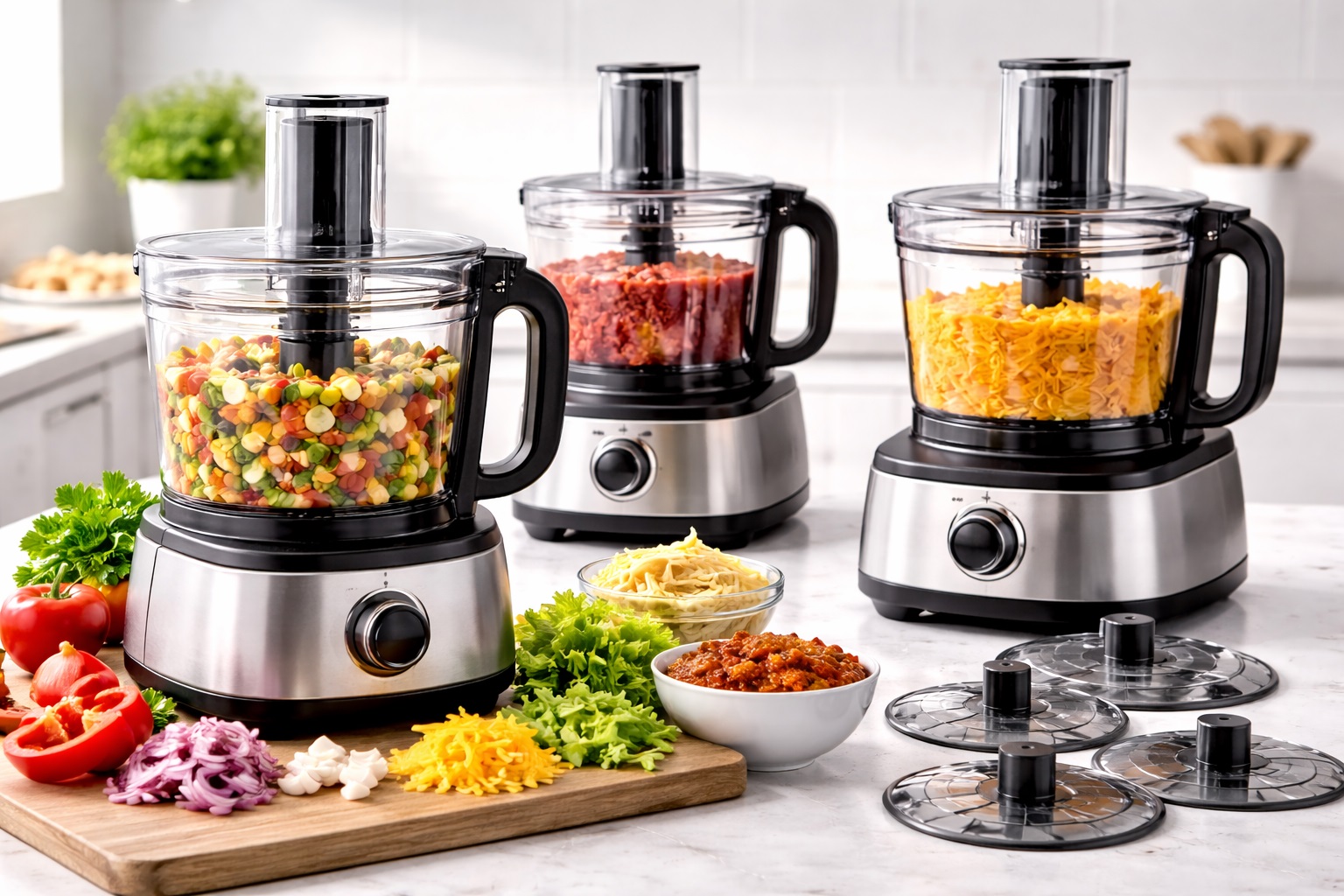
Best Large Capacity Food Processor in 2026
Cooking for a full household changes what you need from a food processor. A compact model built for single servings quickly becomes a bottleneck when you are shredding a full head of cabbage for slaw or prepping vegetables for a week of meals at once. This guide focuses on family size capacity, comparing eight well-known food processors to help larger households find a machine that can keep up with real batch cooking instead of forcing multiple rounds through a small bowl.
Large-capacity food processing is not only about the size of the bowl. Motor power matters just as much, since a bigger bowl filled with dense vegetables or thick dough puts more strain on the motor than a half-full small one. A generously sized bowl paired with an underpowered motor can actually perform worse than a smaller, well-matched machine, so this guide weighs both capacity and power together rather than capacity alone.
This comparison spans a range of prices and bowl sizes, from compact machines better suited to smaller households to genuinely large-capacity models built for feeding a crowd. Not every option here is equally suited to true family-size batches, and this guide is upfront about which models are the strongest fit for larger households versus which are included as reasonable, budget-friendly alternatives for smaller families.
Top 8 Best food processor Picks (Detailed Reviews)
1. Cuisinart DFP-14BCNY – Best For Everyday Family Meal Prep
The Cuisinart DFP-14BCNY leads this list for family use thanks to its 14-cup work bowl, one of the largest capacities in this comparison and genuinely useful for prepping a full week of vegetables or shredding cheese in bulk without multiple batches. Cuisinart has decades of experience building home food processors, and this model channels that into a machine that balances real capacity with controls that stay manageable even when you are cooking in a hurry on a busy weeknight. Its lid and pusher assembly also stay simple despite the added bowl size, so the extra capacity does not come with the added hassle that sometimes accompanies bigger kitchen appliances.
- Pros:
- 14-cup work bowl handles large family batches in a single pass
- Well-established brand with broad parts and accessory availability
- Balanced motor power suited to sustained, everyday family cooking
- Cons:
- Mid-range price higher than smaller-capacity competitors
- Larger footprint requires dedicated counter or storage space
Best For: Families who regularly cook in bulk and need genuine large-batch capacity without stepping up to a commercial-grade price point.
Why We Recommend It: Its 14-cup bowl is large enough for real family meal prep, and its long production history means replacement parts remain easy to find as the machine sees years of frequent use.
2. Ninja BN601 – Best For Batch Cooking & Meal Prep
The Ninja BN601 pairs its Auto-iQ technology with enough capacity to make weekly batch cooking sessions considerably faster for larger households. Instead of manually timing each stage of chopping or pureeing a large batch of ingredients, its automated programs handle multiple steps in sequence, which is particularly useful when you are processing several different components for family meals in one sitting. Ninja's broad appliance lineup also means plenty of family-focused recipes are built specifically around batch preparation. For households juggling several dishes at once, cutting down on hands-on monitoring time can make a noticeable difference over the course of a busy week.
- Pros:
- Auto-iQ programs streamline multi-step batch cooking sessions
- Well suited to preparing several components of a family meal in sequence
- Strong recipe and support ecosystem from a widely recognized brand
- Cons:
- Preset programs offer less manual control for custom techniques
- Mid-range price sits above the most basic family-capacity options
Best For: Families who batch-cook meals for the week and want automated programs to speed up repetitive prep tasks.
Why We Recommend It: Its guided processing sequences are especially useful on the busy prep days that larger households tend to have, cutting down on the hands-on time needed for repetitive family cooking tasks.
3. Black+Decker 8-Cup – Best For Small Families on a Budget
The Black+Decker 8-Cup is worth an honest caveat here: at 8 cups, it is on the smaller end of this comparison and is not the strongest true large-capacity pick. It is included because its easy assembly and low price make it a reasonable option for smaller families or those easing into more frequent batch cooking without a large upfront investment, rather than as a machine built to feed a crowd in a single pass. Its light weight and simple parts also make it easy for anyone in the household to operate, which can be a practical advantage in busy families sharing kitchen duties.
- Pros:
- Lowest price point in this comparison
- Easy assembly suited to frequent, repeated family use
- Lightweight and simple to store between uses
- Cons:
- 8-cup bowl requires multiple batches for larger family portions
- Not a true large-capacity machine despite family-friendly pricing
Best For: Smaller families or larger households on a tight budget who are willing to process bigger batches in two rounds rather than one.
Why We Recommend It: As the most affordable machine here, it lets budget-conscious families get started with regular batch cooking, even if the smaller bowl means slightly more hands-on time per session.
4. Magimix 14-Cup – Best For Large Families Wanting Commercial-Grade Durability
The Magimix 14-Cup matches the Cuisinart's bowl size while adding a 30-year motor warranty that signals genuine confidence in handling the sustained, heavy use that comes with feeding a large family day after day. Magimix built its reputation on commercial kitchen equipment scaled for home use, and that heritage shows in a motor built to process large, dense batches without the strain that can shorten the life of less robust machines. Families who put this machine through years of near-daily use frequently report that it still performs like new, which is exactly what the commercial-grade heritage is meant to deliver.
- Pros:
- 14-cup bowl matched with a commercial-grade, heavy-duty motor
- 30-year motor warranty reflects confidence in sustained family use
- Handles dense, large batches without excessive strain
- Cons:
- Highest price point in this comparison by a wide margin
- Larger, heavier unit that some families may find less convenient to move
Best For: Large families who process big batches frequently and want a machine engineered to handle years of heavy daily use without wearing out.
Why We Recommend It: Its commercial-grade motor and exceptional warranty make it the strongest choice for households that put real, sustained strain on a food processor week after week.
5. KitchenAid 7-Cup – Best For Compact Families Who Need Uniform Slicing
The KitchenAid 7-Cup is another model where honesty matters: its 7-cup bowl is the smallest true capacity in this lineup, making it a better match for smaller families than a household regularly cooking in bulk. Where it earns its place here is its ExactSlice system, which produces consistent slice thickness across a batch, useful for families who prioritize uniform results for dishes like gratins or salads over sheer volume. Many households end up pairing this machine with a larger processor, using each one for the tasks it genuinely handles best.
- Pros:
- ExactSlice system delivers consistent slice thickness across batches
- Familiar, well-supported design within the broader KitchenAid ecosystem
- Compact size fits easily into smaller kitchens
- Cons:
- Smallest bowl capacity in this comparison
- Requires multiple batches for true large-family portions
Best For: Smaller families, or larger households focused specifically on uniform slicing rather than maximum batch size.
Why We Recommend It: While it is not the largest-capacity option here, its slicing consistency makes it a strong secondary machine for families who already own a bigger processor for bulk chopping tasks.
6. Breville Sous Chef – Best For Large Families Who Cook From Scratch Often
The Breville Sous Chef is built around a powerful 1200-watt motor that gives it the muscle to handle dense doughs, large vegetable batches, and thick mixtures that would tax weaker machines. Breville designs this model for home cooks who prepare meals from scratch on a regular basis, which tends to describe larger families cooking multiple dishes at once. Its broader accessory set also lets one machine cover several family meal-prep tasks that might otherwise require separate appliances. This kind of versatility tends to appeal most to families who cook ambitious, varied meals rather than the same handful of simple dishes on rotation.
- Pros:
- Powerful 1200-watt motor handles dense, large-batch ingredients
- Wide accessory set covers multiple family meal-prep tasks
- Reputable brand known for durable, engineering-focused appliances
- Cons:
- Higher price point than more basic family-capacity machines
- More attachments to learn and store than simpler models
Best For: Families who cook elaborate, from-scratch meals often and need a powerful motor to match large or dense batches.
Why We Recommend It: Its motor strength is genuinely suited to the kind of heavy, repeated use that large families cooking from scratch put on a food processor, without straining under demanding batches.
7. Hamilton Beach 10-Cup – Best For Budget-Minded Larger Households
The Hamilton Beach 10-Cup lands in a practical middle ground for larger households that want more capacity than the smallest machines here without paying premium prices. Its Stack & Snap design keeps assembly simple even when you are processing multiple batches back to back during a busy family meal-prep session, and Hamilton Beach's long track record in affordable kitchen appliances gives it solid backing for everyday family use. Its balance of capacity and price makes it an easy recommendation for households that want more than a basic starter model without stretching their budget toward the premium end of this comparison.
- Pros:
- 10-cup bowl offers a reasonable middle ground for family batches
- Stack & Snap design simplifies repeated use during meal prep
- Affordable price relative to its capacity
- Cons:
- Smaller than the largest 14-cup machines in this comparison
- Fewer premium features than higher-priced competitors
Best For: Larger households that want meaningfully more capacity than entry-level machines without paying for premium features they may not use.
Why We Recommend It: Its 10-cup bowl strikes a reasonable balance between true large-family capacity and affordability, making it a practical pick for households watching their budget.
8. Braun FP3020 – Best For Mid-Size Families Needing Fast Prep
The Braun FP3020 relies on its UltraSharp blade system to process ingredients quickly and cleanly, which matters for mid-size families trying to get dinner prep done efficiently on a weeknight. While its capacity is more modest than the largest machines in this lineup, its speed and cutting consistency mean less time spent per batch, which can offset a smaller bowl for households that are willing to run it slightly more often. For families where getting dinner on the table quickly matters more than processing everything in one giant batch, that trade-off is often worthwhile.
- Pros:
- UltraSharp blade system processes ingredients quickly and cleanly
- Efficient design suited to fast weeknight family meal prep
- Mid-range price balances speed and capability
- Cons:
- Capacity is more modest than the largest true family-size machines
- Fewer automated programs than the Ninja BN601
Best For: Mid-size families who prioritize fast, clean cutting over maximum single-batch capacity.
Why We Recommend It: Its efficient blade system reduces per-batch processing time, which helps make up for a smaller bowl on nights when speed matters more than capacity.
Buying Guide: How to Choose the Best Large Capacity Food Processor
1. Match Bowl Size to Your Household Size, Not Just the Largest Option
A genuinely large family benefits from a 12 to 14-cup bowl, but a household of three or four may find a 9 or 10-cup model perfectly adequate. Buying more capacity than you need mostly adds counter space and storage requirements without a real day-to-day benefit. Think honestly about your typical recipe batch sizes over the last few months rather than the occasional large gathering when sizing your purchase.
2. Pair Capacity With Adequate Motor Power
A large bowl filled with dense ingredients needs a motor strong enough to process it evenly without bogging down. When comparing large-capacity machines, check the wattage alongside the bowl size rather than treating capacity as the only number that matters. A large bowl on an underpowered motor can labor and overheat, which shortens the life of the whole appliance over time.
3. Consider How Often You Actually Batch Cook
If your household cooks fresh, smaller portions most nights and only occasionally preps in bulk, a mid-size machine may serve you better day to day than a large one that sits mostly empty during routine use. Reserve the largest capacities for households that batch cook on a genuinely regular schedule rather than a few times a year.
4. Check Whether the Bowl and Blade Assembly Is Easy to Lift When Full
A full 14-cup bowl of processed food is considerably heavier than an empty one, and some large-capacity designs are easier to lift, carry, and pour from than others. This is worth considering if anyone in your household has difficulty lifting heavier kitchen equipment. A wide, stable base and well-placed handles make a noticeable difference once a bowl is loaded with several pounds of processed food.
5. Look at Feed Tube Size for Whole Ingredients
Large families often want to process whole or large-cut vegetables without pre-chopping them first. A wider feed tube reduces prep time before processing even begins, which matters more as batch sizes grow. This small detail can save several minutes of prep work on every single cooking session over the life of the appliance.
6. Factor In Cleanup Time for Larger Bowls and Components
Bigger bowls, lids, and blades take longer to wash by hand, even if they are dishwasher safe. For families processing large batches regularly, dishwasher compatibility of every removable part is worth confirming before buying. A machine that seems convenient to use but is genuinely tedious to clean often ends up used less often than intended.
7. Think About Storage Space Before You Buy
Large-capacity machines take up meaningfully more cabinet or counter space than compact models, and their attachments often require additional storage as well. Measure your available space realistically before committing to the largest option available. It is worth measuring both the machine's footprint and its height with the lid attached, since some large-capacity models are taller than typical upper cabinets allow for.
8. Weigh Automated Programs Against Manual Control for Batch Work
Automated presets can speed up repetitive family meal-prep tasks, but manual control is sometimes preferable for precise techniques on larger, more varied batches. Consider which matters more for the specific dishes your family cooks most often. Some families find the ideal solution is a machine that offers both, using presets for routine tasks and manual settings for anything more specific.
9. Prioritize Durability If the Machine Will See Frequent Heavy Use
A food processor used for large family batches multiple times a week experiences more wear than one used occasionally for small portions. Warranty length and motor build quality matter more the heavier your actual usage pattern is. Households running a food processor several times a week should weigh durability more heavily than households using one occasionally for smaller tasks.
10. Compare Price Per Cup of Capacity, Not Just Sticker Price
A more expensive machine with significantly more capacity can offer better real value per use than a cheaper one that requires constant double-batching. Doing this simple comparison can clarify which option truly fits a larger household's needs. It also helps avoid the common trap of choosing the cheapest sticker price only to find yourself running multiple extra batches every single week.
11. Consider Noise Level During Extended Batch Sessions
Processing several large batches in a row takes longer than a single small task, and a noisy machine becomes more noticeable during extended family meal-prep sessions. This is a minor factor but worth weighing for households that batch cook frequently. If your kitchen is open to a living or dining area, a quieter motor can make a real difference to the overall atmosphere during longer prep sessions.
12. Check Accessory Compatibility for Multi-Task Family Cooking
Families cooking varied meals often benefit from multiple discs and blades rather than the standard chopping blade alone. Confirm which accessories are included versus sold separately before assuming a machine covers all your family's typical prep tasks. Buying attachments separately later can add up in cost, so it is worth checking what is actually included in the box up front.
13. Don't Ignore Secondary Uses Like Dough or Nut Butters
Larger families often use a food processor for more than chopping vegetables, including kneading dough or making nut butters in bulk. If these tasks are common in your household, prioritize a machine with the motor strength to handle them at full capacity. Underpowered motors tend to struggle most with these denser tasks, even if they handle basic vegetable chopping just fine.
Frequently Asked Questions
What bowl size actually counts as large capacity for a food processor?
Generally, 12 to 14 cups is considered large capacity, suitable for bigger families or serious batch cooking, while 7 to 10 cups is better described as mid-size and works well for smaller households. Anything below that range is best suited to individuals or couples rather than a family cooking multiple meals a week.
Does a bigger bowl always mean better performance for large families?
Not on its own. A large bowl needs a correspondingly powerful motor to process full batches evenly, so capacity and wattage should be evaluated together rather than capacity alone. A large bowl paired with a weak motor often ends up performing worse in practice than a smaller, well-matched combination.
Is it better to buy one large food processor or two smaller ones?
For most families, one well-matched large-capacity machine is simpler to store and maintain than two separate units, though some households do keep a smaller secondary processor for quick, single tasks. That combination can make sense if your family regularly needs both large-batch prep and quick, single-serving tasks throughout the week.
How much extra does a large-capacity food processor typically cost?
Larger-capacity models generally command a price premium over compact machines, though the exact difference varies significantly by brand and motor power, as reflected in the range of prices compared in this guide. Comparing that premium against how often you would actually use the extra capacity is the most useful way to decide whether it is worth paying for.
Can a large-capacity food processor still handle small tasks well?
Yes, most large-capacity machines handle small batches without issue, though some users find that very small quantities are processed less evenly in a much larger bowl. Pulsing in shorter bursts rather than running continuously tends to solve this for smaller amounts.
Is motor wattage more important than bowl size for large families?
Both matter, but motor wattage becomes especially important once you are consistently filling a large bowl with dense ingredients, since an underpowered motor can bog down under a genuinely full load. If you had to pick just one specification to prioritize for large families, motor power paired with a matching bowl size would be it.
How do I know if my family actually needs a large-capacity model?
If you frequently find yourself running a smaller processor in multiple batches to finish a single recipe, that is a strong sign a larger-capacity machine would better fit your household's actual cooking habits. Keeping a rough mental tally of how often this happens over a month can make the decision much clearer.
Are large-capacity food processors harder to clean?
They can take a bit longer simply due to their size, though most large-capacity models include dishwasher-safe parts that make cleanup manageable despite the larger bowl and components. Rinsing the bowl shortly after use also prevents food from drying onto the surface, which makes any later cleaning noticeably easier.
Do large-capacity machines take up significantly more storage space?
Yes, generally. Larger bowls, lids, and accessory sets require more cabinet or counter space than compact models, which is worth planning for before purchasing a large-capacity machine. Measuring your intended storage spot in advance can prevent an unpleasant surprise on delivery day.
Is a 30-year motor warranty realistic for a food processor?
Some premium, commercial-grade-inspired brands do offer motor warranties of that length, which reflects real confidence in the durability of the core motor, though other components may carry shorter coverage. It is always worth reading the specific terms rather than assuming the entire appliance is covered for the full warranty period.
Should families prioritize automated programs or manual controls?
It depends on cooking style. Automated programs speed up repetitive batch tasks, while manual control offers more precision for varied family recipes, so the right balance depends on how your household typically cooks. Households with a rotating cast of home cooks sometimes prefer presets specifically because they reduce variation between different people using the same machine.
Can a large-capacity food processor replace a stand mixer for dough?
Many large-capacity models with strong motors can handle basic dough mixing and kneading, though dedicated stand mixers still tend to offer more specialized control for advanced baking tasks. For everyday bread or pizza dough, a strong food processor is often more than sufficient for a large family's needs.
What is the biggest mistake families make when buying a food processor?
Buying based on price alone without considering bowl size, motor power, and how often the household actually batch cooks is one of the most common reasons families end up disappointed with their purchase. Taking a few extra minutes to weigh these factors together tends to result in a machine that actually fits how your household cooks, rather than one that looks good on paper alone.
Final Verdict
- Top Pick: Cuisinart DFP-14BCNY for its genuinely large 14-cup bowl paired with balanced power and a long track record in family kitchens.
- Budget Choice: Black+Decker 8-Cup for smaller families or tighter budgets, with the honest caveat that its capacity is more modest than the true large-capacity picks here.
- Premium Choice: Magimix 14-Cup for large families who batch cook frequently and want a commercial-grade motor backed by an exceptional warranty.
Feeding a large household well comes down to matching real bowl capacity with a motor that can actually handle it, rather than chasing the biggest number on the box. Whether you land on the budget-friendly Black+Decker for smaller batches, the well-rounded Cuisinart for everyday family cooking, or the heavy-duty Magimix for years of frequent large-batch use, choosing based on your actual cooking habits will serve your household better than capacity alone. Take stock of how your family really cooks week to week, and match that pattern to the machine best equipped to support it for years to come.