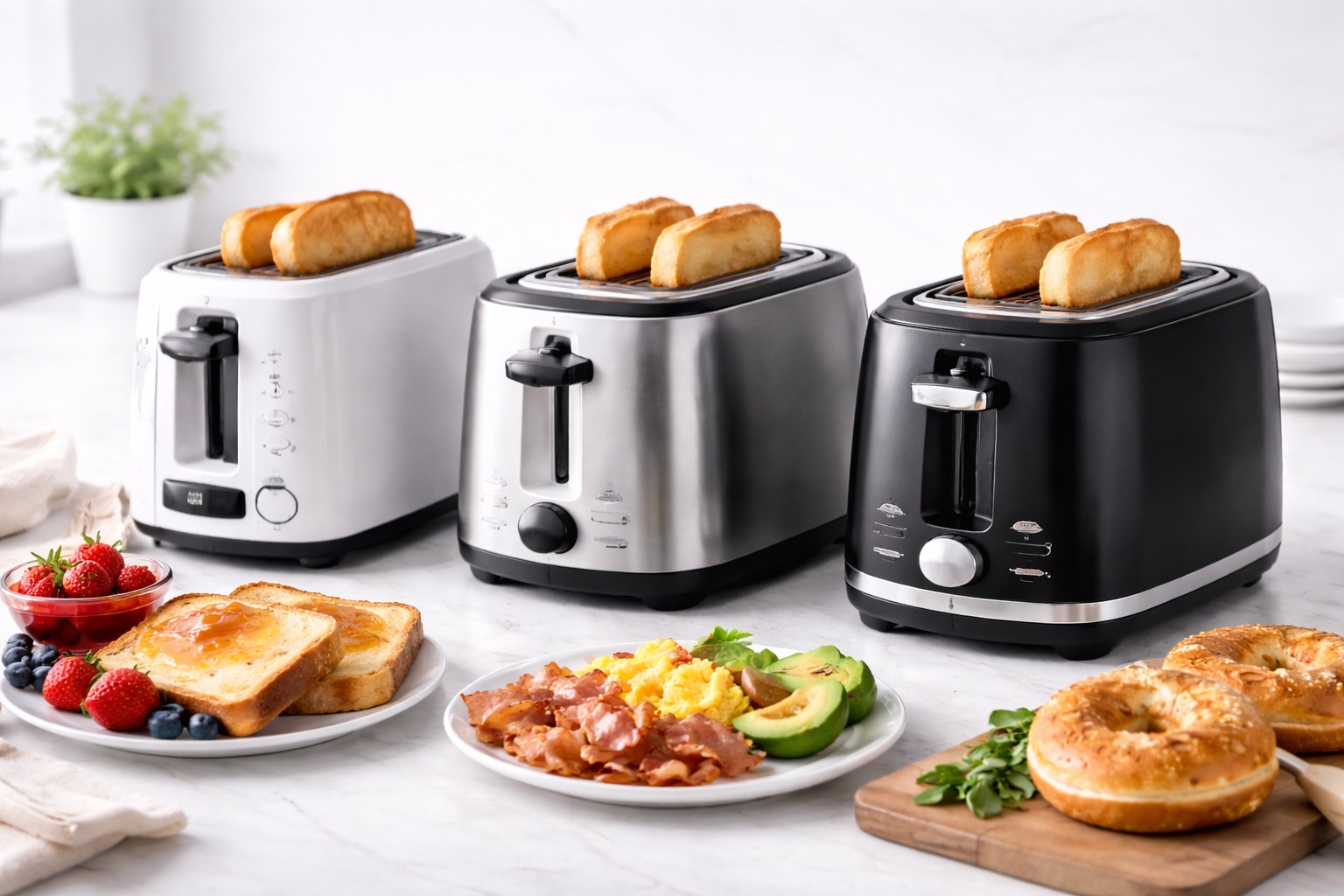
Best Compact Toasters for Small Kitchens: Even Toast Without the Bulk
A toaster seems like the simplest appliance in the kitchen until you're trying to fit one on a counter that's already crowded with a coffee maker, a dish rack, and whatever else has claimed the remaining inches. For small kitchen users and apartment dwellers, the real question isn't just "does it toast bread evenly" — it's whether the toaster's footprint, slot size, and shape actually work with the limited space available, without becoming the appliance that permanently lives in a cabinet because there's nowhere for it on the counter.
This guide covers six distinct approaches to solving that problem, from the classic 2-slice toaster to a mini toaster oven that trades footprint for extra versatility. Each type balances counter space against capability differently, and the right one depends on what you toast most often, how much you're willing to compromise on capacity, and how much extra function you want from a single small appliance.
None of these options is universally correct. A studio apartment with almost no counter space calls for a different toaster than a small kitchen that still has room for a slightly larger appliance in exchange for more versatility. The goal here is matching toaster type to your actual space and habits, not defaulting to whichever model happens to be most popular.
It also helps to separate two things that get lumped together in most toaster shopping: footprint and capacity. A toaster can be physically small while still fitting two full-size slices, or it can be wider than expected while only handling a single narrow slot. Reading dimensions and slot measurements carefully — rather than assuming "compact" always means the smallest possible option — helps avoid a toaster that looks right in a photo but doesn't actually solve your space problem once it's sitting on your counter.
It's also worth thinking about how a toaster fits into your actual morning routine, not just your kitchen's floor plan. Someone who toasts one slice of bread most mornings before rushing out the door has different priorities than someone hosting weekend brunch for four people at once. The right compact toaster balances your available counter space against how often — and for how many people — you're actually using it, rather than optimizing for either dimension alone.
Top Compact Toasters by Category (Detailed Reviews)
1. 2-Slice Toaster – Best Overall for Small Kitchens
The standard 2-slice toaster remains the most space-efficient option for most small kitchens, offering enough capacity for a couple of slices at a time without demanding much counter real estate. Its narrow footprint makes it easy to tuck between other appliances or store in a cabinet when not in use, and the simple mechanical design means fewer things to go wrong over years of daily use.
The obvious limitation is capacity — if you're regularly toasting for more than two people at once, you'll be running multiple batches. Slot width can also be a constraint, since standard 2-slice toasters are sometimes too narrow for thicker artisan bread or bagels without some manual adjustment.
- Pros:
- Compact footprint that fits easily in small kitchens
- Simple, reliable mechanical operation
- Widely available at accessible price points
- Cons:
- Limited to two slices per batch
- Standard slots may not fit thicker bread comfortably
- Fewer specialized features than other categories
Best For: Individuals or couples in small kitchens who mainly toast standard bread slices.
Why We Recommend It: For the smallest possible footprint without sacrificing dependable everyday toasting, a 2-slice toaster remains the sensible default for tight kitchens.
Because the format is so common, it's also the easiest category to compare across brands and price points side by side, since the core design hasn't changed much in decades — what varies most is browning consistency, build quality, and small conveniences like slot centering guides.
It's also usually the easiest category to find replacement parts or a direct swap for if the toaster eventually wears out, since the format has stayed largely consistent across brands for decades.
2. Long Slot Toaster – Best for Bagels & Artisan Bread
A long slot toaster uses a single elongated slot (or two long slots) rather than the standard square opening, specifically designed to accommodate bagels, artisan loaves, and thicker specialty bread that a standard slot struggles to fit. For anyone whose toast routine leans heavily toward bagels or bakery bread rather than sandwich slices, this shape solves a real, everyday annoyance.
Because the slot is designed around longer or thicker items, the footprint is often slightly larger front-to-back than a standard 2-slice toaster, and if your household mostly eats standard sandwich bread, the extra slot length goes largely unused.
- Pros:
- Slot shape accommodates bagels and thicker artisan bread
- Reduces the awkward squeeze-and-hope approach of standard slots
- Often includes a dedicated bagel setting for one-side toasting
- Cons:
- Slightly larger footprint than a standard compact toaster
- Less advantage if you mostly toast standard sliced bread
- Typically priced a bit above basic 2-slice models
Best For: Households that regularly toast bagels or thicker specialty bread.
Why We Recommend It: When your usual bread doesn't fit a standard slot, a long slot design directly addresses the fit problem rather than forcing a workaround.
Anyone who has tried to force a bagel sideways into a standard slot, or ended up with a lopsided, half-toasted result, will likely find this category solves a problem they've been quietly working around for years without realizing a dedicated slot shape existed.
The dedicated bagel setting found on many models in this category is also worth checking for specifically, since it toasts just the cut side while gently warming the outer crust — a small feature that makes a real difference for bagel lovers. Households that split between bagel days and standard toast days benefit most from this feature, since it removes the need to manually adjust browning settings or babysit the cycle to avoid an overly charred bagel edge.
3. Toaster with High Lift Lever – Best for Easy Removal of Small Items
A high lift lever raises toasted items well above the top of the toaster, making it easier to remove smaller slices, English muffins, or thin bread without reaching down into the slot with fingers or tongs. For anyone who has burned a fingertip fishing out a small piece of toast, this is a genuinely practical, low-cost feature to prioritize.
Because the lever mechanism itself is the main differentiator, other features in this category tend to be fairly standard, and the extra lift height doesn't meaningfully change toasting performance or evenness compared to a standard-lift toaster.
- Pros:
- Makes removing small or thin items safer and easier
- Reduces the need to reach into the toaster slot
- Simple mechanical feature that rarely fails over time
- Cons:
- Doesn't improve toasting evenness or speed on its own
- Feature set beyond the lever is often fairly basic
- Less differentiated for households not bothered by standard lift height
Best For: Anyone who frequently toasts smaller items and wants an easier, safer way to remove them.
Why We Recommend It: It's a small design change that solves a specific, common annoyance without adding complexity or cost.
It's an easy feature to overlook when comparing spec sheets, since it doesn't affect browning quality at all, but it's the kind of small daily convenience that becomes noticeable within the first week of ownership rather than something you'd think to shop for in advance.
This feature is particularly appreciated by households with young toast-eaters who prefer smaller or halved slices, where reaching into a standard-depth slot happens more often than with regular full-size bread.
4. Mini Toaster Oven – Best for Versatility Beyond Toast
A mini toaster oven does more than toast bread — it can bake, broil, and reheat small portions, functioning as a compact secondary oven for anyone without much kitchen space or counter room for a full-size toaster and a separate small oven. This versatility makes it appealing for apartment dwellers who want to cover more cooking tasks without adding multiple appliances.
The tradeoff is a larger footprint than a dedicated toaster and, in many models, slower toasting speed and less even browning than appliances built specifically for bread. If toast quality is your top priority, a dedicated toaster usually performs that specific task better.
- Pros:
- Handles baking, broiling, and reheating beyond just toast
- Reduces the need for multiple separate small appliances
- Useful for small households cooking modest portions
- Cons:
- Larger footprint than a dedicated 2-slice toaster
- Toasting speed and evenness can lag behind dedicated toasters
- More surfaces and racks to clean after use
Best For: Small households that want one appliance to cover toast plus light baking and reheating.
Why We Recommend It: For genuinely limited kitchen space, consolidating several small-appliance functions into one unit can outweigh a small drop in toast-specific performance.
Anyone furnishing a first apartment or a small secondary kitchen — a dorm room, a guest suite, an office break room — often finds this category the most practical single purchase, since it covers a wider range of everyday food tasks than a dedicated toaster ever could.
This is often the right tradeoff for a first apartment or a small dorm-style kitchen, where the alternative would be no oven access at all rather than a slightly less perfect slice of toast. The honest caveat is that a toaster oven rarely browns bread as consistently, edge to edge, as a purpose-built toaster does, so anyone who cares deeply about perfectly even toast every single morning may still want a dedicated toaster even if it means owning two small appliances instead of one.
5. Budget Compact Toaster – Best Budget Pick
Budget compact toasters cover the basics — a simple browning dial, a standard-size slot, and a small footprint — without extra features like bagel settings, high lift levers, or extended warranties. For anyone who just needs functional toast without paying for extras, this remains a reasonable, low-risk starting point.
The compromise typically shows up in browning consistency and build durability over time. Cheaper heating elements may not distribute heat as evenly across the slice, and components like the lever mechanism or crumb tray may feel less sturdy than pricier alternatives after extended daily use.
- Pros:
- Low upfront cost for basic, functional toasting
- Small footprint suitable for the tightest kitchens
- Simple controls with no learning curve
- Cons:
- Browning can be less even than pricier models
- Build quality may not hold up as well over years of use
- Fewer specialized features like bagel settings or high lift
Best For: Anyone who wants dependable basic toasting at the lowest reasonable cost.
Why We Recommend It: It covers everyday toasting needs without asking you to pay for features you may never use.
This category also makes sense as a temporary solution — a first toaster for a new apartment, a backup for a shared kitchen, or a low-stakes purchase while you figure out your actual toasting habits before committing to a pricier, more specialized model down the line.
For light or occasional use — a slice or two most mornings rather than heavy daily batches for a full household — this category is often genuinely sufficient rather than a compromise.
6. Stainless Steel 2-Slot Toaster – Best Premium & Durability Pick
A stainless steel 2-slot toaster combines the same compact footprint as a standard 2-slice model with a more durable exterior finish that resists dents, discoloration, and heat damage better than plastic housings over years of daily use. For anyone who wants a longer-lasting appliance and a more polished kitchen look, this is usually the premium version of the classic compact toaster.
The upgraded materials come with a higher price than plastic-bodied compact toasters, and while the exterior is more durable, the internal heating and browning mechanism often performs similarly to other well-made toasters in this category rather than offering dramatically better toasting results.
- Pros:
- More durable exterior that resists dents and heat damage
- Polished appearance that suits a range of kitchen styles
- Compact footprint consistent with standard 2-slice models
- Cons:
- Higher price than plastic-bodied compact toasters
- Toasting performance is often comparable to other quality models
- Exterior can show fingerprints more visibly than matte finishes
Best For: Anyone who wants a compact toaster built to last with a more polished countertop appearance.
Why We Recommend It: The durable stainless housing offers real long-term value for anyone planning to keep the same toaster for many years.
It's a particularly sensible choice for open kitchens where small appliances stay visible on the counter rather than in a cabinet, since the finish tends to look presentable for far longer than a plastic housing exposed to daily use and cleaning.
Buying Guide: How to Choose the Best Compact Toaster
Once you've identified the category that fits your space and habits, these factors help you compare specific models within it.
1. Toasting Evenness
Even browning from edge to edge and slice to slice is the single most important performance factor for any toaster, regardless of size. Inconsistent heating elements can leave one side pale while the other burns, a problem that's worth checking reviews for specifically.
2. Slot Width and Length
Standard slots fit typical sandwich bread but can struggle with bagels, thick artisan slices, or frozen waffles. Match slot dimensions to what you actually toast most often rather than assuming all slots are functionally the same size.
3. Browning Settings and Control Precision
A wider range of browning levels gives more control over the final result, but precision matters more than sheer number of settings — a toaster with five settings that behave inconsistently is less useful than one with fewer, more reliable levels.
4. Crumb Tray Design and Accessibility
A removable, easy-to-access crumb tray makes regular cleaning far more likely, which matters for both hygiene and fire safety, since accumulated crumbs are a genuine risk in any toaster used daily.
5. Counter Footprint
Measure your actual available counter space before choosing a toaster type, factoring in that long slot and toaster oven styles typically need more depth or width than a standard compact model.
6. Cord Length and Storage
A longer cord offers more placement flexibility on a crowded counter, while cord storage (wrapping the cord underneath) helps keep the appliance tidy when not directly in use.
7. Automatic Shut-Off and Safety Features
Look for automatic shut-off in case a slice gets stuck, along with cool-touch exterior housing, especially important in small kitchens where the toaster may sit close to other items or be used by multiple household members.
8. Price and Long-Term Value
Consider not just the toaster's upfront cost but how long it's likely to perform well — a slightly higher price for genuinely more durable components can be worth it if you plan to use the toaster daily for years.
9. Brand Reliability and Parts Availability
Established brands generally offer more consistent quality control and easier replacement if a part like the crumb tray or lever mechanism eventually wears out.
10. Warranty Coverage
Warranty length is a reasonable signal of how confident a manufacturer is in a toaster's heating element and mechanical components holding up over regular daily use.
11. Real-World User Feedback
Specifications rarely capture how evenly a toaster actually browns bread after months of regular use, or whether the lever mechanism starts sticking. Reviews focused on longevity and consistency add valuable context.
12. How Many People You're Toasting For
A 2-slice toaster is fine for an individual or couple, but a household of four toasting breakfast simultaneously may find a 4-slice or mini toaster oven more practical despite the larger footprint.
13. Cleaning Frequency and Convenience
Consider how easy the toaster is to wipe down externally and how accessible internal crumb removal is, since a toaster that's a hassle to clean is less likely to actually get cleaned regularly.
14. Reheat and Defrost Settings
A dedicated reheat setting gently warms already-toasted bread without further browning it, while a defrost setting extends the cycle to properly toast frozen bread straight from the freezer. Both are small conveniences worth checking for if you regularly toast bread that isn't fresh from the bag.
15. Visual Fit With Your Kitchen
In small kitchens especially, appliances left out on the counter are always visible, so finish and color matter more than they might in a larger kitchen with more storage options. A toaster that looks out of place on a small counter is a minor but real daily annoyance.
16. Ventilation and Heat Dissipation
Compact toasters run hot during use, and enough clearance around the vents prevents heat from affecting nearby cabinets, walls, or other small appliances over time. In an already tight kitchen layout, checking recommended clearance distances before placement helps avoid discoloration or heat damage to surrounding surfaces.
17. Noise During the Toasting Cycle
Most compact toasters are relatively quiet, but the mechanical pop of the lever release and any cooling fan noise, more common in toaster ovens, can be noticeable in a small, open-plan kitchen early in the morning. This is a minor factor but worth considering if you're toasting in a space adjacent to a bedroom or shared living area.
Frequently Asked Questions
How much counter space does a compact toaster actually need?
Most 2-slice compact toasters need roughly the same footprint as a large book standing on its side, though long slot and toaster oven styles typically require more depth or width. Measuring your specific counter space before buying avoids an awkward fit.
Do long slot toasters work well for regular sandwich bread too?
Yes, most long slot toasters handle standard bread slices without issue, though the elongated slot is specifically designed to accommodate bagels and thicker bread that a standard square slot can't fit as comfortably.
Is a toaster oven a good replacement for a dedicated toaster?
It can be, particularly in small kitchens where consolidating functions matters more than perfect toast performance. Dedicated toasters generally produce more consistent, faster browning specifically for bread, so the right choice depends on how much you value versatility versus toast-specific performance.
Why does my toast come out unevenly browned?
Uneven browning is usually caused by an inconsistent heating element, uneven bread thickness, or crumbs and buildup affecting heat distribution inside the slot. Regular cleaning and checking reviews for browning consistency before buying both help avoid this issue.
How often should I clean the crumb tray?
For daily use, emptying the crumb tray at least once a week is a reasonable habit, both for toast quality and fire safety, since accumulated crumbs can occasionally smoke or, in rare cases, ignite.
Are stainless steel toasters worth the extra cost over plastic ones?
If you want a more durable, longer-lasting exterior and a more polished kitchen appearance, yes. If toasting performance and lowest possible price are your only priorities, a well-made plastic-bodied toaster can perform just as well functionally.
Can a compact toaster handle frozen bread or waffles?
Many compact toasters include a frozen or defrost setting specifically for this purpose, which extends the toasting cycle to account for the extra time needed to properly heat frozen items through.
What's the safest way to remove stuck toast?
Always unplug the toaster first, then use a wooden or plastic utensil rather than metal to avoid electrical risk or scratching internal heating elements. Never insert anything into a plugged-in toaster.
How long should a compact toaster typically last?
With regular cleaning and normal daily use, most compact toasters last several years before heating elements or mechanical parts begin to wear noticeably, though budget models may show wear sooner than premium ones.
Does slot width affect toasting speed?
Not directly — toasting speed depends more on heating element wattage and browning settings than slot width itself, though a slot too narrow for your bread can force uneven contact and inconsistent results regardless of speed.
Is it normal for a new toaster to smoke slightly the first time it's used?
Yes, a small amount of smoke or odor from manufacturing residue burning off is common with a brand-new toaster's first use and typically resolves after the first cycle or two.
Do I need a toaster with multiple browning settings, or is one enough?
If everyone in your household prefers the same level of toast, one reliable setting is genuinely enough. Multiple settings matter more in households where preferences vary from lightly toasted to well done.
Can a compact toaster still fit under upper cabinets?
Most compact toasters are low enough to fit under standard upper cabinets when the lever is down, though toasting mechanisms with a high lift lever can raise items higher during the cycle. Checking the toaster's height with the lever fully engaged, not just its resting height, avoids a tight-fit surprise.
Should I unplug my toaster between uses?
Many people leave toasters plugged in without issue, but unplugging when not in use eliminates any standby risk and is a reasonable habit in small kitchens where the appliance sits close to a sink or other water sources.
Can I toast just one slice instead of running a full batch?
Yes, most 2-slice and long slot toasters allow single-slice toasting without any issue, though the empty slot may cause slightly faster heat loss on that side. This doesn't damage the toaster and is a normal, expected way to use it.
Do compact toasters need extra ventilation clearance on a crowded counter?
Most manufacturers recommend a few inches of clearance on each side and above the toaster to allow heat to dissipate safely, which is worth checking specifically if you plan to tuck the toaster tightly between other appliances.
Final Verdict
- Best Overall: A 2-slice toaster offers the smallest footprint with dependable everyday performance for most small kitchens.
- Best for Bagels: A long slot toaster solves the fit problem for bagels and thicker artisan bread.
- Best Premium: A stainless steel 2-slot toaster offers the most durable, longest-lasting build in this category.
- Best Budget: A budget compact toaster covers everyday toasting needs at the lowest reasonable cost.
- Best for Versatility: A mini toaster oven consolidates toast, baking, and reheating into one compact appliance.
For most small kitchens, the right toaster isn't the one with the most features — it's the one whose footprint and slot size actually match what you toast and how much counter space you can spare. Start with your actual space constraints and daily bread habits, and the right category becomes clear well before you need to compare specific models.
If you're choosing between two close options, lean toward whichever one better matches your most frequent use case rather than the occasional one. A household that toasts standard bread ninety percent of the time gains little from a bagel-specific slot, while a genuine bagel household will notice the difference every single morning.
It's also worth remembering that a compact toaster is a long-term counter resident in a small kitchen, not a fleeting purchase. Measuring twice, being honest about how much versatility you actually need beyond toast, and prioritizing evenness and safety features over flashy extras will serve you better over years of daily use than chasing whichever model looks most impressive in a photo.