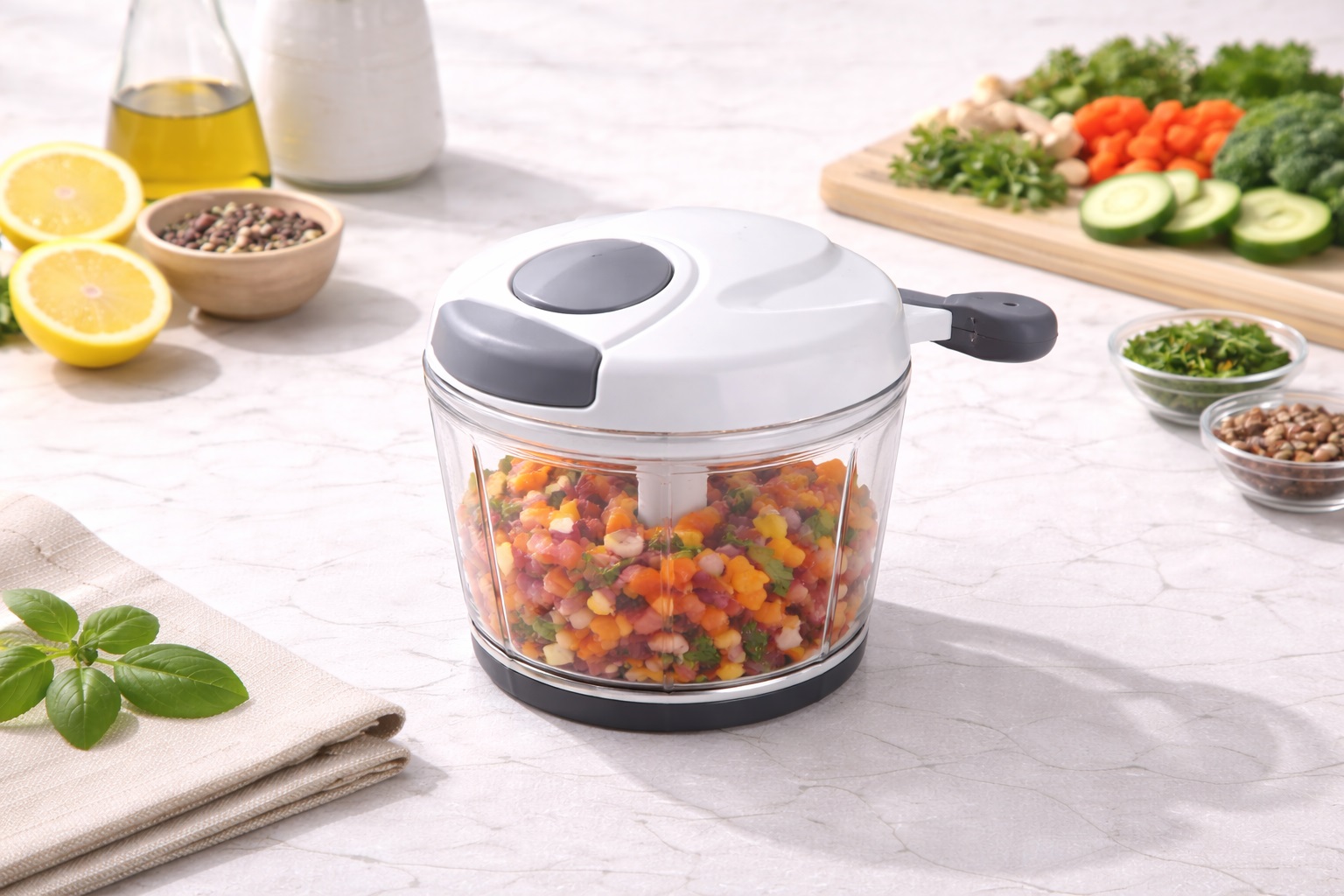
Best Budget Food Choppers: Fast Ingredient Prep Without the High Cost
A food chopper bridges the gap between the speed of a full food processor and the precision of knife work, delivering faster prep times for the everyday cook without requiring the counter space, setup time, or learning curve of a processor. For vegetables, herbs, nuts, and garlic that need uniform chopping quickly, a good food chopper is one of the highest time-return-on-investment kitchen tools available.
The category spans from simple manual pull-cord designs that cost $15 to powerful electric models with interchangeable blades at $100+. Understanding where your daily prep needs fall on this spectrum determines which approach delivers the best value for your specific cooking habits.
This guide evaluates food choppers on metrics that matter in daily kitchen use: chopping consistency across different ingredients, cleanup ease that doesn\'t negate the time saved, capacity for your typical meal prep volume, and durability that sustains the performance across hundreds of daily uses.
Quick Comparison: Top Picks at a Glance
| Product Type | Best For | Our Take |
|---|---|---|
| Electric Food Chopper (3-4 Cup) | Best for Speed and Daily Convenience | Best time-saving investment for daily vegetable prep. |
| Manual Pull-Cord Food Chopper | Best No-Electricity Compact Option | Best simplicity and reliability for small-volume non-electric prep. |
| Large-Bowl Electric Food Processor | Best for High-Volume Daily Prep | Best comprehensive processing capability for high-volume versatile prep. |
Top budget food chopper Picks — In-Depth Reviews
Each product type below has been evaluated based on real performance factors relevant to everyday cooks who want faster chopping and food prep without paying premium food processor prices. We've included detailed performance notes, value assessments, and clear guidance on who each option suits best.
1. Electric Food Chopper (3-4 Cup) — Best for Speed and Daily Convenience
An electric food chopper with a 3–4 cup bowl processes most standard meal-prep volumes for 2–4 people in 10–20 seconds. Sharp stainless steel blades running at 300–400W produce a consistent chop across onions, celery, carrots, garlic, herbs, and nuts. The pulse function — the most important control for chop consistency — gives the user precise control over the degree of chopping rather than committing to a continuous run.
Most electric choppers include a lid that doubles as a press or activator, eliminating external power button interaction for the safest possible operation. The bowl, lid, and blade assembly typically disassemble into 3–4 components for cleaning. Dishwasher-safe bowl and lid components on quality models eliminate the manual washing that negates the time saving of faster prep.
- Pros:
- 10–20 second processing time for most vegetables
- Pulse control for consistent chop degree
- Dishwasher-safe components for easy cleanup
- Compact enough for daily counter storage
- Cons:
- Blade cleaning requires careful hand washing — sharp edge
- Bowl capacity limits very large batch preparation
Best For: Daily home cooks who want the fastest possible daily vegetable prep without hand chopping.
Performance Verdict: The electric chopper is the tool that most noticeably reduces daily cooking preparation time for most home cooks. Chopping an onion takes 5–8 minutes by hand; an electric chopper processes it in 12 seconds. This time saving across every daily cooking session accumulates to significant recovered time.
Who Should Buy This: Anyone who chops vegetables daily and wants to recover the time spent on manual prep without investing in a full food processor.
Value Assessment: At $30–70, the electric chopper delivers better daily-use value than a food processor for pure chopping tasks — lower cost, smaller footprint, faster setup, and equivalent chopping quality for standard meal prep volumes.
2. Manual Pull-Cord Food Chopper — Best No-Electricity Compact Option
A manual pull-cord chopper uses a pull-cord mechanism that spins the blade assembly inside the bowl — each pull rotates the blades through the ingredients. This design requires no electricity, has no motor that can fail, and is completely silent during operation. Pull-cord choppers typically handle 2 cups of ingredients effectively, with blade quality determining chopping consistency and speed.
The pull-cord mechanism's simplicity makes it the most reliable design long-term — there are no electronic components to fail. For households where electricity access is intermittent, kitchen space is extremely limited, or the preference is for appliances with minimal electronic complexity, the pull-cord design provides genuine chopping speed improvement over knife work without any of the complexity of electric alternatives.
- Pros:
- No electricity required — fully manual operation
- Silent operation
- Compact — fits in a drawer when not in use
- Simple mechanism with no electronic failure points
- Cons:
- More physical effort per session than electric alternatives
- Smaller capacity than electric models
Best For: Minimal-equipment kitchens, campers, and users who prefer non-electric tools for simplicity and reliability.
Performance Verdict: The pull-cord chopper provides meaningful chopping speed improvement over knife work with less physical effort than chopping while delivering complete control over the chop degree. It's genuinely useful — not a gimmick — for small prep volumes that don't justify the setup of an electric chopper.
Who Should Buy This: Minimalist cooks, RV and camping users, and anyone who prefers simple tools over electric alternatives for basic prep tasks.
Value Assessment: Pull-cord choppers are the least expensive segment of the food chopper category at $12–25 for quality models. For the specific use cases they suit, they deliver strong value at a minimal investment.
3. Large-Bowl Electric Food Processor — Best for High-Volume Daily Prep
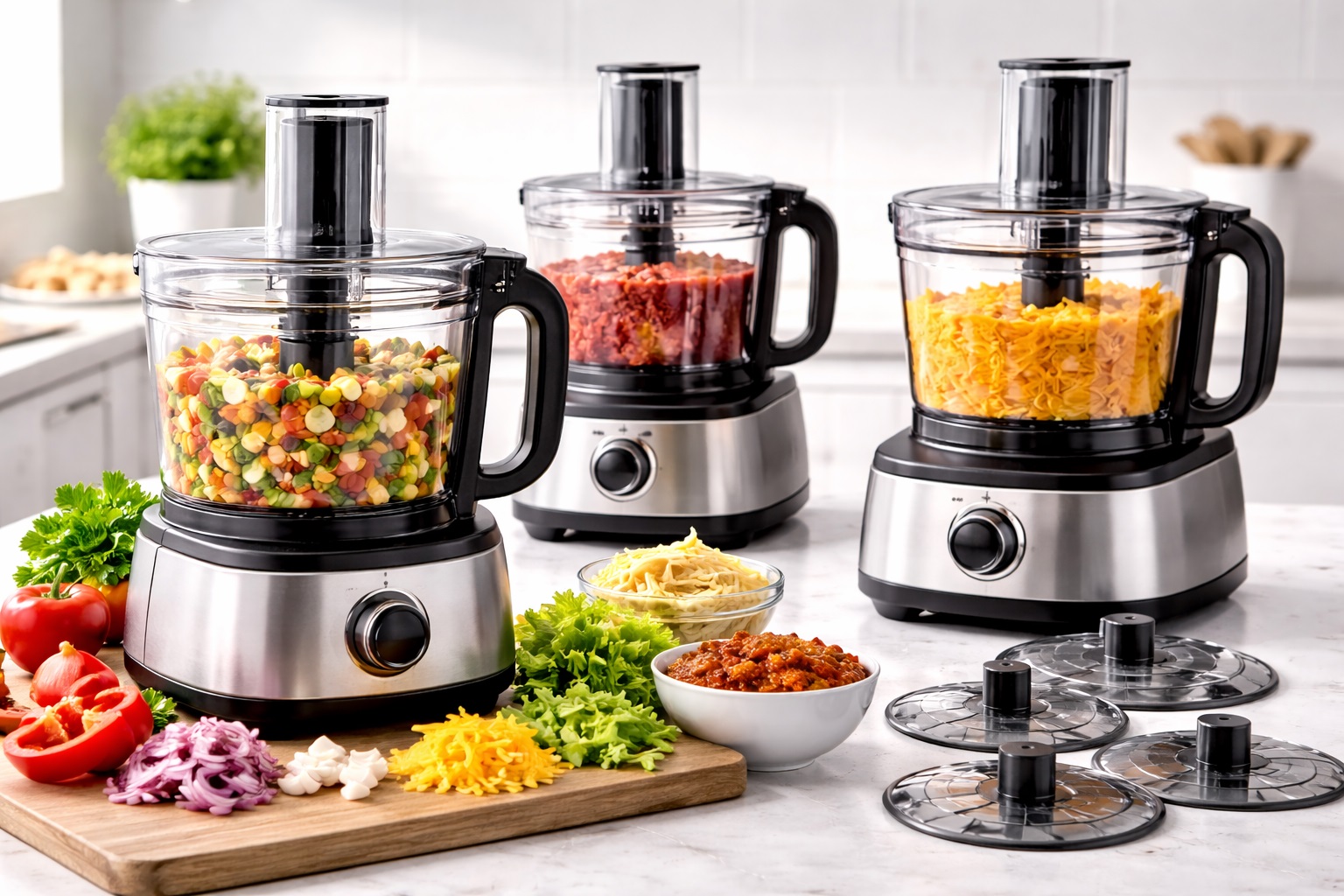
For households where daily meal prep involves large volumes — cooking for 6+ people, meal prepping weekly batches, or preparing multiple dishes simultaneously — a full 7–12 cup food processor provides the capacity and versatility that compact choppers cannot match. Multiple blade attachments handle slicing, shredding, kneading, and pureeing in addition to chopping.
The investment in a full processor is justified when prep volumes regularly exceed 3–4 cups, when the need for slicing and shredding functions is consistent (not just occasional), or when the household's cooking complexity warrants the full range of food processing functions. For pure chopping of standard quantities, a compact chopper remains more practical and convenient than a full processor for daily use.
- Pros:
- 7-12 cup capacity for large batch preparation
- Multiple attachments for slicing, shredding, and pureeing
- Handles large volumes without refilling
- One-time setup for comprehensive food processing capability
- Cons:
- Significantly larger footprint than compact choppers
- Setup and cleanup more time-intensive than compact alternatives
Best For: Large households, dedicated meal preppers, and serious home cooks who regularly process high volumes across multiple preparation functions.
Performance Verdict: The full processor's versatility justifies its larger footprint specifically for households where the range of functions is used regularly. A household making hummus, slicing vegetables, shredding cheese, and chopping onions across a weekly cooking session uses the full processor's capability. A household that only chops vegetables is better served by a compact chopper.
Who Should Buy This: Serious home cooks, large families, and dedicated meal preppers who regularly use multiple food processing functions across different preparation tasks.
Value Assessment: Full food processors represent a larger investment ($80–200 for quality models) and require dedicated counter or cabinet storage. This investment is justified for households who use the full range of functions regularly; it represents excessive cost and footprint for households whose needs are primarily chopping.
Complete Buying Guide: How to Choose the Best Best Budget Food Choppers: Fast Ingredient Prep Without the High Cost
Knowing which product to buy is one challenge. Understanding why one product is better suited to your specific situation is the more useful skill. The following guide explains every important buying factor in plain, practical terms.
1. Blade Quality: The Critical Variable
The sharpness and quality of the chopping blade determines both the speed of processing and the consistency of the chop. High-quality stainless steel blades cut cleanly through onion cells without crushing them — preserving the cellular structure produces a less sharp, less pungent flavor from the chopped onion compared to crushed cells. Quality blades also require fewer processing pulses to reach the desired chop degree, reducing the risk of inadvertent over-processing to mush.
Pro Tip: Blade quality is most consistently indicated by brand reputation and price tier. Budget choppers use thinner, lower-grade stainless blades that become dull faster and produce less consistent results from the first use. For an appliance used daily, blade quality is the most important component-level investment.
2. Pulse Control Technique
The pulse function is the most important feature in an electric food chopper for producing consistent, intentional chops. Each pulse applies power briefly, allows you to assess the current chop degree visually, and pulse again if needed. Continuous operation produces inconsistent results — some pieces over-processed and others under-processed depending on position relative to the blade. Always use pulse for chopping; reserve continuous operation for purees and smooth preparations.
Pro Tip: Standard pulse technique: 3–4 short pulses for a coarse chop. 8–10 pulses for a fine chop. 12–15 pulses for minced consistency. These are starting points — the right number depends on ingredient density, freshness, and piece size going in. Pause and check after every 3–4 pulses until you've calibrated for your specific ingredients.
3. Capacity Planning for Your Meals
Most electric choppers process 2–4 cups per batch. Most recipes for 2–4 people require 1–3 cups of chopped vegetables. For a standard family dinner, one batch in a 3-cup chopper handles the full prep requirement. For meal prepping or cooking for 6+ people, multiple batches may be needed or a larger capacity unit. Don't overestimate capacity requirements for daily cooking — the most convenient chopper is the one sized for your actual daily prep volume.
Pro Tip: Overfilling a food chopper produces uneven chopping — the pieces at the bottom over-process while those at the top remain under-chopped. Fill the bowl to 80% maximum for best results. Processing in two smaller batches consistently produces better results than one overfilled batch.
4. Cleaning: The Deciding Factor for Daily Use
The time saved by faster chopping is only genuinely valuable if the cleaning doesn't negate it. A chopper that takes 10 minutes to clean (versus 2 minutes of hand chopping) delivers negative net time value despite faster processing speed. Dishwasher-safe bowl and lid components are essential for daily-use value. Blade cleaning requires hand washing with care — a blade cover or dishwasher-safe blade design significantly reduces the cleaning time and injury risk of this step.
Pro Tip: The cleaning time test: calculate how long cleaning your specific chopper takes after a session. If it exceeds the time you saved chopping by hand, the chopper isn't delivering net time value. Quality dishwasher-safe designs should clean in under 60 seconds of manual handling — bowl to dishwasher, blade to soapy water soak, reassembly after drying.
5. Ingredients That Work Best
Food choppers excel at: onions, garlic, shallots, herbs (cilantro, parsley, basil), celery, carrots, nuts, cooked proteins, dried fruits, and bread for breadcrumbs. They work adequately on: tomatoes (produces more liquid than a clean chop), mushrooms, peppers. They don't work well for: very leafy greens (wrap around blade), extremely hard ingredients (beets, raw turnips at full hardness), very wet ingredients (cucumber), or foods requiring thin, even slices.
Pro Tip: Understanding what a food chopper does well versus what it doesn't prevents the frustration of expecting uniform slice results from a device designed for chopping — and suggests when knife work remains the better approach for specific ingredients.
6. The Garlic Chopper Use Case
Garlic is the single ingredient where food choppers deliver the most consistent daily value. Mincing garlic by hand is time-consuming, leaves odor on hands, and produces inconsistent results. A food chopper minces 4–6 cloves in 6 seconds with no odor transfer. Most serious home cooks who use garlic daily find this single application justifies the chopper purchase. If you use garlic daily and haven't tried an electric chopper for this task, the time saving is immediate and substantial.
Pro Tip: Peel garlic cloves and add them whole to the chopper bowl. 3–4 pulses produces a coarse chop. 8–10 pulses produces a fine mince suitable for most cooking applications. Stop and scrape down the sides with a spatula between pulses if the garlic pieces are clumping at the edges.
7. Herb Chopping Without Bruising
Tender herbs (basil, cilantro, parsley, mint) bruise easily during chopping — the cellular damage from crushing releases oxidative enzymes that cause rapid browning. A sharp food chopper blade cuts rather than crushes, preserving more cellular integrity. However, electric choppers with continuous operation can still cause excessive bruising of very tender herbs. Use brief pulse intervals and check frequently when chopping tender herbs.
Pro Tip: For basil specifically: use the highest-quality blade available and process with brief, single-pulse bursts rather than sustained operation. Alternatively, chiffonade basil by hand (roll and slice) for the least cellular damage — this is one case where hand technique produces better results than machine processing.
8. Safety with Blade Handling
Food chopper blades are extremely sharp — comparable to professional knives in their cutting edge. Always handle blades by the central hub, never by the blade edges. When cleaning, use a bottle brush or sponge rather than running a cloth along the blade edge. Store blades in the chopper bowl assembly or a dedicated blade guard, not loose in a drawer where reaching in blindly creates injury risk.
Pro Tip: The most common food chopper injury is a cut during cleaning from running a cloth along the blade edge. Establish from first use: blades are always handled at the center hub, cleaned with a brush rather than cloth, and stored in the bowl assembly.
9. Wet vs Dry Ingredient Processing
Food choppers handle dry or moderately moist ingredients most effectively. Very wet ingredients (cucumbers, very ripe tomatoes, soft fruits) produce liquid rather than a clean chop because the blades release too much cellular moisture during processing. For wet ingredients, add them after processing dry ingredients and process with fewer pulses, or use a sharp knife for cleaner results. For very dry ingredients (hard nuts, dried fruits), soak briefly before processing for more uniform results.
Pro Tip: When chopping a mixture of wet and dry ingredients for a recipe, process the dry ingredients first (onion, celery, carrots), then add any wetter ingredients (tomatoes, peppers) for the final 1–2 pulses to prevent over-processing the wet components into liquid.
10. Food Chopper vs Mini Food Processor
The terms "food chopper" and "mini food processor" are used interchangeably by many manufacturers but describe slightly different designs. A food chopper typically has a simpler blade assembly optimized for chopping with a 2–4 cup bowl. A mini food processor typically has interchangeable blades (chopping blade plus slicing/shredding disc) and a 3–5 cup bowl with more processing versatility. If you need only chopping, a dedicated chopper is typically faster and simpler. If you also need slicing and shredding, a mini processor adds versatility at modest additional cost and footprint.
Pro Tip: For most daily cooking scenarios where chopping is the primary need, a dedicated food chopper outperforms a mini food processor on simplicity, setup speed, and cleaning ease. Choose the mini processor if slicing and shredding functions are genuinely part of your regular cooking routine.
Understanding budget food chopper: What the Specifications Actually Mean
Product listings for budget food chopper use technical language that can be difficult to evaluate without context. This section translates the most important specifications into plain terms so you can compare products accurately.
The Physics of Consistent Chopping
Consistent chopping requires both blade sharpness and the right surface contact between blade and food. A sharp blade cuts cells cleanly; a dull blade crushes them, releasing liquid and producing a wet, mushy result rather than clean-cut pieces. The chopping action in an electric food chopper depends on centrifugal force throwing food outward to contact the stationary blade — food that isn't moving isn't being chopped. This is why overfilling prevents consistent results: pieces at the center don't reach the blade.
The design of the blade assembly — whether a single curved blade, paired blades, or multi-tier blades — affects how efficiently food circulates through the chopping zone. Higher-quality choppers with better-designed blade assemblies produce more consistent results because more food contacts the cutting edge per pulse.
Manual vs Electric: When Each Is the Right Choice
The efficiency advantage of an electric chopper over a manual pull-cord design increases proportionally with the volume of ingredients being processed. For small quantities (2 cloves of garlic, a small handful of herbs), the setup and cleanup of an electric chopper may exceed the time benefit over a pull-cord or even a sharp knife. For medium quantities (1 onion, 3 celery stalks, 5 garlic cloves), the electric chopper produces a clear time advantage. For large volumes, only an electric processor is practical.
Experienced cooks who own both a manual and an electric chopper tend to use the manual for very small quantities (garlic, a single shallot) and the electric for standard prep volumes. The threshold where electric becomes clearly faster than manual is roughly equivalent to one medium onion of volume.
Food Chopper Maintenance for Daily Longevity
The motor in an electric food chopper is designed for short-burst operation — 10–20 seconds of continuous operation with pauses between bursts. Running the motor continuously for minutes at a time overheats it, which degrades motor windings over time and shortens the unit's effective lifespan. Pulse technique isn't just about chopping consistency — it also protects the motor by allowing brief cooling between operation bursts.
The bowl-to-motor coupling connection is a common failure point in budget choppers. Cheap plastic coupling mechanisms strip or crack under repeated daily use. Quality choppers use metal coupling components that maintain their integrity through thousands of daily use cycles. This component-level quality difference is the primary reason quality choppers outlast budget alternatives significantly.
What "Dishwasher Safe" Actually Means for Food Choppers
Dishwasher-safe certification for plastic components means the component can withstand the temperatures and pressures of a standard dishwasher cycle without warping, cracking, or significant color changes. However, repeated high-temperature dishwasher cycles do accelerate plastic aging and may dull edge sharpness on stainless blades over time compared to hand washing. "Dishwasher safe" means safe to wash, not that dishwasher washing is optimal for longevity.
Compromise: wash bowl and lid in the dishwasher for convenience. Hand wash blades with a brush rather than dishwasher exposure — this preserves blade sharpness longer while maintaining the key convenience of dishwasher cleaning for the higher-contact components.
Frequently Asked Questions About budget food chopper
These are the questions buyers most commonly ask before purchasing a budget food chopper. Each answer reflects real-world usage rather than manufacturer marketing language.
1. Can a food chopper replace a chef's knife?
For daily vegetable prep: it replaces knife chopping for most standard tasks faster and with less physical effort. However, a food chopper cannot perform precision knife work — thin slicing, brunoise, chiffonade, or intricate cuts require knife skill that no chopper replicates. Most kitchens benefit from both: a chopper for bulk prep and a knife for precision work.
2. Why is my food turning to mush in the chopper?
Most common causes: overfilling the bowl (food processes unevenly and compresses to mush), too many pulses (over-processing beyond chop to puree), very wet ingredients without control of processing time, or dull blades that crush rather than cut. Solution: reduce bowl fill to 70%, use 3–4 pulses between assessments, and consider whether the ingredient is suited to chopper processing.
3. Can I chop meat in a food chopper?
Yes, cooked meat chops well. Raw meat can be processed briefly for grinding applications — partial freeze for 20 minutes first for cleaner results. Raw bone or cartilage should never be processed in a standard food chopper — the hard material damages blades and overloads the motor. For ground meat production, a dedicated meat grinder produces better results than a food chopper.
4. How do I prevent the onion from making me cry when using a chopper?
The compounds that cause eye irritation (propanethial S-oxide) are released when onion cells are crushed and become airborne. Chopping onions in a food chopper still releases these compounds — the difference is that the process happens faster and with the bowl acting as a partial barrier. Chill the onion in the refrigerator for 20 minutes before processing — cold temperatures slow the enzyme reaction that produces the irritating compound.
5. What is the best way to clean a food chopper after processing garlic or onion?
Rinse immediately after use — don't allow the residue to dry. Bowl and lid in the dishwasher. Blade: fill the bowl with warm water and a drop of dish soap, pulse briefly (2–3 seconds), discard the soapy water, rinse, and air dry. This self-cleaning method removes odor-causing residue without requiring direct contact with the blade during cleaning.
6. Can food choppers chop frozen ingredients?
Most food choppers can process partially frozen ingredients — semi-frozen at -5°C rather than fully frozen at -18°C. Fully frozen hard ingredients can damage blade mounting and motor coupling. Partially frozen proteins are ideal for food choppers when making ground meat — the slight freezing firms the texture for cleaner processing than fully fresh or fully frozen.
7. Is a food chopper worth it if I have a full food processor?
Yes, if you use the food processor primarily for chopping. A dedicated chopper is faster to set up, faster to clean, and more convenient for the daily small-volume chopping that a full processor handles at 3x the setup and cleanup effort. Most households who own both use the chopper for daily prep and the processor for larger batch work and slicing.
8. How often should I replace food chopper blades?
Quality stainless blades in a well-maintained chopper maintain adequate sharpness for 3–5 years of daily use. Signs of blade degradation: food requires more pulses to reach the same chop degree, results are mushier rather than cleaner cut, or the blade shows visible nicking. Some manufacturers sell replacement blade assemblies; others only offer complete unit replacement.
9. What is the minimum bowl size for practical daily use?
2 cups is the practical minimum for single-meal prep. Below this, the bowl fills too quickly for standard single-onion preparations. 3 cups handles standard meal prep for 2–4 people comfortably. 4 cups provides a buffer for larger prep or slight overfilling without affecting results.
10. Can I make salsa in a food chopper?
Yes — food choppers produce excellent salsa. Process tomatoes separately from other vegetables and use fewer pulses to maintain some texture rather than producing a liquid. Combine all ingredients in the bowl and pulse 3–5 times for chunky salsa or 8–10 for a smoother consistency. Chill before serving — the flavor improves significantly after 30 minutes of refrigeration for the acid and herb components to integrate.
Final Verdict — Which budget food chopper Should You Buy?
The food chopper is one of the highest time-return kitchen tools for daily cooks who spend 10–20 minutes on vegetable prep for most dinners. The right chopper depends on your daily prep volume and preference for electric convenience versus manual simplicity. Electric models deliver the fastest daily prep at the lowest physical effort for standard meal volumes. Manual pull-cord designs deliver adequate speed at no electricity requirement for small volumes. Full food processors handle the highest volumes with the greatest versatility.
- Best for Speed and Daily Convenience: Electric Food Chopper (3-4 Cup) — Best time-saving investment for daily vegetable prep.
- Best No-Electricity Compact Option: Manual Pull-Cord Food Chopper — Best simplicity and reliability for small-volume non-electric prep.
- Best for High-Volume Daily Prep: Large-Bowl Electric Food Processor — Best comprehensive processing capability for high-volume versatile prep.
Whatever you choose, the key habits that extract maximum value are: use pulse rather than continuous operation for consistent chop quality, fill the bowl to 80% maximum, clean immediately after use before residue dries, and handle blades carefully at all times. These four practices make the difference between a food chopper that saves time daily and one that sits unused in a cabinet.