Best Travel Desks for Remote Work On the Go
Working from a hotel nightstand or balancing a laptop on your knees for an entire flight is manageable once. Do it for a week of travel, though, and the lack of a proper work surface starts to show up in your posture, your focus, and honestly your output. A travel desk exists to close that gap — giving you something closer to a real workspace without needing to check a suitcase full of furniture.
The category covers more ground than it might seem at first glance. Some travel desks fold down to the size of a laptop sleeve and are meant purely for lap use on a plane or a couch. Others are small standing tables built to set up quickly in a hotel room and pack away just as fast. A few prioritize weight above everything else, aimed at travelers who count every ounce in their carry-on. None of these approaches is universally correct — the right one depends on how you actually travel and where you expect to be working.
This guide walks through the travel desk styles that show up most often among digital nomads, remote employees, and frequent business travelers, with a candid look at what each style is good at and where its compromises show up. After the reviews, a buying guide covers the practical details worth checking before you buy, followed by answers to common questions from people building a mobile work setup for the first time.
Before diving into specific styles, it helps to be honest about your own travel pattern. Someone who takes two or three short domestic trips a year has very different needs from someone who spends most of the year moving between cities with a laptop as their primary income source. Neither situation calls for the same product, and part of the value of a guide like this is helping you rule out categories that don't actually match how you travel, rather than trying to find one universally "best" option.
Part of why this category has grown so much is that remote and hybrid work has quietly raised expectations for what a "good enough" workspace looks like, even away from home. A decade ago, working from a hotel bed for a week was simply accepted as an unavoidable part of travel. Now that so many people are expected to stay just as productive on the road as they are in an office, the gap between a real desk and no desk at all has a bigger effect on how a trip actually goes — not just comfort, but whether video calls look professional, whether typing for hours leaves your wrists sore, and whether a full workday is even realistic in the space available. A travel desk is a small, inexpensive way to close that gap, which is part of why it's worth treating the decision with a bit more care than an impulse purchase.
Top Travel Desk Styles (Detailed Reviews)
Each style below is built around a different travel scenario — carry-on-only flying, hotel-heavy trips, extended stays, or simply needing a comfortable surface when no table is available. Reading through all of them before deciding is worth the time, since many travelers realize partway through that a style they hadn't initially considered actually matches their real routine better than the one they assumed they needed.
Foldable Laptop Travel Desk – Best For Carry-On Flyers
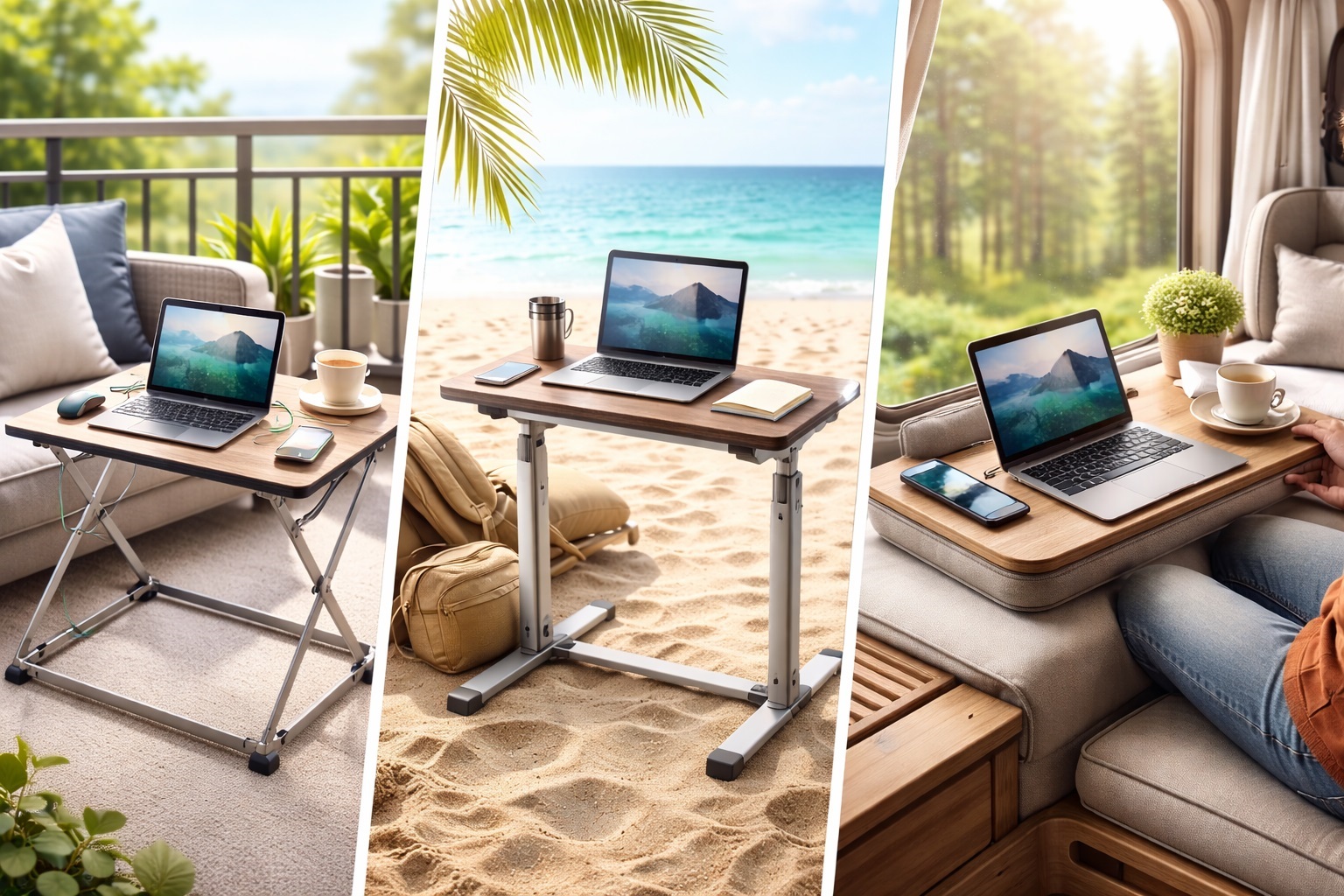
This style folds flat for packing and opens into a small, stable surface roughly the size of a laptop plus a notebook. It's designed as a general-purpose solution: light enough to carry daily, sturdy enough for actual typing, and versatile enough to use on a bed, a hotel desk that's too cluttered, or a low coffee table. For most people who travel regularly for work but don't have one fixed setup they return to, this is the style that ends up getting used the most often, simply because it adapts to whatever surface is available.
- Pros:
- Folds compactly enough to fit in most carry-on bags or backpacks
- Stable enough for regular typing, unlike a soft lap cushion
- Works across varied settings — bed, floor, low table, or hotel desk
- Cons:
- Surface area is limited compared to a dedicated folding table
- Not designed for standing use or multi-monitor setups
Best For: Travelers who want one flexible desk that works in multiple settings without dedicating a specific setup routine to it.
Why We Recommend It: It covers the widest range of travel scenarios with the fewest compromises, which is exactly what most frequent travelers need from a single piece of gear. It's also the style most likely to still be useful years into a travel routine, since it doesn't lock you into one specific setting the way a lap desk or a hotel-only design does.
Portable Lap Desk – Best For Couches, Beds, and No-Table Settings
A portable lap desk is built specifically for situations where there's no table at all — a plane seat, a couch, a hotel bed. Rather than folding into a freestanding table, it typically rests directly on your lap or legs, often with a cushioned or angled base that keeps it stable without a hard table surface underneath. This makes it the most useful option for travelers who do a meaningful share of their work reclined or seated somewhere without a desk nearby.
- Pros:
- Works in settings with no table or flat surface at all
- Comfortable for extended lap use, unlike a rigid flat board
- Typically lighter and more compact than a folding table
- Cons:
- Less stable than a freestanding desk for tasks needing precision, like writing by hand
- Not a substitute for a proper desk during long work sessions
Best For: Travelers who frequently work from planes, couches, or beds without access to a table.
Why We Recommend It: It solves a specific and common travel problem — the total absence of a usable surface — better than any style built around a rigid tabletop. For travelers who spend long stretches of a trip in transit seating or hotel beds rather than at a desk, this is often the single most-used item in their travel gear.
Ultralight Folding Table – Best For Minimal Packing Weight
Built around weight above all else, the ultralight folding table strips away anything that isn't essential to holding a laptop steady. Frames tend to be thin and minimal, and the whole unit is meant to disappear into a bag without meaningfully adding to its weight. For travelers who are already tracking every gram in a carry-on-only setup, this is the style that fits that mindset without asking for a trade-off in packed weight.
- Pros:
- Among the lightest options available in this category
- Packs down small, leaving more room in a bag for other gear
- Sufficient stability for basic laptop and typing use
- Cons:
- Lighter frames can feel less sturdy than heavier folding desks
- Smaller surface area limits use with additional accessories
Best For: Carry-on-only travelers and minimalist packers who prioritize weight and packed size above extra features.
Why We Recommend It: It directly answers the biggest objection frequent travelers have to bringing a desk at all — that it adds too much bulk or weight to a bag. For travelers who've previously left a bulkier desk at home simply to save space, this category removes that trade-off almost entirely.
Travel Desk for Hotel Use – Best For Extended Hotel Stays
Hotel room desks are notoriously inconsistent — some are spacious, many are undersized, poorly lit, or simply absent in budget accommodations. This style is designed to supplement or replace a hotel desk, typically offering a slightly larger surface than a lap desk along with enough stability for a multi-hour work session. It sets up quickly, which matters for travelers who move between hotels frequently and don't want a complicated assembly routine each time they check in.
- Pros:
- Larger surface than lap-focused designs, better suited to full workdays
- Quick to set up and pack away between hotel stays
- Can compensate for undersized or poorly positioned hotel desks
- Cons:
- Bulkier to pack than lap desks or ultralight folding tables
- Less useful in settings outside a hotel room, such as on a plane
Best For: Frequent hotel travelers who need a dependable, full-size work surface regardless of what the room provides.
Why We Recommend It: It removes the uncertainty of relying on whatever desk a hotel happens to provide, which matters for anyone working full days on the road. Business travelers in particular tend to appreciate the predictability — arriving in an unfamiliar city no longer means gambling on whether the room's desk will actually be usable.
Compact Standing Travel Desk – Best For Avoiding All-Day Sitting
For travelers who prefer to stand for at least part of their workday, this style offers a portable standing surface that sets up on a table, dresser, or other elevated base. It's bulkier than most other travel desk styles and asks more of your luggage space, but for someone managing back or neck strain from long sitting sessions, the ability to stand periodically during a work trip can matter more than packing convenience.
- Pros:
- Allows standing work during long travel workdays
- Can reduce strain from extended sitting on multi-day trips
- Sets up on top of existing furniture rather than needing a floor footprint
- Cons:
- Bulkiest and heaviest option among the styles reviewed here
- Requires a stable elevated surface underneath it to work properly
Best For: Travelers managing posture or back discomfort who want the option to stand periodically during work sessions.
Why We Recommend It: It's the only style here that directly addresses the physical toll of sitting through long travel workdays, which some travelers find worth the extra bulk. If back discomfort has ever cut a productive travel workday short, this is the category most likely to fix that specific problem rather than just working around it.
Budget Portable Work Surface – Best For Occasional Travelers
This category covers simple, no-frills folding surfaces that get the basic job done without the price tag of more specialized travel desks. They're usually a straightforward flat board or a simple folding frame, without the ergonomic angling or premium materials found in pricier options. For occasional travelers who don't need a desk for every trip, this is a reasonable way to have a backup surface on hand without a significant investment.
- Pros:
- Lowest price point among the styles covered in this guide
- Simple to use with no assembly or setup routine
- Adequate for occasional or short-term travel needs
- Cons:
- Less durable construction than dedicated travel desk designs
- Fewer features, such as angle adjustment or added stability
Best For: Occasional travelers who want a basic backup work surface without paying for features they won't use regularly.
Why We Recommend It: It covers the core need — something flatter and steadier than your lap — at a price that makes sense for infrequent use. There's little reason to pay for premium travel-desk features if the desk itself only comes out of the closet a couple of times a year, and a modest, no-frills surface tends to hold up fine when it's used a handful of times annually rather than being packed and unpacked on every trip. For someone still deciding whether they even like working from a portable desk at all, starting here also keeps the initial investment low enough that upgrading later to a more specialized style, once actual travel habits become clearer, doesn't feel like a wasted purchase.
Looking across all six styles, the common thread is that none of them try to be a full replacement for a home office desk. Each one solves a narrower, more specific problem — a missing table, an unreliable hotel desk, an overweight bag, or a long day of sitting — and the best choice is simply whichever problem shows up most often in your own travel routine.
Buying Guide: How to Choose the Best Travel Desk
Once you know the general styles available, matching one to your actual travel pattern is the next step. These are the factors that make the most practical difference for people building a mobile work setup.
1. Think about your typical trip length
A desk you'll use for a single weekend trip has different requirements than one meant for weeks of continuous travel. If you travel for extended stretches, prioritizing durability and comfort over the absolute lightest weight tends to pay off, since a fragile design has more opportunities to fail over a longer trip.
2. Weigh packed weight against your luggage limits
If you're flying carry-on only or watching airline weight limits closely, an ultralight design may be worth a trade-off in surface size or sturdiness. Travelers who check bags or drive to their destinations have more flexibility to prioritize comfort over weight.
3. Consider where you'll actually be working
A lap desk solves a different problem than a hotel desk substitute or a standing surface. Think honestly about whether you'll be working from beds and couches, hotel rooms with real desks, or a mix of both, and choose a style suited to your most common scenario rather than the least common one.
4. Check the surface size against your actual devices
If you regularly work with an external mouse, a second monitor, or a notebook alongside your laptop, make sure the desk's surface can accommodate all of it. Some ultralight and lap-desk styles are sized for a laptop alone and little else.
5. Assess setup and breakdown speed
Frequent movers — those checking in and out of accommodations every day or two — benefit most from designs that set up and fold away in seconds. A desk that takes several minutes to assemble becomes a chore quickly when you're doing it daily.
6. Test stability on uneven or soft surfaces
Hotel carpets, bedspreads, and uneven outdoor tables can all affect how stable a folding desk feels in practice. If you expect to use your desk on surfaces other than a hard floor or table, look specifically for reviews or specifications addressing stability under those conditions.
7. Factor in whether you need standing capability
If back or neck discomfort is a concern on long trips, a standing-capable design may be worth the extra bulk. If it isn't a concern for you, a flatter, lighter desk will serve you better without the added packing weight.
8. Consider material durability for frequent travel
Desks that travel constantly are exposed to more wear than furniture that stays in one place — being packed and unpacked, jostled in transit, and set up on a wide range of surfaces. A slightly heavier but sturdier build can outlast a lighter one that wasn't designed for constant handling.
9. Check compatibility with your specific laptop size
Larger laptops, particularly 16-inch and 17-inch models, need a wider stable surface than an 11-inch ultraportable. Confirm the desk's dimensions against your actual device rather than assuming a "laptop desk" will automatically fit any laptop.
10. Think about how it fits into your existing travel bag
A travel desk that doesn't fit your typical carry-on or backpack defeats much of its purpose. Check its folded dimensions against the bag you actually travel with, rather than assuming it will fit because it's described as "portable."
11. Look at price relative to how often you'll use it
A frequent business traveler who works from the road every month has different value math than someone who travels occasionally for leisure and occasionally needs to check email. Match your spending to how much genuine use the desk will get.
12. Read return policies before buying online
Since travel desks are often bought without a chance to test them in person, check the retailer's return policy in case the stability or size doesn't match your expectations once you've tried it in real travel conditions.
13. Consider how many people will use it
If you travel with a partner or colleague who also needs a workspace, factor in whether you need two smaller desks or one larger shared surface. This changes the packing calculus significantly compared to buying for a single traveler.
14. Account for climate and environment
Humid climates, sandy beaches, or cold outdoor conditions can all affect certain materials differently. If your travel involves varied climates, check whether the desk's materials are rated to handle temperature and moisture swings without warping.
15. Think about cable and accessory management
A charger cord, a mouse, and sometimes a second cable for an external monitor all need somewhere to go once your desk is set up. Designs with even a simple pocket, strap, or routing channel keep cords from dangling off the edge or tangling underfoot, which matters more than it sounds like on a desk you're setting up and breaking down daily. If you regularly travel with more than just a laptop, this small detail can make the difference between a tidy setup and a cluttered one.
16. Weigh noise and stability while typing
A desk that flexes, creaks, or wobbles with every keystroke is a minor annoyance at home but a bigger problem while traveling, whether you're trying to work quietly next to a sleeping partner in a hotel room or typing in a shared hostel common area. Firmer, better-braced designs tend to feel more solid under regular typing, while lighter or thinner builds can transmit more motion and sound. If quiet, stable typing matters to your routine, it's worth weighing against the weight savings a flimsier design might offer.
Frequently Asked Questions
What is the difference between a travel desk and a laptop stand?
A laptop stand typically elevates and angles a laptop for better ergonomics on an existing surface, while a travel desk creates the surface itself. Many travelers use both together, especially on trips where no table is available at all.
Are folding travel desks sturdy enough for real work?
Sturdiness varies significantly by design and materials, which is why matching the style to your specific use case matters. A model built for a specific purpose, such as lap use or hotel-room use, tends to perform better within that role than a generic folding surface asked to do everything.
Can a travel desk replace a hotel room desk entirely?
For many travelers, yes, particularly when a hotel desk is undersized, poorly lit, or positioned somewhere inconvenient. A dedicated travel desk gives you a consistent setup regardless of what any individual hotel room provides.
How much does a good travel desk typically weigh?
Weight varies by style, with ultralight folding tables generally the lightest and standing-capable designs generally the heaviest. If packed weight matters to your travel style, compare specific product weights rather than assuming all folding desks weigh roughly the same.
Do I need a travel desk if I mostly work from cafes?
Cafes usually provide a table, which reduces the need for a travel desk in that specific setting. A travel desk becomes more valuable for hotel rooms, transit, or accommodations without a dedicated workspace.
Is a portable standing desk worth the extra bulk for travel?
It depends on how much you value the ability to stand periodically during long work sessions. For travelers managing back or posture issues, the benefit can outweigh the added packing size. For others, a flatter design is usually the more practical choice.
Can a lap desk be used on a plane tray table?
Many lap desks work fine directly on a lap without needing a tray table at all, which is part of their appeal for economy-class travel where tray tables are small. Check the specific product's intended use if plane use is a priority.
How do I keep a travel desk from sliding on smooth surfaces?
Look for designs with a grippy or rubberized base, and be cautious using flat, ungripped surfaces on polished tables or smooth countertops. Some travelers add a thin non-slip mat underneath as an extra precaution.
What's the most common regret travelers have after buying a travel desk?
Buying a style that doesn't match their actual travel pattern — for example, purchasing a bulky standing desk for trips where lap use would have been more practical, or the reverse. Being specific about your typical work setting before buying helps avoid this.
Are travel desks worth it for occasional travelers?
For infrequent trips, a simple budget option is usually sufficient rather than investing in a premium, feature-rich design. Reserve the higher-end options for travelers who work on the road on a regular basis.
Can a travel desk double as a home desk when not traveling?
Some compact and foldable designs work reasonably well as an occasional home desk, particularly in small apartments, though they generally aren't built for the same daily wear as furniture designed to stay in one place permanently.
How do I clean a travel desk after regular use?
Most folding surfaces can be wiped down with a damp cloth, though it's worth checking the specific material before using any cleaning products, since some finishes are more sensitive to certain chemicals than others.
Is it better to buy a travel desk before a big trip or well in advance?
Buying well in advance gives you time to test it on a shorter trip first, so you can catch any sizing or stability issues before relying on it during a longer, more important trip.
Can two travelers share one travel desk?
It depends on the size and style. A larger hotel-focused desk can sometimes work for quick shared use, but most travel desks are sized around a single laptop and aren't practical for two people working simultaneously.
Do travel desks come with a warranty?
Coverage varies by manufacturer and price point. Given how much handling travel gear goes through, checking the warranty terms before buying is a reasonable step, particularly for pricier or more mechanically complex designs like standing desks.
Should I pack a travel desk in checked luggage or carry it on?
Lightweight, foldable styles are generally fine in carry-on luggage and add little bulk. Bulkier hotel-focused or standing designs may be better suited to checked luggage or car travel where weight and space restrictions are less strict.
What's a reasonable price range for a good travel desk?
Prices vary widely by style and materials, but most practical, durable options fall into an accessible mid-range bracket. Spending significantly more usually buys extra stability, premium materials, or added features like standing capability rather than a fundamentally different experience.
Can a travel desk be used with a tablet instead of a laptop?
Yes, and in some ways a tablet is an easier fit, since it's lighter and puts less strain on a smaller or lighter-built desk surface. Travelers who work primarily from a tablet with a keyboard case can often get away with a smaller, lighter style than someone who needs to support a full-size laptop.
How long should a travel desk realistically last with regular use?
A well-built travel desk used on a normal travel schedule should hold up for several years of regular folding and unfolding, though the busiest travelers who set up and break down daily will naturally see more wear than someone using theirs a few times a month. Choosing a sturdier build over the absolute lightest option tends to pay off in longevity for anyone traveling on a frequent, ongoing basis.
Final Verdict
- Best Overall: The foldable laptop travel desk, for its balance of portability and everyday versatility.
- Best Budget: The budget portable work surface, for covering basic needs at the lowest cost.
- Best for Minimal Packing Weight: The ultralight folding table, for travelers counting every ounce.
- Best for Long Workdays: The travel desk for hotel use, for dependable full-day work sessions on the road.
The right travel desk comes down to matching its strengths to your actual travel habits rather than chasing the most feature-rich option available. A frequent flyer working from planes and hotel beds needs something very different from someone who mostly wants backup coverage for the occasional bad hotel desk. Once you're clear on how and where you actually work while traveling, the right choice tends to become obvious.
It's also worth revisiting the choice periodically rather than assuming your first travel desk purchase will suit every future trip. A schedule that shifts from short weekend trips to extended multi-week stays, or from solo travel to trips with a partner who also needs a workspace, can change which style actually serves you best. Treating this as a decision you can revisit, rather than a one-time purchase, keeps your setup matched to how you're traveling now rather than how you traveled when you first bought it.