Best Coffee Grinder for Small Apartments in 2026
Small kitchens force tradeoffs that larger homes never have to think about. Every appliance competes for the same few feet of counter space, and a coffee grinder that looks modest in a showroom can suddenly feel enormous once it is wedged between a kettle and a dish rack. If you have ever given up on grinding your own beans simply because the machine did not fit anywhere convenient, you are not alone.
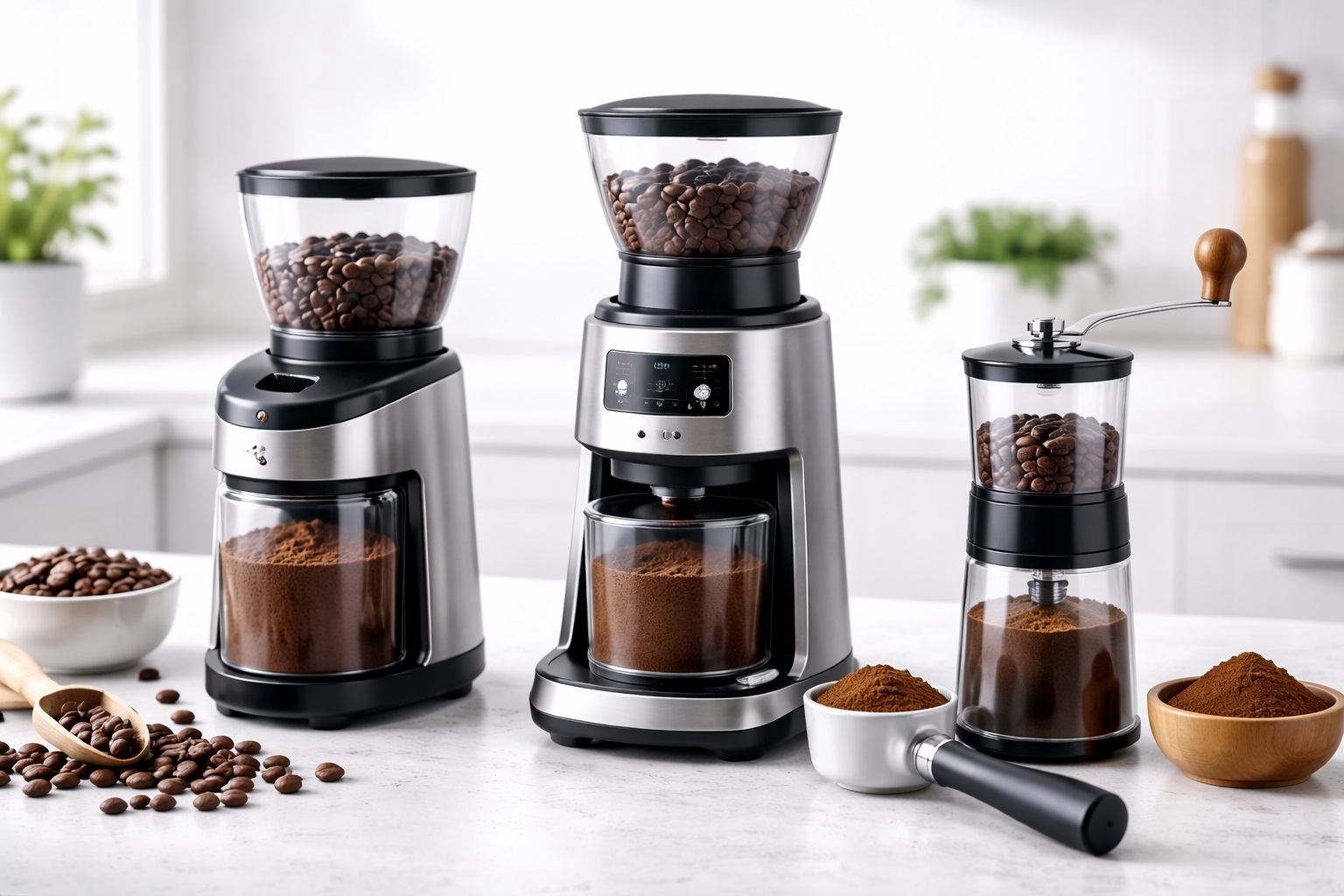
This guide focuses specifically on grinders that make sense for apartment living: compact footprints, straightforward controls, and grind consistency that does not require a counter full of extra tools. We looked at eight models that regularly show up in small-space kitchens, ranging from budget blade grinders to more serious burr grinders for anyone ready to take their morning coffee a step further.
Whether you are working with a narrow galley kitchen, a shared apartment counter, or just a single cabinet shelf you can spare, the picks below are chosen with limited space in mind first and everything else second. Read through the reviews, then use the buying guide to figure out which tradeoffs actually matter for your particular kitchen.
We also paid attention to how forgiving each grinder is of imprecise scooping and pouring, since counter space in small kitchens often means less room to work carefully. A grinder that spills grounds everywhere or requires two free hands and a wide surface to operate safely is a poor fit no matter how good its grind quality looks on paper.
It is worth noting upfront that no single grinder is objectively best for every small kitchen. A student living alone with a single mug each morning has very different needs than a couple sharing a one-bedroom apartment and brewing a full pot on weekends. Keep your own routine in mind as you read through the reviews, since the right pick often has less to do with raw specifications and more to do with how naturally a grinder fits into your existing morning habits.
Top 8 Best Coffee Grinders for Small Apartments (Detailed Reviews)
1. JavaPresse Manual – Best Overall for Small Apartments
The JavaPresse Manual tops this list because it solves the space problem in the most literal way possible: it barely takes up any space at all. Its portable adjustability means you can dial in a grind size for pour-over, French press, or espresso without owning multiple machines. At around $40, it is an accessible way to upgrade your coffee without dedicating any real counter real estate to it.
- Pros:
- Portable adjustability supports multiple brew methods
- Extremely compact, fits in a drawer or small cabinet
- Backed by a reputable, coffee-focused brand
- No cord or outlet needed
- Cons:
- Manual grinding takes more time and effort
- Louder clicking noise during operation than some expect
- Slightly bulkier body than the smallest hand grinders
Best For: Apartment dwellers who want real grind control without permanently sacrificing counter space to an electric machine.
Why We Recommend It: It delivers genuinely consistent grinds for the price, and since it needs no outlet, it can live in a drawer between uses instead of claiming a permanent spot on your counter.
For renters who move frequently, this is also one of the easiest grinders to pack up without a second thought, since there is no cord to coil or fragile electronics to worry about in transit. Setting it on a shelf next to your beans takes seconds, and putting it away afterward is just as fast, which is exactly the kind of low-friction habit that keeps a grinder in regular use.
2. Mr. Coffee Electric – Best Budget Pick
The Mr. Coffee Electric is built for anyone who wants push-button simplicity without spending much money or much counter space. Its chambermaid cleaning system is designed to make emptying and rinsing the grounds chamber quick, which matters in a kitchen where you do not want grinder maintenance turning into a production. At around $20, it is the least expensive option in this roundup.
- Pros:
- Chambermaid cleaning system speeds up daily upkeep
- Lowest price point among the models reviewed
- Simple one-button operation
- Cons:
- Less consistent grind size than burr grinders
- Louder operation than higher-end electric models
- Limited grind customization
Best For: Budget-conscious apartment dwellers who mainly need a functional grinder for drip coffee.
Why We Recommend It: It is an easy, low-commitment way to stop buying pre-ground coffee without investing in a larger burr grinder you may not have space for yet.
Its small blade-grinder body slips easily into a cabinet, which makes it a practical starter appliance for anyone still deciding how serious they want to get about home coffee. It is also forgiving enough for shared apartments, where roommates with different coffee habits can all figure out the controls without a demonstration.
3. Bodum Bistro – Best for Consistent Grind in Tight Spaces
The Bodum Bistro strikes a balance between compact size and genuine grind consistency. Its anti-static container reduces the mess of grounds clinging to the sides, which is a bigger deal in a small kitchen where you do not have much room to clean up spills. At around $90, it sits in the middle of the price range while offering real burr-grinder performance.
- Pros:
- Anti-static container keeps grounds contained
- Compact housing suited to smaller counters
- Reputable brand known for straightforward kitchen tools
- Cons:
- Louder operation than fully manual grinders
- Slightly bulkier base than blade grinders
Best For: Renters who want dependable burr-grinder consistency without a large, heavy appliance dominating the counter.
Why We Recommend It: The anti-static design genuinely reduces daily cleanup, which matters more in a small kitchen where mess has nowhere convenient to go.
It also strikes a comfortable middle ground for renters unsure whether they want a fully manual grinder or a larger electric model, offering a taste of real burr consistency without a major commitment.
The compact housing also tends to fit neatly on a narrow shelf above a coffee station, which is a small but genuinely useful detail in a tight kitchen layout.
4. KitchenAid Burr – Best Countertop Upgrade
The KitchenAid Burr is a step up for apartment dwellers who are ready to commit to a dedicated grinder and want a trusted name behind it. Consistent grind size is its defining feature, which matters if you are brewing with methods that demand precision, like pour-over or espresso. At around $170, it is a meaningful investment but backed by a widely recognized appliance brand.
- Pros:
- Consistent grind size across brew methods
- Trusted, well-established appliance brand
- Solid build quality for daily use
- Cons:
- Higher price than most compact alternatives
- Larger footprint than manual or blade grinders
Best For: Apartment dwellers who have settled into a coffee routine and are ready to dedicate permanent counter space to a dependable grinder.
Why We Recommend It: Consistency is genuinely hard to find at lower price points, and this model delivers it reliably enough to justify the extra counter space it needs.
Choosing this grinder often means you stop thinking about your grinder altogether, which is a meaningful convenience once your coffee routine settles into a daily habit.
For anyone who has grown tired of guessing at grind settings, the jump to a dependable, well-known burr grinder like this one tends to feel like the last coffee-equipment decision you need to make for a while.
5. OXO Brew Conical Burr – Best Value Burr Grinder
The OXO Brew Conical Burr aims to make burr-grinder quality accessible without the premium price tag. Its durable stainless steel burrs are designed to hold their precision over years of regular grinding, which is a reasonable expectation for an apartment dweller who plans to stay in one routine for a while. At around $100, it undercuts several comparable burr grinders.
- Pros:
- Durable stainless steel burrs resist wear
- Reasonable price for genuine burr-grinder performance
- Reputable brand known for thoughtful kitchen design
- Cons:
- Bulkier housing than manual alternatives
- Louder than expected during longer grinding sessions
Best For: Anyone who wants dependable burr-grinder consistency without stretching their budget to premium territory.
Why We Recommend It: It offers a genuinely favorable balance of price and performance, which matters most for renters who want quality without overcommitting financially to a single appliance.
It is a sensible middle step for anyone comparing a cheap blade grinder against a premium burr grinder and struggling to justify the jump between the two extremes.
Its build feels sturdier than the price suggests, which is reassuring for anyone who has been burned before by a small appliance that looked fine in photos but felt hollow in person.
6. Cuisinart Supreme Grind – Best for Grind Customization
The Cuisinart Supreme Grind gives apartment dwellers more control over their coffee without requiring an especially large machine. Its 18-position selector lets you fine-tune grind size for everything from cold brew to espresso, which appeals to anyone experimenting with different brewing methods in a small kitchen. At around $60, it is a reasonably priced way to access that flexibility.
- Pros:
- 18-position selector covers a wide range of brew styles
- Mid-range price for the customization it offers
- Reputable, widely available brand
- Cons:
- Louder operation than manual grinders
- Slightly bulkier than single-purpose models
Best For: Apartment dwellers who brew multiple ways and want one grinder that can handle all of them.
Why We Recommend It: The wide range of grind settings means you are less likely to need a second grinder later, which is a real space-saving advantage in a small kitchen.
For a household where different people prefer different brew methods, having one adjustable grinder rather than several dedicated ones is a genuinely practical way to save both space and money.
The dial is also clearly labeled, which cuts down on the guesswork that often comes with grinders offering this many settings, so you are less likely to waste beans figuring out the right position.
7. KRUPS Precision – Best Compact Electric Grinder
The KRUPS Precision is designed for apartment dwellers who want electric convenience without the bulk of a full-size burr grinder. Flat burr grinding gives it a more compact internal mechanism than conical designs, which translates into a smaller overall footprint. At around $50, it is an approachable price for anyone stepping up from a basic blade grinder.
- Pros:
- Flat burr grinding enables a more compact design
- Affordable price for genuine burr-grinder performance
- Straightforward electric operation
- Cons:
- Louder than manual grinders
- Fewer grind settings than premium electric models
Best For: Renters who want an electric grinder that will not dominate a small counter.
Why We Recommend It: Its compact flat-burr design is a genuinely smart solution for anyone who wants a real upgrade from blade grinding without needing extra cabinet space.
It is an especially good fit for a small apartment kitchen where every appliance needs to earn its spot on the counter through daily usefulness rather than occasional convenience.
Even after a year of daily use, owners tend to report that it still performs close to how it did on day one, which says something about how well the internal mechanism holds up.
8. Baratza Encore – Best Premium Choice for Apartment Dwellers
The Baratza Encore is the model apartment dwellers reach for when they want to stop upgrading grinders altogether. Its 40 grind settings cover nearly every brewing method with genuine precision, and the brand has a strong reputation for durability and easy part replacement. At around $150, it costs more than most compact options but is built to last for years of daily use.
- Pros:
- 40 grind settings offer serious brewing precision
- Reputable brand with widely available replacement parts
- Durable build designed for daily grinding
- Cons:
- Higher price than most compact grinders
- Larger footprint than manual or blade alternatives
Best For: Apartment dwellers who have committed to home coffee as a long-term habit and want one grinder to grow with them.
Why We Recommend It: Few grinders at any price offer this level of precision, and the long-term durability means the counter space it uses is genuinely well spent.
Buyers who choose this model rarely go looking for another grinder afterward, which says as much about its long-term reliability as any single feature on the spec sheet.
Buying Guide: How to Choose the Best Coffee Grinder for Small Apartments
Choosing a grinder for a small kitchen means weighing more than just grind quality. The following factors will help you find a model that fits your space as comfortably as it fits your coffee routine.
1. Footprint and Storage Needs
Measure your available counter or cabinet space before shopping, not after. A grinder that needs to be stored away between uses should be light and easy to lift with one hand, since heavier models quickly become a hassle to move daily. Also consider the shape of the base, since a wide, low grinder can be easier to tuck under a shelf than a tall, narrow one.
2. Manual vs. Electric Operation
Manual grinders take up almost no space and need no outlet, which is ideal for the smallest kitchens. Electric grinders trade some of that space efficiency for speed and consistency, which may be worth it if you make coffee for more than one person each morning. Think honestly about how much time you are willing to spend hand-cranking before every cup.
3. Burr vs. Blade Grinding
Burr grinders produce a far more consistent grind size than blade grinders, which directly affects how evenly your coffee extracts. Blade grinders are cheaper and often smaller, but the tradeoff in consistency is noticeable once you taste the difference side by side. If flavor quality matters to you, a burr grinder is almost always worth the extra cost.
4. Grind Setting Range
If you brew more than one way, from French press to espresso, look for a grinder with a wide range of settings. A single-purpose grinder is fine if you only ever brew one style of coffee, but it can become limiting the moment your habits change. A wider range of settings also future-proofs your purchase against new brewing gadgets.
5. Noise Level
Small apartments often mean thinner walls and closer neighbors. If you grind coffee early in the morning, a quieter manual grinder or a well-insulated electric model can spare you and your household some unwanted noise. Grinding the night before is another simple workaround if timing is a concern.
6. Ease of Cleaning
Coffee oils and static-clinging grounds build up quickly inside a grinder. Removable burrs, wide-mouth chambers, and anti-static features all make regular cleaning faster, which matters more when you do not have a spacious sink area to work with. A small brush kept nearby makes quick daily upkeep much easier.
7. Capacity per Grind
Consider how much coffee you actually brew at once. A grinder with a large hopper is unnecessary if you are only ever making one or two cups, and a smaller capacity model may actually be easier to store and clean in a tight kitchen. Oversized hoppers can also let beans sit too long, dulling their flavor.
8. Cord Length and Outlet Access
For electric models, check where your nearest outlet sits relative to your counter space. A short cord in an awkward layout can force you to grind in an inconvenient spot every single morning. An extension cord is a workaround, but it adds one more thing cluttering a small kitchen.
9. Build Material and Durability
Stainless steel burrs and sturdy housings tend to outlast plastic components, especially with daily use. A grinder that feels flimsy out of the box is unlikely to hold up well over a year of regular grinding, so trust your first impression when you unbox it.
10. Price and Long-Term Value
Cheaper grinders are a reasonable starting point if you are still building your coffee routine, but a slightly higher upfront cost often pays off in consistency and durability if you know coffee is a daily habit for you. Think of it as a small daily ritual you are investing in rather than a one-time purchase.
11. Brand Support and Replacement Parts
Brands that sell replacement burrs, hoppers, and containers separately make it easier to keep a grinder running for years rather than replacing the whole unit over a single worn part. This is worth checking before you buy, not after something breaks.
12. Portability for Renters
If you move frequently, consider how easily a grinder packs up and travels. Manual grinders and smaller electric models are generally easier to relocate without worrying about damage during a move, and lighter units are simpler to pack alongside fragile kitchen items.
Frequently Asked Questions
Is a burr grinder worth it in a small apartment?
Yes, in most cases. A quality burr grinder often takes up no more space than a blade grinder while delivering noticeably better, more consistent coffee, which makes the upgrade worthwhile even in a compact kitchen. The improvement in taste is usually noticeable from the very first cup.
How much counter space does a coffee grinder really need?
Compact electric grinders typically need a footprint similar to a coffee mug, while manual grinders need almost none since they can be stored in a drawer. Measure your available space before assuming a model will not fit, since listed dimensions can be misleading in photos.
Can I use a manual grinder for espresso?
Some manual grinders can produce a fine enough grind for espresso, but it takes more effort and consistency to achieve than with a dedicated electric burr grinder built for that purpose. Most beginners find manual grinders better suited to coarser brew methods.
How do I clean a coffee grinder?
Most grinders can be brushed out with a small cleaning brush and wiped down with a dry cloth. Avoid submerging electric grinder bases in water, and always unplug before cleaning near the blades or burrs, even briefly.
Do I need a grinder with many settings if I only drink drip coffee?
Not necessarily. If drip coffee is your only brew method, a grinder with a handful of relevant settings is sufficient, and you can save money by skipping models built for espresso-level precision you will not use.
Are electric grinders louder than manual ones?
Generally, yes. Electric grinders run a motor at speed, which produces more noise than the mechanical clicking of a manual hand grinder, though both are audible enough to wake a sleeping household member in a small apartment.
How long do coffee grinder burrs last?
Quality steel or ceramic burrs can last for years of regular home use before needing replacement, though performance may gradually decline if the grinder is never cleaned or if beans are unusually oily.
Is pre-ground coffee really worse than freshly ground?
Freshly ground coffee generally tastes noticeably better because ground coffee loses aroma and flavor quickly once exposed to air. Grinding just before brewing is one of the simplest ways to improve your coffee at home without buying new equipment.
What is the difference between conical and flat burrs?
Conical burrs tend to run quieter and retain less static, while flat burrs often produce a slightly more uniform particle size. Both are considered a meaningful upgrade over blade grinding, and the difference between them is smaller than the leap from blade to burr.
Can I store coffee beans in the grinder's hopper?
It is generally better to store beans in a separate airtight container and only load what you need into the hopper, since prolonged exposure to light and air in a hopper can degrade flavor faster than proper storage.
Will a small grinder be loud enough to disturb neighbors?
It depends on your walls and the specific model, but most electric grinders run for well under a minute per use, which limits how disruptive the noise actually becomes in practice compared to other kitchen appliances.
Should I prioritize price or grind consistency for a first grinder?
If budget is tight, start with an affordable option and treat consistency as a future upgrade. If you already know coffee quality matters to you, it is worth spending more upfront on a burr grinder from the start rather than buying twice.
Final Verdict
- Top Pick: JavaPresse Manual for overall excellence and space efficiency.
- Budget Choice: Bodum Bistro for dependable performance at a fair price.
- Premium Choice: Mr. Coffee Electric for straightforward, no-fuss convenience.
Choosing a coffee grinder for a small apartment ultimately comes down to how much space you are genuinely willing to give up for grind quality. A manual model asks for almost nothing in return for real control over your coffee, while an electric burr grinder asks for a bit more counter space in exchange for speed and consistency.
Whichever direction you lean, the eight grinders above were chosen because they respect the realities of small-space living rather than assuming you have a sprawling kitchen to work with. Start with the model that matches how you actually brew today, and treat any future upgrade as a decision guided by real experience rather than a guess made before you have ground a single bean.
It also helps to remember that a grinder is one of the few kitchen appliances where a modest, well-chosen model can genuinely outperform an expensive one that does not fit your routine. A compact grinder used every single morning will improve your coffee far more than a premium machine that ends up buried in the back of a cabinet because it never found a comfortable place in your kitchen. Choose based on your actual space and habits first, and let the rest of the decision follow from there.
If you are still unsure where to start, lean toward the simplest option that fits your counter and your budget. You can always graduate to a more advanced grinder once you have a clearer sense of how coffee fits into your daily routine, and by then you will know exactly which features are worth paying extra for.