Best Electric Kettles for Daily Tea and Coffee: Precision Boiling for Every Brew
Few kitchen appliances match the electric kettle\'s combination of daily utility and underestimated importance. For the hundreds of millions of daily tea and coffee drinkers worldwide, the kettle is the first appliance activated every morning and among the most frequently used throughout the day. Yet most households own a kettle without having deliberately selected one — it came with the rental, was a casual gift, or was the cheapest available at the time.
The difference between a basic and a thoughtfully chosen kettle is felt in every morning cup: the temperature precision that produces green tea without bitterness, the rapid boil speed that doesn\'t require planning your tea break 10 minutes in advance, the pour control that doesn\'t flood your cup with aggressive flow, and the cleaning ease that makes weekly descaling take 5 minutes rather than a frustrating scrubbing session.
This guide explains what actually matters in kettle selection for your specific daily beverage habits, household size, and kitchen setup — with detailed reviews of each kettle type and a comprehensive guide to everything from limescale prevention to the chemistry of tea temperature.
Quick Comparison: Top Picks at a Glance
| Product Type | Best For | Our Take |
|---|---|---|
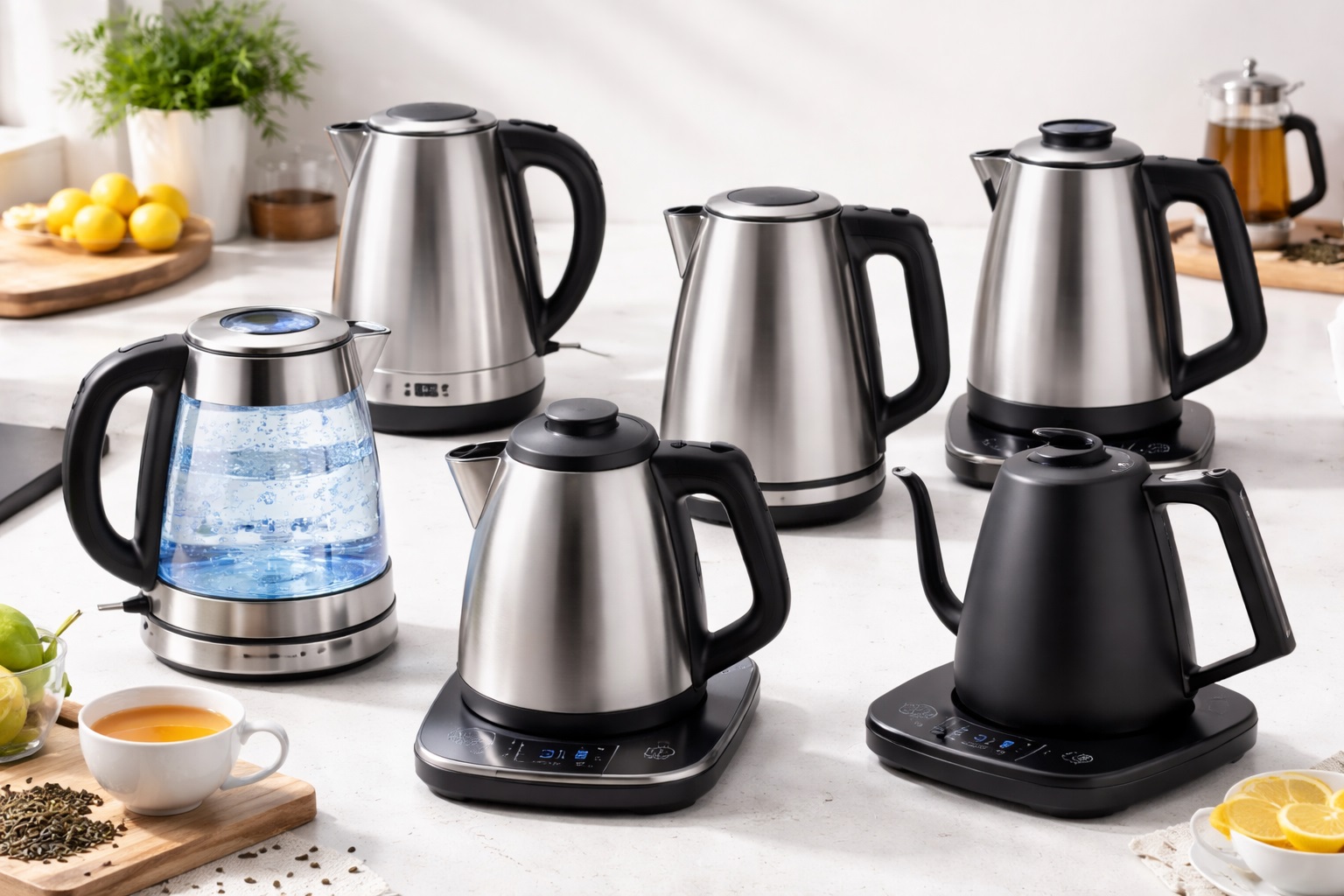
| 1.7L Stainless Steel Auto-Shutoff Kettle | Best Everyday Workhorse | Best general-purpose, no-compromise daily kettle. |
| Variable Temperature Smart Kettle | Best for Specialty Tea and Coffee | Best flavor optimization for specialty tea and coffee brewing. |
| Gooseneck Pour Kettle | Best for Pour-Over Coffee and Precise Brewing | Best precision pour for manual coffee brewing techniques. |
Top electric kettle for daily tea and coffee Picks — In-Depth Reviews
Each product type below has been evaluated based on real performance factors relevant to daily tea and coffee drinkers who want temperature control and fast boiling for consistently perfect hot drinks every day. We've included detailed performance notes, value assessments, and clear guidance on who each option suits best.
1. 1.7L Stainless Steel Auto-Shutoff Kettle — Best Everyday Workhorse
A 1.7-liter stainless steel kettle with automatic shutoff is the standard-bearer for practical household water boiling. The 1.7L capacity handles 6–7 mugs per boil — sufficient for most family morning routines or afternoon tea sessions without multiple boil cycles. Stainless steel interior avoids plastic taste concerns common with BPA-free plastic interiors, and auto-shutoff is the essential safety feature that prevents boiling dry.
Boiling times for a full 1.7L are typically 4–5 minutes at 1800–3000W (depending on region voltage — UK 3000W kettles boil significantly faster than US 1500W models due to voltage differences). For household water heating, this represents the optimal balance of capacity, speed, and counter space. Thermal carafe insulation on some models maintains boiling temperature for 30–60 minutes after the boil cycle completes.
- Pros:
- 1.7L serves 6-7 mugs per boil
- Auto-shutoff prevents boiling dry
- Stainless interior avoids plastic taste
- Wide-mouth opening simplifies filling and cleaning
- Cons:
- No temperature control — boils to 100°C only
- Thermal carafe models add weight
Best For: Most households for daily general-purpose water heating.
Performance Verdict: Delivers fast, safe, consistently hot water without any guesswork or manual intervention. The auto-shutoff and boil-dry protection make it a set-and-forget appliance in daily use.
Who Should Buy This: Any household using boiled water for tea, coffee, instant meals, baby food preparation, or cooking.
Value Assessment: The cost-per-boil across a year of daily use is negligible. The primary investment is the initial purchase — after which the appliance delivers value for 5–10 years of daily use at minimal electricity cost.
2. Variable Temperature Smart Kettle — Best for Specialty Tea and Coffee
Variable temperature kettles allow setting specific temperatures between 60°C and 100°C in precise increments — typically 5°C steps. This precision matters significantly for specialty teas and coffee. Green tea brewed at 80°C rather than 100°C produces a dramatically smoother flavor because boiling water extracts tannins that create bitterness; lower temperatures preserve the delicate polyphenol compounds that create green tea's characteristic taste.
The temperature presets on quality smart kettles encode specific optimal temperatures for different beverages: White tea at 65°C, Green tea at 75–80°C, Oolong at 85°C, Black tea at 95°C, French press coffee at 92°C, and boiling at 100°C for instant coffee, herbal tea, and cooking. A keep-warm function holds the set temperature for 20–30 minutes, allowing unhurried brewing without temperature dropping before steeping is complete.
- Pros:
- Precise temperature settings for different tea and coffee types
- Keep-warm holds temperature during brewing
- Prevents bitterness from over-hot brewing of delicate teas
- Gooseneck option for precise pour control
- Cons:
- Higher cost than standard kettles
- Temperature precision adds unnecessary complexity for non-specialty drinkers
Best For: Tea enthusiasts, specialty coffee brewers, and anyone who regularly makes multiple types of tea or precise pour-over coffee.
Performance Verdict: The temperature control fundamentally changes the quality ceiling of tea and coffee preparation. For specialty tea drinkers who have never used a variable temperature kettle, the improvement in green and white tea quality is immediately and dramatically noticeable.
Who Should Buy This: Specialty tea and coffee enthusiasts who understand different brews benefit from different temperatures and want precise control over their daily brewing.
Value Assessment: Variable temperature kettles cost 2–4x more than standard alternatives. For daily specialty tea or coffee drinkers, the per-cup quality improvement and the replacement of expensive café beverages justify this premium. For standard black tea and instant coffee drinkers, the premium adds no practical value.
3. Gooseneck Pour Kettle — Best for Pour-Over Coffee and Precise Brewing
A gooseneck kettle features a long, curved narrow spout that provides precise water flow control during manual brewing. This precision matters critically for pour-over coffee methods (V60, Chemex, AeroPress) where the rate, direction, and pattern of water application to coffee grounds determines extraction quality and consistency. Standard kettle spouts pour too aggressively for controlled pour-over technique.
Both stovetop and electric gooseneck kettles exist; electric models with temperature control combine the precision pour with accurate temperature — the combination required for specialty coffee preparation. The narrow spout produces a thin, controllable stream that allows technique-conscious brewers to execute blooming, circular pours, and targeted saturation patterns that optimize extraction.
- Pros:
- Precise flow control for pour-over brewing technique
- Narrow spout enables targeting specific areas of coffee bed
- Electric models with temperature control for complete brewing precision
- Aesthetic design suits specialty coffee presentation
- Cons:
- Narrow spout makes filling slightly more time-consuming
- Higher cost than standard electric kettles
Best For: Pour-over coffee enthusiasts, specialty coffee brewers, and anyone for whom manual brewing technique is part of the coffee ritual.
Performance Verdict: The gooseneck design is purpose-built for manual brewing technique. The difference in pour control between a standard kettle and a gooseneck is immediately apparent on first use — the thin, steady stream allows a level of brewing precision that standard kettles simply cannot replicate.
Who Should Buy This: Specialty coffee enthusiasts committed to manual brewing methods who want the equipment to match their technique.
Value Assessment: Gooseneck kettles range from $40–150 for electric models with temperature control. For daily specialty coffee brewers, the per-cup cost at home versus café pricing means the kettle pays for itself within weeks of use.
Complete Buying Guide: How to Choose the Best Best Electric Kettles for Daily Tea and Coffee: Precision Boiling for Every Brew
Knowing which product to buy is one challenge. Understanding why one product is better suited to your specific situation is the more useful skill. The following guide explains every important buying factor in plain, practical terms.
1. Boiling Speed: Wattage Matters
Electric kettle wattage determines how quickly water reaches boiling temperature. US 120V kettles max out at approximately 1500W due to circuit limitations. UK 230V kettles commonly reach 3000W. At 1500W, a full 1.7L takes 5–7 minutes. At 3000W, the same volume boils in 2–3 minutes. If you need fast water frequently, the highest wattage available for your electrical system is the practical priority.
Pro Tip: In the US, 1500W is the practical maximum for household kettles without dedicated circuits. If speed is critical and you're in a 120V region, look for the highest available wattage within the 1500W limit rather than expecting the fast boil times seen in UK kettle reviews.
2. Capacity for Your Household Size
1.0L suits 1–2 people who boil 1–3 mugs at a time. 1.5L suits 2–4 people. 1.7–2.0L suits 4+ people or households that boil multiple rounds without refilling. Boiling only what you need is the most energy-efficient approach — a half-full kettle boils in half the time and uses half the energy of a full one.
Pro Tip: The most energy-efficient kettle habit: fill only the amount you'll use per session. Most kettles have a minimum fill level (typically 500ml) — below this, the heating element may be exposed and can damage the unit.
3. Materials: Stainless, Glass, or Plastic
Stainless steel interiors: most hygienic, no taste impact, easy to clean, rust-resistant, durable. Glass interiors: visually appealing, no taste impact, allows inspection of interior cleanliness, fragile. Plastic interiors: lightest and least expensive, BPA-free is safe, but some users report a mild plastic taste particularly in new units that fades after break-in period. For daily water heating, stainless steel provides the best combination of hygiene, durability, and taste neutrality.
Pro Tip: If you choose a plastic exterior kettle, ensure the interior in contact with water is stainless steel rather than plastic. The exterior material has no impact on taste; the interior surface does.
4. Descaling and Limescale Prevention
Limescale (calcium carbonate deposits) accumulates inside kettles from hard water. Limescale reduces heating efficiency (insulates the heating element), can flake into boiled water, and shortens the heating element's lifespan if left unaddressed. Descale monthly in hard water areas using white vinegar (fill halfway with equal parts water and white vinegar, boil, let stand 30 minutes, discard, rinse twice) or citric acid solution.
Pro Tip: The rate of limescale accumulation depends on water hardness. In very hard water areas, descaling every 2–3 weeks maintains optimal performance. In soft water areas, quarterly descaling is typically sufficient. Kettle water filters that soften incoming water reduce accumulation significantly between descaling sessions.
5. Auto-Shutoff and Boil-Dry Protection
Auto-shutoff triggers when steam is detected at the spout — indicating the water has reached a full boil. This is the essential minimum safety feature; no kettle should be considered without it. Boil-dry protection triggers when the heating element temperature spikes above boiling point without the presence of water — indicating the kettle is boiling dry. This prevents element burnout if the kettle is switched on without water.
Pro Tip: Never leave an electric kettle unattended without auto-shutoff — a standard kettle boiling completely dry reaches temperatures that damage the heating element and surrounding components within minutes.
6. Corded vs Cordless Design
All modern electric kettles use a 360-degree swivel base — the kettle body lifts from the base for pouring and returning in any orientation without cord alignment. The power cord connects to the base only, not the kettle body, making pouring completely cord-free. This is the practical standard and should be the expectation for any electric kettle purchase.
Pro Tip: If you find a kettle that appears to have a fixed cord connection to the kettle body itself, this is an outdated design and should be avoided — it creates a cord management problem during pouring and is generally indicative of older or lower-quality construction.
7. Keep-Warm and Hold-Temperature Functions
A keep-warm function maintains the boiled (or set) temperature for a specified period — typically 20–60 minutes — after the initial boil cycle. This is most valuable for variable temperature kettles where the set temperature needs to be maintained during an extended brewing process. For standard boiling, keep-warm is less critical — reheating a full kettle takes only minutes.
Pro Tip: Variable temperature kettles with 60-minute keep-warm are the most practical for specialty tea drinkers who brew multiple steepings from the same leaves over an extended session, needing consistent temperature for each infusion.
8. Noise Level for Household Use
Kettles produce noise during boiling — primarily from the heating element's vibration resonating through the water and body. Quieter kettle designs use lower-wattage elements (producing gentler boiling) and better insulation. In open-plan homes where the kettle operates in a shared living space, noise level is a meaningful comfort factor.
Pro Tip: There is an inherent trade-off: faster-boiling high-wattage kettles are louder; quieter kettles boil more slowly. Quiet kettle models are specifically marketed as such — user reviews from noise-sensitive buyers in similar living situations are the most useful indicator of real-world noise level.
9. Filter and Scale Trap Maintenance
Most kettles include a mesh filter at the spout to catch limescale flakes before they enter the cup. This filter needs regular removal and cleaning — calcified flakes block the mesh and reduce pour rate over time. Clean the spout filter monthly by removing it and soaking in white vinegar for 30 minutes, then rinse thoroughly.
Pro Tip: A blocked spout filter causes the kettle to pour more slowly and unevenly than it should — a symptom users often attribute to the kettle failing when it's simply a maintenance issue resolvable in 30 minutes.
10. Travel and Dual-Voltage Kettles
Frequent international travelers who want to bring their kettle abroad need a dual-voltage kettle that operates at both 120V (US) and 230V (European and UK) without an adapter. These kettles include a voltage selector switch and work with an appropriate plug adapter. Most single-voltage kettles will be permanently damaged if used at the wrong voltage without a converter.
Pro Tip: A dual-voltage travel kettle is a specific product category distinct from standard household kettles. If international travel is a requirement, verify explicitly that the kettle is dual-voltage rated — not just dual-plug compatible.
Understanding electric kettle for daily tea and coffee: What the Specifications Actually Mean
Product listings for electric kettle for daily tea and coffee use technical language that can be difficult to evaluate without context. This section translates the most important specifications into plain terms so you can compare products accurately.
The Chemistry of Why Temperature Matters for Tea
Tea quality is determined by the extraction of specific chemical compounds from the leaf during steeping. Caffeine and polyphenols (antioxidants) extract readily at all temperatures. Theanine (the relaxing compound) extracts better at lower temperatures. Tannins (bitter astringent compounds) extract rapidly at temperatures above 85°C. The goal of temperature control in tea brewing is to maximize the extraction of desirable compounds while minimizing tannin extraction.
Green tea brewed at 100°C is bitter because the heat rapidly extracts tannins that overwhelm the tea's more delicate polyphenol compounds. The same green tea brewed at 75°C produces a smooth, complex flavor because tannin extraction is dramatically reduced at this temperature. This is the scientific basis for every tea temperature recommendation.
How Limescale Affects Your Kettle and Water
Hard water contains dissolved calcium and magnesium ions. When water boils, these ions precipitate as calcium carbonate — the white crusty mineral deposit called limescale. Limescale accumulates on the heating element as an insulating layer, reducing heating efficiency and increasing energy consumption. It can also flake into boiled water as white particles. Significant limescale buildup shortens the heating element's lifespan and in severe cases can cause complete element failure.
The hardness of your local water determines how quickly limescale accumulates. Water hardness maps are available for most municipalities. If you live in a hard water area, a kettle water filter (a descaling filter placed in the water reservoir that reduces calcium ion content before heating) dramatically reduces accumulation frequency.
Understanding Kettle Wattage Across Different Electrical Systems
The US runs on 120V at 60Hz. Standard household circuits are limited to 15A or 20A, creating a practical maximum wattage of 1800W for a 15A circuit. Most US kettles are 1500W. The UK runs on 230V at 50Hz, allowing 13A circuits to support up to 3000W. This voltage difference means UK kettles literally boil twice as fast at the same amperage. US buyers looking at kettles marketed in the UK or Australia should not expect the stated boiling times.
If you purchase a UK kettle for use in the US without a step-up voltage converter, the kettle will operate at significantly reduced wattage (and boil much more slowly) or may be damaged depending on its voltage tolerance specifications.
Environmental Impact of Kettle Use
The electric kettle is one of the most environmentally favorable appliances in the kitchen when used correctly. Boiling only the water needed (not the full kettle when one mug is needed) reduces energy use by up to 65% compared to always boiling the full capacity. Compared to stovetop heating on gas or electric, the electric kettle is typically more energy-efficient because it loses less heat to the surrounding environment during heating.
Building the habit of measuring water before boiling — rather than filling the full kettle for every session — is the single most impactful sustainable practice for electric kettle users. This habit reduces electricity use, reduces boiling time, and reduces mineral accumulation rate.
Frequently Asked Questions About electric kettle for daily tea and coffee
These are the questions buyers most commonly ask before purchasing a electric kettle for daily tea and coffee. Each answer reflects real-world usage rather than manufacturer marketing language.
1. How much electricity does an electric kettle use?
A 1500W kettle boiling a full 1.7L takes approximately 5 minutes, using 0.125 kWh per boil. At the US average electricity rate of $0.12–0.16/kWh, this costs approximately $0.015–0.02 per boil. For 3 boils per day, daily electricity cost is approximately $0.05 — or roughly $18 per year. Electric kettles are among the most energy-efficient kitchen appliances relative to the heating task they perform.
2. Why does my new kettle taste plastic-y?
New kettles with plastic components often have a plastic taste for the first few boil cycles as manufacturing residues burn off from the heating element and interior surfaces. Boil and discard 3–4 full kettles of water before using for consumption. Add a tablespoon of bicarbonate of soda to one of the boiling cycles to accelerate the process. The taste typically disappears completely within 3–5 use cycles.
3. Is distilled or filtered water better for kettles?
Filtered water reduces limescale accumulation by removing calcium ions before they can precipitate on the heating element. Distilled water contains no minerals and produces no limescale — but drinking or making beverages with completely mineral-free water produces a flat taste. Lightly filtered water that reduces hardness without eliminating all minerals is the optimal balance for daily kettle use.
4. Can I put my electric kettle on the stove?
No — under any circumstances. Electric kettles have plastic and electronic components in their base and body that are not designed for open flame or stovetop heating. Attempting to heat an electric kettle on a stovetop will damage or destroy the appliance and creates fire and electrocution risk. Electric kettles heat only via the element inside the kettle body.
5. How often should I descale my kettle?
In hard water areas: monthly. In moderate water areas: every 2–3 months. In soft water areas: every 4–6 months. The clearest indicator that descaling is needed: visible white deposits on the heating element, particles in boiled water, or noticeably slower boiling time than when the kettle was new. Don't wait for these indicators — schedule regular descaling based on your water hardness.
6. What temperature is best for instant coffee?
Around 95°C (203°F) — just below boiling. Instant coffee dissolves better and faster in very hot water, and the slight reduction from 100°C is unnecessary for instant coffee quality. Standard auto-shutoff kettles (which boil to 100°C then shut off) are entirely adequate for instant coffee — allow the kettle to rest for 30 seconds after shutoff before pouring for the slight temperature reduction.
7. What temperature should I use for green tea?
75–80°C (167–176°F) for most green teas. Delicate Japanese green teas (gyokuro, sencha) benefit from 65–70°C. Chinese green teas (dragonwell, biluochun) are generally brewed at 75–80°C. Never use boiling water — the resulting bitterness from tannin extraction at 100°C is the most common reason people claim to dislike green tea. A variable temperature kettle preset to 75°C is the single best investment for green tea quality improvement.
8. Should I leave water in my kettle between uses?
It's not recommended to leave water in the kettle for extended periods. Stagnant water promotes limescale deposition on the heating element and interior surfaces, and can develop a stale taste if left for hours. Best practice: empty the kettle after each use and refill with fresh water before the next boil. This maintains water freshness and reduces limescale accumulation rate.
9. How long should an electric kettle last?
A quality electric kettle from an established brand should last 5–10 years with proper care. The heating element is the component most likely to fail — typically from scale buildup that creates a hot spot and eventually burns through. Regular descaling is the single most impactful maintenance practice for maximizing kettle lifespan. Kettles with exposed heating elements (those visible inside the base of the kettle) are more vulnerable to scale damage than concealed element designs.
10. Is it safe to reboil water in an electric kettle?
Reboiling water concentrates dissolved minerals and reduces dissolved oxygen slightly, which can slightly affect taste. It is not a safety concern for healthy adults. The "don't reboil" advice is most relevant in areas with very high nitrate levels in water, where boiling concentrates already-elevated nitrates. For most municipal water systems, reboiling has negligible health implications and is a common practice.
Final Verdict — Which electric kettle for daily tea and coffee Should You Buy?
The right kettle for your household depends primarily on what you drink daily. For standard tea and instant coffee drinkers, a quality stainless steel auto-shutoff kettle delivers all the performance needed at an accessible price. For specialty tea enthusiasts and pour-over coffee brewers, the temperature control investment produces dramatically better daily results. For those who prioritize pour precision above all, the gooseneck design is the specific tool the job requires.
- Best Everyday Workhorse: 1.7L Stainless Steel Auto-Shutoff Kettle — Best general-purpose, no-compromise daily kettle.
- Best for Specialty Tea and Coffee: Variable Temperature Smart Kettle — Best flavor optimization for specialty tea and coffee brewing.
- Best for Pour-Over Coffee and Precise Brewing: Gooseneck Pour Kettle — Best precision pour for manual coffee brewing techniques.
Whatever you choose, descale regularly, measure only the water you need before boiling, and upgrade to variable temperature control the moment you find yourself brewing green, white, or specialty teas regularly. The difference in cup quality is immediate and permanent.