Best Air Fryer Under $150: Mid-Range Picks for 2026
The middle of the air fryer market is where genuine feature differentiation actually starts to appear. Below roughly $60, most models on the market converge fairly closely on the same basic formula — a basket, a heating element, a small fan, and minimal, largely interchangeable controls that don't vary much from one budget brand to the next. Above $150, premium brands typically add polish, notably longer extended warranties, and marginal performance refinements that mostly matter to genuine enthusiasts and dedicated home cooks rather than the average, casual everyday user. In between sits a genuinely interesting category: air fryers with smart connectivity, dual-zone cooking, dehydrate functions, and noticeably better build quality, all without quite reaching the price point where an appliance starts to feel like a genuine luxury purchase rather than a practical, justifiable one for an everyday household kitchen budget.
This guide focuses specifically on that middle tier, for buyers who have already decided, for whatever specific reason, that a basic model won't quite meet their needs but don't want to pay full premium prices for capability they would rarely, if ever, actually use in a normal week of cooking. The genuinely right pick in this specific range depends heavily on identifying which single specific feature actually matters most to your own cooking style — app-guided recipes, simultaneous multi-food cooking, or expanded functionality like dehydrating — rather than simply defaulting to whichever specific model happens to have the longest, most impressive-looking feature list printed on the outside of the retail box at the store.
The three options below represent genuinely distinct value propositions within the sub-$150 range, chosen deliberately because each one delivers real, genuinely usable capability rather than a superficial feature checked off a list purely for marketing purposes, or included simply because a competitor's product happens to have it too.
It's worth being honest about what this price range actually buys versus what it doesn't. Temperature accuracy improves meaningfully over budget models, build quality is noticeably sturdier, and genuinely useful features like smart app control or a second cooking zone become available. What doesn't change nearly as dramatically, however, is the most basic cooking outcome for simple everyday foods — a $40 entry-level fryer and a $140 mid-range fryer both produce genuinely crispy, satisfying fries when used correctly. The premium in this range buys capability and durability, not a fundamentally different cooking result for everyday meals.
It's worth pausing on why this specific price band even exists as its own coherent category. Manufacturers segment their product lines partly around genuine engineering differences and partly around psychological price anchoring — the jump from budget to mid-range typically corresponds to a real jump in components, while the jump from mid-range to premium often corresponds more to brand positioning, marketing spend, and smaller refinements than to a proportionally larger leap in engineering. Understanding this helps explain why the value proposition in this specific range is often stronger than either the budget or premium tiers on their own: buyers are paying for real capability upgrades without yet paying for the diminishing returns that set in above roughly $150.
It's also worth thinking about this purchase as a genuine upgrade decision rather than a first purchase in isolation. Many buyers in this price range already own a basic air fryer and are specifically looking for a feature it lacks — smart connectivity, a second cooking zone, or expanded functionality through dehydrating. Framing the decision around that specific gap, rather than starting from scratch with a generic feature comparison, usually leads to a more satisfying purchase than simply picking whichever model has the highest overall rating.
Top Picks Reviewed
1. 5-Quart Smart Air Fryer with App Control – Best Feature Set Under $150
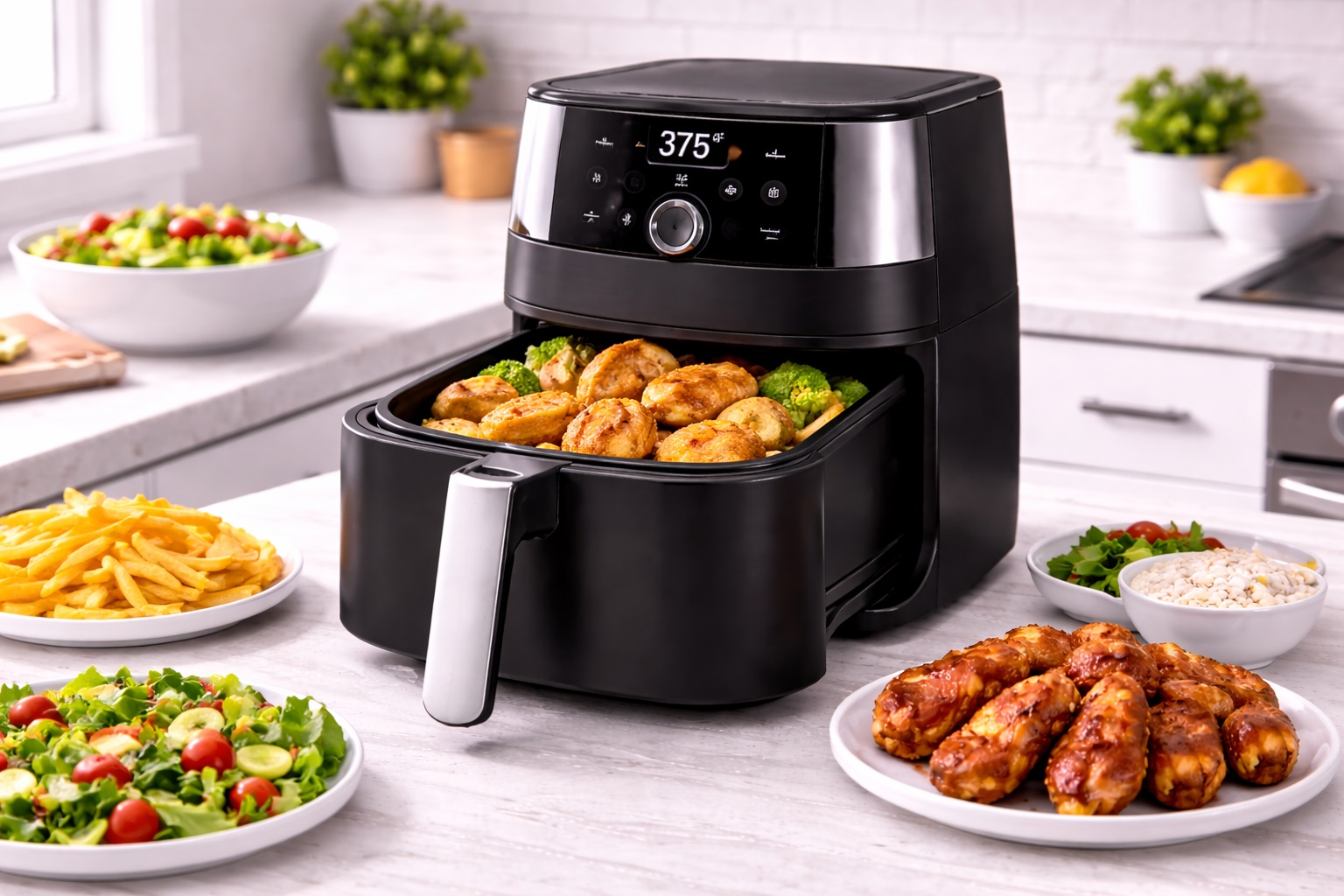
Mid-range smart air fryers include Wi-Fi or Bluetooth connectivity, smartphone app control, and integrated recipe libraries. The companion app enables remote monitoring from another room, guided cooking with clear step-by-step instructions displayed on screen, and automatic temperature adjustment based on whichever specific recipe has been selected for that particular meal. At the sub-$150 price point, this feature set was previously only available in premium-priced models costing considerably more, sometimes double or triple the amount, before manufacturers began pushing smart connectivity down into the mid-range tier as a genuine differentiator.
- Pros:
- App-guided cooking with automatic adjustments built in
- Remote monitoring conveniently available via smartphone from another room in the house
- An integrated recipe library complete with clear, guided step-by-step instructions
- 5-quart total capacity comfortably suits most typical everyday household sizes
- Regular firmware updates can improve stability and add entirely new features over time
- Cons:
- Requires an initial Wi-Fi setup process, adding a small amount of upfront complexity
- App dependency also means offline cooking requires falling back to manual settings
Best For: Tech-comfortable home cooks who want guided cooking assistance and remote monitoring without paying full premium appliance prices for the same underlying capability. This suits anyone still actively building confidence in the kitchen who genuinely appreciates a bit of digital reassurance alongside the actual physical cooking process itself, rather than relying purely on guesswork built up through trial and error over time.
Why We Recommend It: The smart air fryer's recipe guidance reduces cooking failures significantly for users still developing air fryer technique and confidence. The ability to follow a guided recipe that adjusts automatically based on the specific unit removes much of the guesswork from getting started, which is precisely the gap that stops many new owners from actually using an appliance they were initially excited about.
2. Dual-Zone Air Fryer Under $150 – Best Multi-Food Cooking Value
Several genuinely capable dual-zone air fryers are available below $150, making simultaneous multi-food cooking accessible at a meaningfully mid-range price rather than a premium one. These models include two entirely independent 4-quart baskets each with their own separate temperature and timer controls, plus a sync function that finishes both baskets at exactly the same moment, representing genuinely excellent practical value at this specific price point compared to what dual-zone cooking used to cost only a few years ago.
- Pros:
- Two fully independent baskets can cook two entirely different foods at the same time
- A sync function finishes both baskets together automatically without any manual timing needed
- 8 quart total capacity supports larger family cooking needs
- Genuinely mid-range build quality that's noticeably above budget-category alternatives
- The sync feature removes the ongoing mental burden of manually timing two entirely separate baskets
- Cons:
- A noticeably larger counter footprint than comparable single-basket equivalents require
- Higher overall power draw than comparable single-basket models on average
Best For: Families and households who cook structured meals regularly and want the efficiency of simultaneous cooking without paying full premium prices for that specific capability. This suits busy weeknight households especially well, where minutes genuinely matter between arriving home tired from work or school and getting a complete, balanced meal on the table for everyone before anyone's patience runs out.
Why We Recommend It: The dual-zone design under $150 delivers its core value proposition — finishing the protein and the side at exactly the same time — at a price point that was previously only achievable by spending significantly more. This is genuinely where the mid-range category delivers its single strongest overall value proposition compared to every other feature discussed anywhere in this entire guide, and it's often the deciding factor for households torn between two otherwise similar models.
3. Compact Premium Air Fryer with Dehydrate Function – Best Versatile Under $150
Mid-range air fryers with dehydrate functions extend cooking capability well beyond basic air frying to jerky, dried fruit, herbs, and general food preservation. The dehydrate function uses low, carefully sustained heat maintained consistently over several extended hours to remove moisture from food gradually and evenly without cooking it through in the traditional sense. Combined with standard air frying and roasting capability already built in, these models handle the widest range of genuinely useful cooking tasks available anywhere within their specific price bracket, making a single appliance meaningfully more versatile in its everyday practical use than its physical footprint on the counter alone would ever suggest to a first-time buyer just glancing at it in a showroom.
- Pros:
- Dehydrate function meaningfully extends overall cooking capability
- Comfortably handles jerky, dried fruit, fresh herbs, and general food preservation tasks
- Genuinely premium-feeling build quality noticeably above budget-category alternatives
- Wide multi-preset coverage across a genuinely broad range of everyday foods
- Consolidates several separate specialized appliances into a single, unified countertop footprint
- Cons:
- Dehydrate cycles genuinely take several hours from start to finish to fully complete
- A slightly larger overall footprint than the most basic, entry-level models on the market
Best For: Home cooks who want to explore beyond basic air frying and use dehydration for food preparation, preservation, and making healthy snacks at home for the whole family. This also suits anyone growing their own herbs, fruit, or vegetables at home who wants a genuinely practical way to preserve a surplus harvest before it inevitably goes to waste in the refrigerator.
Why We Recommend It: The dehydrate function transforms an air fryer from a single-method appliance into a genuinely multi-purpose kitchen tool. For users interested in food preservation and homemade dried snacks, this substantially increases the practical, everyday utility of the appliance well beyond what the base purchase price would otherwise imply for what would otherwise be a purely single-purpose, air-frying-focused unit sitting on the counter.
Buying Guide: How to Choose the Best Air Fryer Under $150
Use these factors to determine which specific mid-range feature actually delivers value for your own cooking habits.
| Priority | Best Match |
|---|---|
| Guided cooking and remote monitoring | 5-Quart Smart Air Fryer with App Control |
| Simultaneous multi-food cooking | Dual-Zone Air Fryer Under $150 |
| Expanded functionality beyond air frying | Compact Premium Air Fryer with Dehydrate Function |
1. Evaluating Smart Features Honestly
Smart app features are genuinely useful if you actively use guided cooking on a regular basis. If you prefer manual, independent cooking, the smart connectivity adds no practical value and simply introduces a dependency on app updates and reliable Wi-Fi availability. Choose based on your actual, honest, day-to-day cooking style rather than the initial appeal of the feature described on paper, since a feature you never actually open on your phone provides essentially zero real value regardless of how impressive it might sound written out in a glossy product description online, no matter how many times it's mentioned in the listing itself.
2. Capacity for Your Actual Household
Under $150, buyers can access 5 to 6 quart single-basket designs or dual-zone models. A dual-zone unit purchased at this specific price point gives roughly 8 quarts of combined total capacity across both baskets — significantly more usable capacity than a single 5-quart basket design offers entirely on its own. Assess honestly whether simultaneous cooking justifies the larger footprint for your specific household's use case, or whether that extra second-zone capacity would mostly sit unused and idle on a typical, ordinary weeknight when a single dish is really all that's actually being cooked for the household that evening, with the second basket rarely if ever getting filled.
3. Build Quality Indicators to Look For
At sub-$150 prices, look specifically for stainless steel exterior accents, PFOA-free non-stick coatings, and a genuinely solid plastic feel rather than thin, flexible panels that flex noticeably under light pressure. Reviews that specifically discuss build quality after months of actual daily use are considerably more useful than early reviews written the week a product first arrives, since those simply can't yet capture long-term durability under the strain of genuine, repeated household handling.
4. Accessory Compatibility and Ecosystem
Mid-range air fryers generally have considerably better accessory ecosystems than budget alternatives. Both manufacturer-provided and third-party accessories — baking pans, skewer racks, silicone liners, additional rack levels — extend the appliance's cooking capability meaningfully beyond the basic air-frying function alone. Check the available accessories for your specific model directly before purchasing rather than assuming universal compatibility exists across an entire brand's broader product line, since accessory support genuinely varies quite a bit between individual models even within the same manufacturer.
5. Temperature Accuracy at This Price
Mid-range models typically deliver noticeably better temperature accuracy than budget alternatives. This matters considerably for precise recipes, particularly baking within an air fryer, which requires consistent, reliable temperature control throughout the entire cooking cycle rather than just at the start. Reviews that actually test measured temperature accuracy against the manufacturer's stated settings, ideally with a separate thermometer, are the most genuinely useful signal available for comparing otherwise similar-looking models.
6. Preset Quality and Calibration
Presets on mid-range models are typically better calibrated than budget alternatives, sometimes developed alongside professional cooks during product testing and refinement. Look specifically for brands that mention calibrated presets in their product development process rather than simply listing preset names on a spec sheet without any further supporting detail or evidence of actual calibration behind them.
7. Warranty and After-Sales Support
At sub-$150 prices, look for a minimum one-year warranty as a reasonable baseline expectation. Brands offering two-year warranties at this price point are signaling genuine confidence in their own build quality and manufacturing consistency. Verify exactly and specifically what the warranty covers — replacement parts only versus a full unit replacement on a genuinely defective appliance that fails somewhere within the stated coverage period.
8. Energy Efficiency Over Time
Mid-range air fryers typically draw 1,500 to 1,800 watts and cook 20 to 30 percent faster than conventional ovens for broadly equivalent results. For frequent daily use across a full year, the resulting energy savings from consistently shorter cooking cycles partially offset the higher initial purchase cost of the appliance across its realistic multi-year lifetime of regular household use, an incremental saving that's genuinely easy to overlook in the moment but adds up quite meaningfully once compounded across hundreds, even thousands, of individual cooking sessions spread over several years of ownership.
9. Cooking Guide and Recipe Support
Established brands at this specific price point have extensive recipe communities, YouTube tutorials, and official recipe books available to new owners. This support ecosystem has genuine, tangible practical value, particularly for users actively exploring the full range of what an air fryer at this level can actually accomplish well beyond the basic fries-and-chicken routine most people start with. A brand with a genuinely active community also tends to resolve common troubleshooting questions considerably faster than one where new owners are left entirely to figure things out on their own through slow, frustrating trial and error, particularly during those first few weeks of ownership when small problems feel bigger than they really are.
10. Return and Replacement Policy Confidence
At sub-$150 prices, purchasing from a retailer with a clear return policy and from a brand with genuinely accessible customer service provides real, tangible assurance. A mid-range appliance at this specific price point represents a significant enough financial investment to justify carefully confirming the full return path and any restocking fees before committing firmly to a specific purchase decision that's harder to undo after the fact.
11. Realistic Feature Usage Assessment
Before paying extra for smart connectivity, dual zones, or dehydrate functions, honestly assess how often you'll genuinely use each specific feature in a normal month of cooking. A single well-matched feature used weekly delivers considerably more real value than three separate features that sound appealing on a spec sheet but go largely untouched after the first excited month of ownership fades into ordinary, routine daily use across a longer stretch of time.
12. Comparing Against Both Directions
Before committing to a specific mid-range model, briefly compare it against both a solid budget option and an entry-level premium model sitting just above it in price. This confirms the mid-range pick genuinely earns its price gap in both directions rather than simply sitting in the middle of a price range by pure coincidence of positioning, which does happen with some listings that inflate a price without any corresponding improvement in what's actually inside the appliance.
Frequently Asked Questions
1. Is a $100 to $150 air fryer significantly better than a $50 one?
For build quality and feature set specifically, yes, meaningfully so and in ways that are noticeable during regular daily use. Temperature accuracy improves, overall build quality is noticeably sturdier, and genuinely useful features like smart control, a dehydrate function, and dual-zone cooking become realistically available at this price for the first time. For basic day-to-day fries and chicken results specifically, the difference is less dramatic than the price gap alone might suggest to a first-time buyer.
2. Should I buy a smart air fryer under $150?
If you actively use guided cooking and would genuinely benefit from step-by-step recipe integration on your phone, yes. If you prefer independent, manual cooking without any app dependency, the smart features add no real practical value to your daily routine. Assess your actual, day-to-day cooking style honestly before prioritizing connectivity features over other capabilities that may matter considerably more to how you personally use a kitchen appliance on a regular basis.
3. Is a dual-zone air fryer under $150 worth it?
Yes, for households that cook structured meals — protein plus a side — on a fairly regular basis throughout the week. The ability to cook two foods simultaneously at different temperatures and finish together saves meaningful time daily. At sub-$150 prices specifically, dual-zone models represent genuinely excellent value for this particular structured-meal use case, delivering a capability that used to require spending considerably more just a few product generations ago.
4. Is the most expensive air fryer under $150 always the best?
Not always. Price reflects features and build quality, but many mid-range options genuinely outperform more expensive alternatives for everyday needs. Match the specific product to your own actual use case rather than defaulting to the highest price point available within the range.
5. How long should a quality air fryer under $150 last?
A well-built air fryer under $150 from a reputable manufacturer typically lasts two to five years with reasonable care and regular, consistent cleaning. Warranty length remains a genuinely useful indicator of the manufacturer's own internal confidence in its build quality over an extended period of ordinary daily use in a real household kitchen.
6. Can I return an air fryer under $150 if it doesn't suit me?
Most retailers offer fifteen to thirty day return windows. Test the unit thoroughly using your actual, everyday cooking routine, including any smart features or dual-zone functions you specifically bought this particular model for, well before that return window closes on you for good.
7. What should I prioritize when buying an air fryer under $150?
Start with your primary use case, identify the one specific feature that would genuinely improve your daily cooking routine, and match the specific model to that single feature rather than chasing the longest possible feature list on a comparison chart, since a longer feature list rarely translates directly into a more satisfying day-to-day cooking experience once the initial novelty of unboxing a new appliance has genuinely worn off after the first few uses.
8. Does brand name matter for an air fryer under $150?
Established brands offer better warranty support and more consistent quality control across units, which matters meaningfully more at this specific investment level, where a genuinely defective unit represents a real, tangible financial disappointment for the buyer that's harder to simply shrug off than it would be for a much cheaper, budget-tier appliance.
9. Is the dehydrate function on mid-range air fryers actually useful?
Genuinely yes, for anyone interested in making jerky, dried fruit, or preserving fresh herbs at home on a regular basis. For users who won't realistically use it more than once or twice a year, the feature simply adds cost without adding meaningful real value, so an honest self-assessment matters here considerably more than the feature's initial appeal reads on paper before purchase.
10. Do smart air fryers require a subscription to use the app?
Most smart air fryer apps are free to download and use without any subscription, though some manufacturers offer optional premium recipe content for an additional fee. Verify this specific detail directly on the manufacturer's own website before purchase if ongoing subscription costs are a genuine concern for your household's monthly budget, since this detail can sometimes be buried in fine print rather than stated clearly upfront.
11. Can a mid-range air fryer replace a full-size oven?
For most everyday cooking tasks, yes, especially with dual-zone or dehydrate capability extending its practical range considerably. For very large batches, a large family holiday roast, or genuinely large baking projects, a full-size conventional oven still holds real, meaningful advantages in raw internal volume that a countertop appliance, however well-featured, simply can't fully replace or match.
12. Is it worth waiting for a sale to buy a mid-range air fryer?
Often yes, since mid-range models frequently see meaningful discounts during major sale periods throughout the year, sometimes bringing genuinely premium features down noticeably closer to budget-category pricing for a limited, genuinely worthwhile window of time around major shopping holidays throughout the calendar year.
Final Verdict
- Best Feature Set Under $150: 5-Quart Smart Air Fryer with App Control — the best guided cooking experience available at this price.
- Best Multi-Food Cooking Value: Dual-Zone Air Fryer Under $150 — the best simultaneous multi-food cooking value in this specific range.
- Best Versatile Under $150: Compact Premium Air Fryer with Dehydrate Function — the best cooking versatility expansion available under $150.
The right air fryer under $150 depends on identifying which single feature would genuinely improve your actual cooking routine, rather than assuming more features automatically means better value. Matched correctly to a real habit or need, the extra investment in this range earns its place rather than becoming an unused feature sitting quietly on a spec sheet.
It's worth resisting the pull of a longer feature list simply because it looks more impressive on a comparison page. The mid-range category rewards buyers who already know, or take a few minutes to figure out, exactly what gap they're trying to fill — smart guidance for a still-developing cook, simultaneous cooking for a busy structured household, or expanded versatility for someone interested in food preservation. Approaching the purchase with that specific gap in mind, rather than a generic desire for "more features," is what separates a genuinely satisfying mid-range purchase from one that quietly underdelivers relative to its price despite looking good on paper at the time of purchase.