Best First Aid Kit for Home in 2026
Every household eventually needs a first aid kit, whether it is for a kitchen cut, a scraped knee in the backyard, a headache, or a splinter that needs tweezers at ten at night, and the moment it is actually needed is rarely a convenient one. A good home first aid kit is built around daily readiness: enough supplies to handle the small, unpredictable injuries that come up in everyday family life, stored somewhere everyone in the house can find quickly. In 2026, more families are moving away from a single half-used box of bandages shoved in a bathroom drawer and toward a properly stocked, organized kit that actually covers what a household needs.
This guide compares the top first aid kits for home use, focusing on supply depth, organization, and how well each one holds up to years of regular household use rather than a single outdoor trip. A home kit gets opened far more often than a travel kit, so ease of use and restocking matter just as much as the initial supply list.
None of the picks below were selected purely for a single headline feature. A kit that photographs well but is awkward to open one-handed, or that includes an impressive item count but buries the basics under specialty gear, is not actually a strong choice for a household that mainly deals with everyday cuts, scrapes, and minor burns.
Daily readiness is a different problem than emergency preparedness for a disaster scenario, though the two overlap. A home kit needs to be easy to grab one-handed while holding a crying toddler, easy to restock after a busy week of minor scrapes, and organized enough that a partner, babysitter, or teenager who has never opened it before can still find what they need without digging through everything.
Below you will find detailed reviews of eight well-regarded first aid kits, a buying guide covering what actually matters for a household kit, and answers to the questions families ask most often about keeping a home kit stocked and ready.
It is worth thinking about a home kit differently than a travel or outdoor kit from the start. A kit that lives in a closet for months and then gets opened in a hurry needs to prioritize clarity over compactness, since nobody is trying to save weight on a shelf. What matters is that the right item is easy to find under stress, that the kit is easy to restock after use, and that it holds up to years of occasional handling without falling apart or losing pieces.
Top 8 Best First Aid Kit Picks (Detailed Reviews)
The picks below are ordered with everyday household usability in mind first, followed by options that lean more toward specialty use cases like water sports or tactical outdoor scenarios. Even those more specialized kits can work well as a home kit if their particular strengths line up with how your household actually uses its supplies.
As you read through these reviews, think about how each kit would actually perform after six months of sitting in your specific storage spot, being reached for occasionally by different family members. A kit that looks great on a comparison chart still needs to hold up to the reality of a busy household, and that practical durability is just as important as the initial supply list.
1. Surviveware Small Kit – Best For Organized Fast Response
The Surviveware Small Kit is built around labeled compartments that make it easy for anyone in the household to find what they need without asking where things are kept. That matters enormously for a home kit, since the person reaching for it during a minor emergency is not always the person who originally organized it. At around $40, it costs more than some of the other options here, but the clear internal layout, with bandages, wound care, and trauma supplies each sorted into their own labeled section, makes daily use noticeably smoother. Parents in particular tend to appreciate being able to hand the kit to an older kid or a babysitter with confidence that they can find gauze or antiseptic without a lengthy explanation first. That same clarity also makes it easier to notice at a glance when a specific compartment is running low, so restocking becomes a quick check rather than a full inventory.
- Pros:
- Clearly labeled compartments speed up emergency response
- Compact, well-organized modular layout
- Reputable, widely trusted brand in the outdoor space
- Cons:
- Higher price point than some household-focused alternatives
- Limited color and size options
Best For: Households where more than one person needs to be able to use the kit confidently, including babysitters and visiting relatives.
Why We Recommend It: Clear labeling removes the guesswork that slows families down during a stressful moment, which is exactly when speed and clarity matter most, and that benefit compounds every single time the kit gets opened over the years.
2. Adventure Medical Kits .7 – Best For Wet & Water-Exposed Conditions
Adventure Medical Kits .7 uses a watertight bag system, which is a genuine advantage for households near pools, on boats, or in humid climates where a standard case can let moisture creep in over time. At around $30, it is reasonably priced for the level of protection offered, and its compressible bag format also makes it easy to store in a cabinet without taking up excessive shelf space. For families that spend a lot of time outdoors around water, this kit doubles as both a home kit and a grab-and-go option for a pool day or a lake trip, which means one purchase covers two very different use cases without compromising on either.
- Pros:
- Watertight bag system built specifically for wet conditions
- Competitive pricing for the protection level offered
- Reputable brand known for outdoor medical gear
- Cons:
- Bag-style design holds less rigid protection than a hard case
- Limited color options
Best For: Households near pools, boats, or humid climates where moisture is a regular concern for stored medical supplies.
Why We Recommend It: It handles both indoor storage and outdoor water activities well, giving families flexibility without needing two separate kits for two different parts of the same active lifestyle.
3. Protect Life Kit – Best For Emergency Preparedness Stockpiling
Protect Life's broader emergency preparedness focus makes it a strong complement to daily readiness, since it includes a wider mix of supplies meant for extended situations rather than just quick cuts and scrapes. At around $22, it is an affordable way to build out a more complete household stock, useful for storms, power outages, or any situation where you cannot simply run to the pharmacy. Many households keep a kit like this specifically for these longer-tail scenarios, separate from the smaller kit used for everyday bumps and bruises, so neither kit gets depleted by the wrong kind of use.
- Pros:
- Broader emergency preparedness focus beyond basic first aid
- Affordable price point
- Reputable brand in the preparedness space
- Cons:
- Not specifically optimized for quick, frequent daily access
- Limited color options
Best For: Households wanting broader coverage for storms, outages, or extended emergencies at home when outside help may be delayed.
Why We Recommend It: The wider preparedness angle fills a gap that daily-use kits are not designed to cover, which matters when normal routines are disrupted and outside help may not be immediately available.
4. Swiss Safe Kit – Best For FDA-Grade Medical Essentials
Swiss Safe focuses on FDA-approved essentials, giving parents and caregivers confidence that the medical-grade items inside meet a recognized standard, which matters when treating a child's injury or an elderly family member's minor wound. At around $30, it is competitively priced in the mid-range, and its no-frills case design keeps the focus on the quality of what is inside rather than extra features that add cost without adding real value for everyday household use. For families who read ingredient and material labels carefully in other areas of the home, that same standard applied to a first aid kit tends to matter too.
- Pros:
- FDA-approved essentials for genuine medical-grade quality
- Balanced, mid-range pricing
- Reputable brand with consistent quality control
- Cons:
- Case design is fairly basic compared to premium alternatives
- Limited color options
Best For: Families who want verified medical-grade contents they can trust for everyday household injuries without second-guessing quality.
Why We Recommend It: Knowing the supplies meet a recognized standard offers real peace of mind for parents treating a child's scraped knee or a kitchen burn, without needing to second-guess the quality of what's in the case.
5. Deftget First Aid – Best For Ultra-Portable Everyday Carry
Deftget's compact, portable nylon case works well as a secondary kit for a household that already has a larger main kit, since it is small enough to keep in a kitchen drawer, a car, or a kid's backpack without taking up much space. At around $20, it is the most affordable option in this roundup, which makes it easy to justify buying a few extras to spread around the house, one for the kitchen, one for the car, one for a bag by the front door, all without a significant dent in the household budget.
- Pros:
- Compact, lightweight nylon case
- Most affordable option in this lineup
- Reputable brand for entry-level first aid gear
- Cons:
- Limited supply depth compared to larger household kits
- Limited color options
Best For: A secondary, easy-access kit spread around different rooms or vehicles for whenever the main kit isn't nearby.
Why We Recommend It: Its low price and small footprint make it easy to place several around the house, so a kit is always within arm's reach no matter which room an injury happens in.
6. First Aid Only 299 Piece – Best For Comprehensive Supply Coverage
With 299 individual pieces, this kit is one of the strongest choices for a busy household that goes through bandages and wound care items quickly, whether from active kids, kitchen mishaps, or general wear and tear. At around $25, it offers excellent value for the depth of supplies included, and having that much backup stock on hand means you are far less likely to run out of a specific bandage size mid-week, right before you were planning to restock. That kind of buffer is especially valuable during a stretch when several household members are dealing with minor injuries at the same time, which happens more often than most people expect.
- Pros:
- Comprehensive supply range with hundreds of individual items
- Good value for the number of supplies included
- Reputable brand commonly found in workplace settings
- Cons:
- Case itself is fairly basic and not heavily weatherproofed
- Limited color options
Best For: Busy households with kids or frequent minor injuries that deplete supplies quickly and need frequent restocking.
Why We Recommend It: The sheer volume of included supplies means fewer mid-week restocking trips, which matters for households that go through bandages fast and would rather buy in bulk once than restock constantly.
7. Everlit Emergency Kit – Best For Tactical & Outdoor Emergencies
Everlit's tactical-grade materials make this the most rugged option in the lineup, which is more supply than most households need for everyday cuts and scrapes, but at around $50 it is worth considering for families who also camp, hike, or want a single robust kit that can move between home and outdoor use without missing a beat. The reinforced construction holds up to years of storage and occasional heavy use better than lighter-duty alternatives, which some families see as reason enough to standardize on a single rugged kit rather than juggling separate indoor and outdoor options.
- Pros:
- Tactical-grade materials built for rough outdoor conditions
- Reinforced construction holds up over repeated use
- Reputable brand among outdoor and preparedness communities
- Cons:
- Highest price point in this roundup
- More kit than most purely indoor households need
Best For: Families who want one durable kit that works equally well at home and outdoors, without maintaining two separate cases.
Why We Recommend It: The rugged build means it holds up over years of household use, even if it occasionally also goes camping or on a road trip, without needing to be babied on the shelf in between.
8. General Medi Kit – Best For Rugged Hard-Case Protection
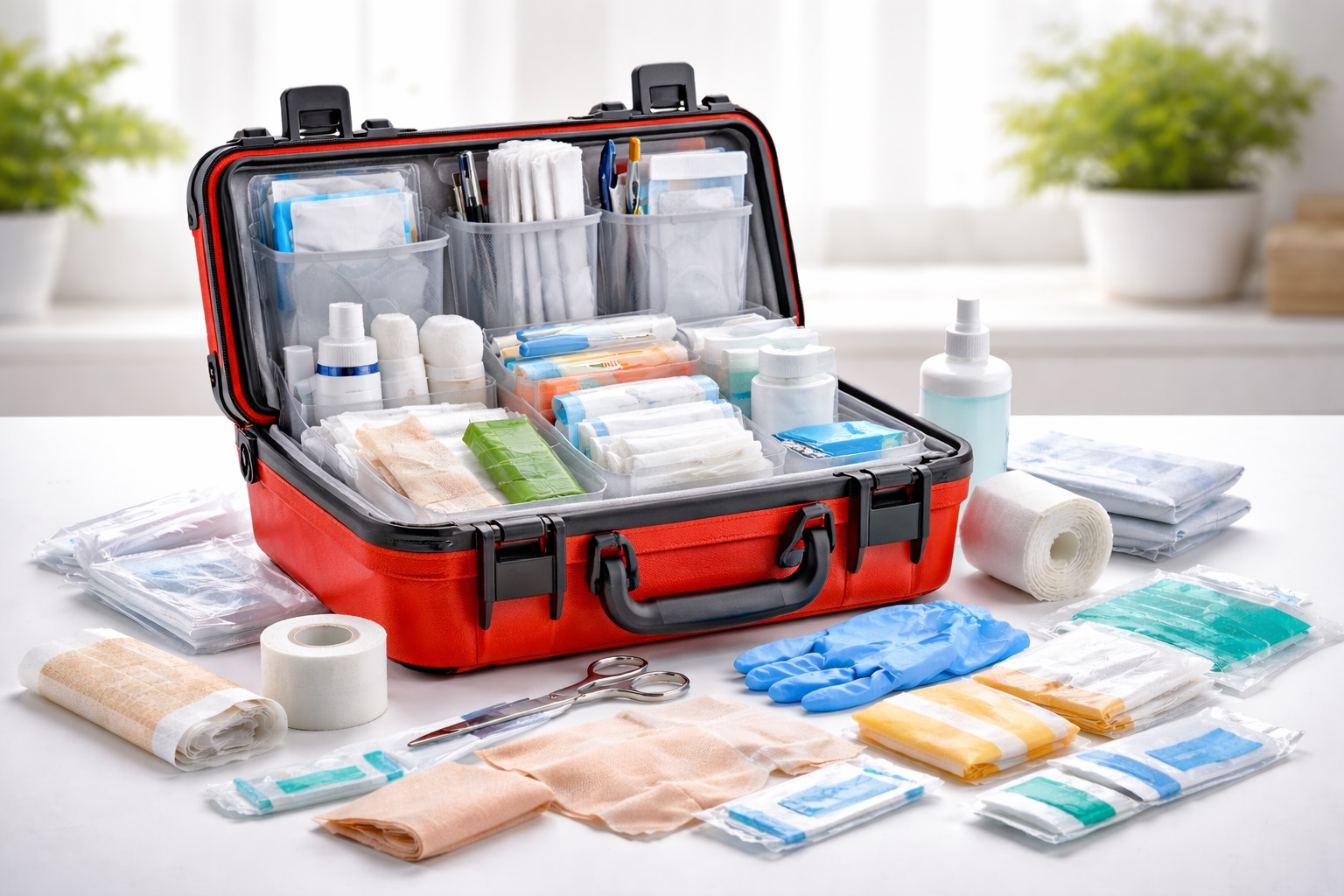
General Medi's hard-shell case protects its contents from being crushed on a closet shelf or knocked around in a garage, which is a practical, if less glamorous, benefit for a kit that mostly sits in storage between uses. At around $35, it lands in the middle of the price range, offering solid protection for households that store their kit somewhere it might get bumped, like a garage shelf or an entryway closet with coats and shoes piled nearby. That kind of everyday wear is easy to underestimate until you open a soft-sided kit and find the contents crushed or disorganized after months of storage.
- Pros:
- Hard case resists crushing and impact damage
- Better splash resistance than soft-sided alternatives
- Reputable brand with consistent build quality
- Cons:
- Hard shell adds some bulk compared to soft kits
- Limited color options
Best For: Households storing the kit in a garage, entryway, or closet where it might get bumped or stacked under other items on a shelf.
Why We Recommend It: A rigid case protects supplies from the everyday wear of household storage, which matters more over years of use than it might seem at first, especially once other items start getting piled on top of it.
Buying Guide: How to Choose the Best First Aid Kit for Home
Choosing the right home first aid kit is less about finding the single most impressive product and more about matching supplies, organization, and storage to how your specific household actually lives day to day. The sections below cover what matters most for a kit that will get opened regularly, sometimes weekly, over the years you own it.
Because a home kit is used so much more frequently than a travel kit, small annoyances tend to compound over time. A slightly awkward zipper, a compartment that is hard to reach, or a case that does not sit flat on a shelf can become genuinely frustrating after the fiftieth time you reach for it, even if none of those issues seemed significant when you first bought the kit.
1. Match Supply Count to Household Size
A kit built for one or two people will run out of bandages fast in a household with active kids or multiple family members. Choose a kit with enough supply depth for your actual household size, and consider a larger kit or refill packs for bigger families with more frequent minor injuries.
2. Prioritize Clear Organization
Labeled compartments or color-coded sections make it far easier for every household member, including kids old enough to help themselves to a bandage, to find what they need quickly without asking for help every time an injury happens.
3. Consider Who Else Might Use the Kit
A home kit often gets used by babysitters, visiting family, or older children. Choose a kit organized clearly enough that someone unfamiliar with it can still use it correctly during a minor emergency without a parent standing over their shoulder.
4. Check for FDA-Approved or Recognized Components
Verified medical-grade supplies matter more for a kit you use frequently. Look for FDA-approved essentials rather than assuming a home-focused kit automatically includes quality contents just because it is marketed for families.
5. Think About Where It Will Be Stored
A kitchen cabinet, bathroom closet, or hallway shelf are all common home storage spots, each with different humidity and accessibility considerations. Choose a case durable enough for its actual storage location and easy enough to reach without needing a step stool.
6. Plan for Restocking
Home kits get opened often, so look for brands that sell refill packs for commonly used items like adhesive bandages and antiseptic wipes, since you will be replacing these more often than specialty items that rarely get touched.
7. Cover Common Household Injuries Specifically
Kitchen burns, scraped knees, splinters, and minor cuts are among the most common household injuries. Make sure your kit includes burn gel, tweezers, and a range of bandage sizes rather than just generic gauze that does not fit smaller wounds well.
8. Consider a Kit for Every Key Location
Many households benefit from a main kit in a central location plus smaller secondary kits in the kitchen, car, and any frequently used outdoor space like a backyard or garage, so help is always close by.
9. Factor In Case Durability for Long-Term Storage
A home kit often sits unused for weeks between incidents. A durable case that resists dust, moisture, and being knocked around on a shelf holds up better over years of intermittent use than a flimsier alternative.
10. Watch Expiration Dates Closely
Home kits can go unchecked for a long time if injuries are infrequent. Set a recurring reminder to check expiration dates on ointments, adhesives, and any included medications at least twice a year, ideally alongside another routine household task.
11. Balance Price Against How Often You'll Use It
A kit that gets opened weekly in an active household justifies a higher upfront investment in quality and supply depth compared to a kit that mostly sits as a backup for rare emergencies and gets used only occasionally.
12. Keep a Separate Kit for Serious Emergencies
A daily-use kit for minor injuries is different from a broader emergency preparedness kit meant for storms, outages, or extended situations. Consider keeping both rather than expecting one kit to do everything a household might need.
13. Involve the Household in Where It's Kept
The best-stocked kit is useless if family members do not know where it is. Pick a consistent, memorable location and make sure everyone in the household, including regular visitors like grandparents, knows where to find it.
Frequently Asked Questions
The questions below cover the details families most often want answered before choosing and stocking a home first aid kit, from what to include to how to keep it organized as it gets used over time.
What should every home first aid kit include?
Adhesive bandages in multiple sizes, gauze pads, antiseptic wipes, tweezers, burn gel, pain relievers, and medical tape cover the vast majority of common household injuries a family typically encounters.
How often should a home kit be restocked?
Check contents every few months in an active household, and restock immediately after using up specific items rather than waiting for a scheduled check to notice a shortage.
Where is the best place to store a home first aid kit?
A kitchen cabinet, hallway closet, or bathroom shelf works well, as long as it is easily accessible and every household member knows the exact location without having to search.
Should I keep more than one kit at home?
Many households benefit from a main kit plus smaller secondary kits in the kitchen, car, or garage, so a kit is always within reach regardless of where an injury happens to occur.
How many people should one home kit cover?
Standard kits are often designed for four to six people, but larger households or homes with young, accident-prone kids may want a bigger kit or extra refill supplies on hand.
Is a hard case or soft case better for home storage?
Hard cases resist crushing and stacking damage better, which matters for kits stored in a closet or garage, while soft cases are easier to tuck into a smaller cabinet or drawer.
Do first aid kits expire?
Yes, individual components like adhesives, ointments, and medications have expiration dates, even though the outer case itself does not expire and can be reused indefinitely.
What's the most commonly overlooked home first aid item?
Burn gel and blister treatment are frequently missing from basic kits, despite kitchen burns and household blisters being fairly common minor injuries that come up more than people expect.
Can kids use a home first aid kit on their own?
For minor injuries like small cuts, yes, especially with a clearly labeled, well-organized kit, though kids should always be taught when to get an adult for anything more serious than a scrape.
How much should I budget for a quality home kit?
Reasonable options range from around $20 for a compact supplemental kit to $40 or more for a larger, well-organized main household kit with deeper supplies.
Should I keep a separate kit for emergencies like storms or outages?
Yes, a broader emergency preparedness kit with more supplies is a useful complement to a smaller daily-use kit meant for everyday bumps and scrapes rather than extended situations.
What certifications should I look for in a home kit?
FDA-approved components are a good baseline indicator of medical-grade quality for items that will be used on family members regularly, including kids and older relatives.
How do I keep a home kit organized as it gets used?
Return items to their labeled compartment after each use and do a quick restock check whenever you notice a section running low, rather than waiting for a full inventory to catch it later on.
Final Verdict
- Top Pick: Surviveware Small Kit for clear organization that makes it easy for the whole household to use confidently.
- Budget Choice: Deftget First Aid for an affordable secondary kit that's easy to place in multiple rooms or vehicles.
- Premium Choice: Everlit Emergency Kit for a rugged, long-lasting build that holds up to years of household use.
A good home first aid kit is one that gets used, restocked, and trusted by everyone in the household, not just the person who bought it. Prioritize clear organization and supply depth over flashy extras, and consider pairing a daily-use kit with a broader emergency preparedness kit for situations that go beyond minor cuts and scrapes. Whichever kit you choose, make it a habit to check expiration dates and restock used items regularly, since a home kit only earns its keep when it is actually ready the moment someone needs it.
It also pays to walk through the kit with the rest of the household at least once, rather than assuming everyone will figure it out during an actual emergency. A five-minute conversation about where the kit lives, what each compartment holds, and when to call for outside help turns a well-stocked case into something the whole family can actually rely on, not just the person who originally set it up.