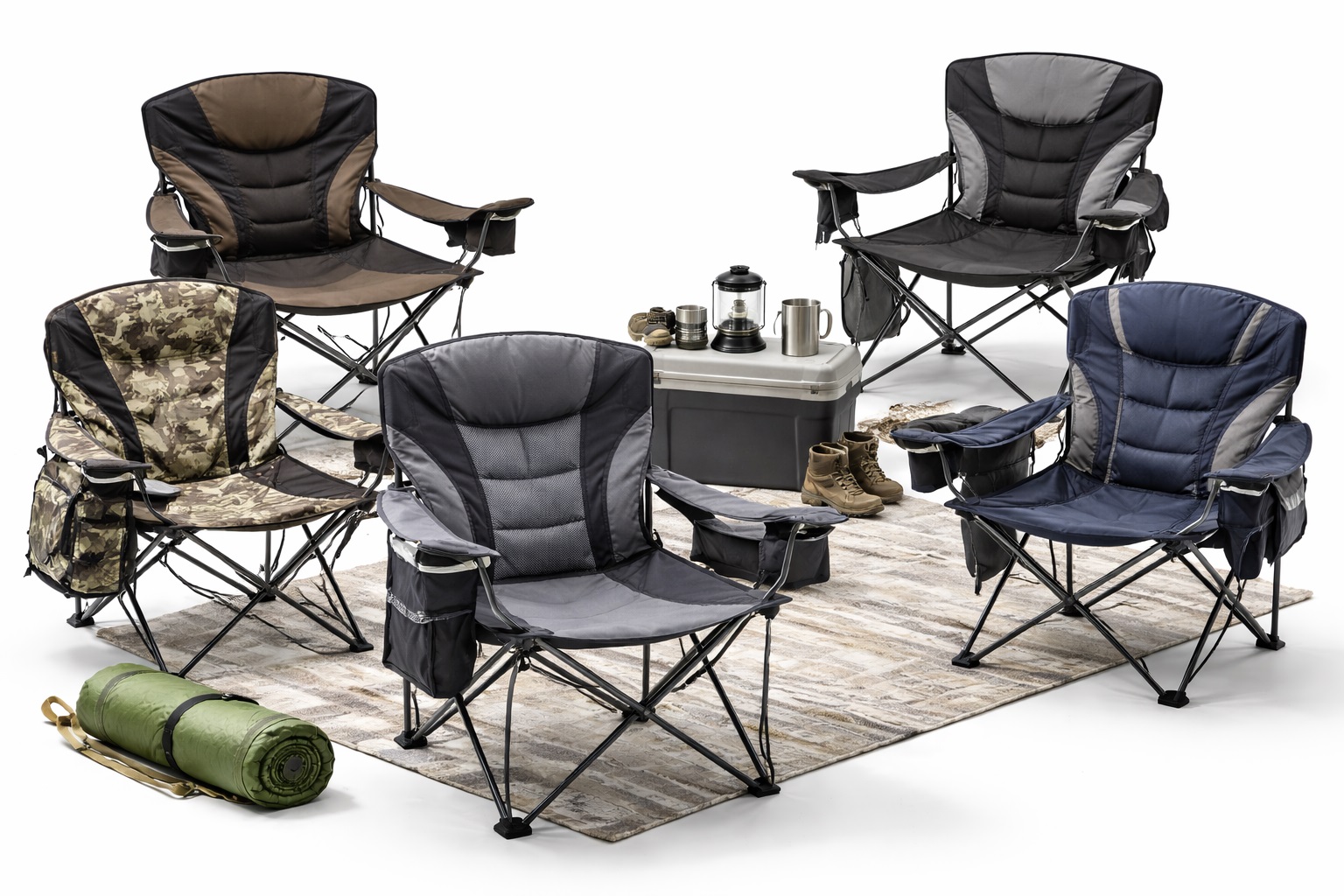
Best Heavy Duty Camping Chair in 2026
Not every camper fits the standard weight rating printed on a typical folding chair, and for bigger or taller users, a chair's advertised comfort means little if the frame flexes, creaks, or feels unstable the moment you sit down. A genuinely heavy duty camping chair is built around a sturdier frame, reinforced stitching, and a high weight capacity rating from the start, rather than simply being a standard chair squeezed into a bigger-sounding description.
In this guide we compare eight widely available camping chairs with an eye toward which ones offer the most reassuring stability and load support, ranked roughly from the sturdiest, most heavy-duty options down to lighter designs that are worth knowing about even though they're not built primarily for higher weight capacities. Some of these chairs use genuinely reinforced frames specifically designed to carry more weight; others are included so you can clearly see the tradeoff between weight capacity and portability.
Below, each chair is reviewed with frame strength, stability, and seat width in mind, followed by a full buying guide covering how to judge weight capacity claims, frame materials, and construction quality before you buy. Whether you need a chair rated well above your own weight for peace of mind or simply want the sturdiest option available for rough terrain, the picks below should help you find a seat that won't let you down.
It's also worth remembering that heavy duty does not have to mean unattractive or overly utilitarian. Many of the sturdiest frames on this list come from brands that also pay attention to comfort details like recline angle, cup holder placement, and breathable fabric, so you don't have to sacrifice everyday enjoyment for peace of mind about the frame's strength.
It's worth noting upfront that a chair's advertised weight rating only tells part of the story. Two chairs rated for the same maximum load can feel very different in practice, depending on seat width, seat height, and how evenly the frame distributes stress across its joints. As you read through the reviews below, pay attention not just to the stated capacity but to the specific design choices, wider bases, reinforced seams, lower seat heights, that translate a number on a spec sheet into a chair that actually feels solid and trustworthy once you sit down in it.
Top 8 Best Heavy Duty Camping Chairs (Detailed Reviews)
1. Kelty Low Loveseat – Best For Maximum Combined Weight Support
The Kelty Low Loveseat's two-person bench design, priced around $140, uses a reinforced, wider frame built to distribute the combined weight of two occupants without the stress concentrating on any single seam. Because it's engineered from the outset to support two people at once, its overall frame tends to have more structural margin than a typical single chair, which is exactly the kind of engineering philosophy that benefits heavier individual users as well. Even used by a single occupant, the extra width and reinforced construction give it a noticeably more solid feel than most single-seat designs at a similar price.
- Pros:
- Reinforced, wider frame built to handle above-average combined loads
- Low seat height improves stability on uneven ground
- Reputable brand known for durable camp furniture
- Cons:
- Higher price point than a single-seat chair
- Bulkier and heavier to transport
- Limited color options
Best For: Larger campers or couples who want a wide, reinforced frame with generous structural margin built in from the start.
Why We Recommend It: A frame engineered to support two adults at once tends to have more reserve strength than a standard single chair, which is a meaningful advantage for anyone who wants extra confidence in their seat.
2. GCI Outdoor Rocker – Best For Stable Support With a Rocking Motion
The GCI Outdoor Rocker pairs a sturdy steel frame with a spring-action rocking base, priced at around $80, and its wider, low-slung stance is built specifically to stay stable through repeated rocking motion under real weight. That same engineering, a stable base designed to resist tipping and flexing, translates well into confident support for larger users who want a rocking chair without sacrificing stability. The springs themselves are also engineered to handle repeated compression under load, which is a detail that matters more here than on a chair without any moving parts.
- Pros:
- Sturdy steel frame engineered for stability under motion
- Spring-action rocking mechanism built for repeated stress
- Reasonable mid-range price for the reinforced construction
- Cons:
- Heavier than static, non-rocking chairs
- Bulkier footprint when folded
- Limited color options
Best For: Campers who want a stable, wide-stance chair that can handle a rocking motion without feeling tippy under a heavier load.
Why We Recommend It: Building a rocking mechanism that stays stable requires a naturally wider, sturdier base, which happens to make this chair a strong choice for larger users as well.
3. Coleman Quad Chair – Best For Simple, Sturdy Everyday Support
At around $35, the Coleman Quad Chair uses a straightforward four-legged steel frame that has been a reliable, time-tested design in camp seating for years. Its built-in cooler pouch adds convenience, but the real appeal for heavier users is the simplicity of the design itself: a wide, stable four-legged stance with fewer complex mechanisms that could otherwise become a weak point under load. Its widespread availability at big-box and outdoor retailers also makes it one of the easiest heavy-duty-leaning chairs to find in person before buying, which lets you sit in one before committing.
- Pros:
- Stable four-legged steel frame with a proven track record
- Built-in cooler pouch adds everyday convenience
- Very affordable price point for a sturdy design
- Cons:
- Heavier and bulkier than backpacking-style chairs
- Basic padding compared to premium options
- Limited color options
Best For: Budget-conscious campers who want a simple, sturdy frame without paying for a specialized heavy-duty design.
Why We Recommend It: Simplicity is an underrated strength for a heavy-duty chair; a straightforward four-legged frame has fewer complex parts that can fail under sustained load.
4. NEMO Stargaze – Best For a Robust Suspension Frame
The NEMO Stargaze's swinging, reclining seat, priced around $250, is suspended from a robust frame engineered specifically to handle the mechanical stress of constant motion without the hardware loosening over time. Building a frame that can support a swinging, reclining motion reliably requires a sturdier structure than a static chair needs, which gives larger users a genuinely reassuring amount of built-in structural margin. The reclining function also spreads a sitter's weight across a wider arc of the frame than a fixed-angle backrest does, which can feel more forgiving under sustained heavier use.
- Pros:
- Robust suspension frame engineered for repeated motion under load
- Premier build quality from a reputable outdoor brand
- Comfortable, supportive seating for extended use
- Cons:
- Highest price point on this list
- Bulkier and heavier, better suited to car camping
- Limited color options
Best For: Campers who want a genuinely different, supportive seating experience backed by a frame built for repeated mechanical stress.
Why We Recommend It: A frame engineered to safely support constant swinging and reclining motion needs real structural reserve, which benefits larger users looking for confident, stable support.
5. Amazon Basics Camp Chair – Best For Affordable Everyday Sturdiness
At around $25, the Amazon Basics Camp Chair keeps things simple with a basic steel frame that, while not marketed specifically as heavy-duty, offers dependable support for a wide range of users at an accessible price. It won't match the reinforced frames of dedicated heavy-duty designs, but its straightforward construction and low cost make it an easy chair to try without a large financial commitment. Its simple four-legged geometry also means there's little to diagnose if something eventually feels loose, since there are far fewer moving parts than on a rocking or reclining design.
- Pros:
- Lowest price point of any chair on this list
- Simple steel frame with dependable everyday sturdiness
- Easy to replace if it ever wears out
- Cons:
- Not specifically reinforced like dedicated heavy-duty chairs
- Basic padding compared to premium options
- Limited color options
Best For: Budget-conscious shoppers who want dependable everyday support without paying for specialized heavy-duty engineering.
Why We Recommend It: It proves that a genuinely usable, sturdy seat doesn't always require a premium price tag, even if it isn't purpose-built for the very highest weight capacities.
6. Big Agnes Skyline – Best For Reinforced Comfort on the Lighter Side
The Big Agnes Skyline's pre-bent pole frame, priced around $110, is designed to distribute weight evenly across the seat, which helps it feel supportive despite using lighter aluminum poles rather than heavier steel. It's a reasonable middle-ground option for users who want better support than a basic budget chair but don't need the heaviest-duty steel construction of a dedicated big-and-tall design. The pre-tensioned poles also resist the gradual sagging that flatter aluminum frames sometimes develop under regular use, which helps the seat keep its supportive shape for longer.
- Pros:
- Pre-bent pole frame improves weight distribution and comfort
- Lighter than steel-framed heavy-duty alternatives
- Reputable brand with a strong backcountry reputation
- Cons:
- Not rated as high as dedicated heavy-duty steel chairs
- Higher price than basic steel-frame chairs
- Limited color options
Best For: Campers who want improved weight distribution and comfort without carrying a heavier steel-framed chair.
Why We Recommend It: Its pre-bent frame design genuinely improves support over flatter pole designs, even though it isn't marketed specifically as a heavy-duty option.
7. REI Co-op Flexlite – Best For Lighter Users Who Still Want Reliability
The REI Co-op Flexlite's shock-corded pole design, priced around $100, prioritizes packability and weight savings over maximum load capacity, which makes it a better fit for lighter to average-weight users than for those specifically seeking the highest possible weight rating. It's included here as an honest comparison point, since its build quality is excellent within its intended use case, even if that use case isn't maximum weight support. Its shock-corded poles are genuinely well engineered for repeated setup, just not for the same load range as the steel-framed options higher on this list.
- Pros:
- Shock-corded pole frame assembles quickly and reliably
- Reputable brand with a long track record in outdoor gear
- Lightweight and packable for backpacking trips
- Cons:
- Not designed for the highest weight capacity needs
- Less padded than heavier lounge-style chairs
- Limited color options
Best For: Lighter to average-weight campers who want a reliable, packable chair rather than maximum load capacity.
Why We Recommend It: It's a genuinely well-built chair, just one whose engineering priorities lean toward weight savings rather than the highest possible capacity.
8. Helinox Chair Zero – Best For Minimal Weight, Not Maximum Capacity
At under 1lb, the Helinox Chair Zero is included here specifically as a contrast: its minimal frame and fabric are engineered for weight savings above nearly everything else, which generally means a lower weight capacity than the sturdier, heavier chairs elsewhere on this list. At around $130, it's a poor fit if your priority is maximum load support, but an excellent fit for the very different priority of minimizing pack weight. Comparing it against the steel-framed options on this list is a useful way to see just how directly weight capacity and pack weight trade off against each other.
- Pros:
- Exceptionally light and packable
- Premier build quality within its intended ultralight use case
- Reputable brand known for backpacking-specific gear
- Cons:
- Lower weight capacity than heavier-duty designs
- Higher price relative to its minimal materials
- Less cushioned than heavier lounge-style chairs
Best For: Lighter backpackers who prioritize pack weight over maximum weight capacity.
Why We Recommend It: It's honestly not the right choice for heavy-duty needs, but it's worth including so shoppers can clearly see the tradeoff between an ultralight frame and one built for maximum load support.
Buying Guide: How to Choose the Best Heavy Duty Camping Chair
1. Understand What Weight Capacity Ratings Actually Mean
A chair's stated weight capacity reflects the manufacturer's tested maximum load, and it's generally wise to choose a chair rated comfortably above your own weight rather than right at the limit, since a rating close to your actual weight leaves little margin for movement, shifting, or uneven ground. Keep in mind that this figure typically reflects a static, seated load rather than the extra force generated by sitting down quickly or shifting your weight while getting settled.
2. Frame Material: Steel vs. Reinforced Aluminum
Steel frames are typically the sturdiest and most affordable option for high weight capacities, while reinforced aluminum can achieve similar strength at a lighter weight but usually at a higher price. Neither is universally better; the right choice depends on how much you value portability alongside raw strength. Some manufacturers also use thicker-gauge tubing at key stress points even within an otherwise standard frame design, which can boost capacity without a full material upgrade.
3. Seat Width and Stability
A wider seat and a lower center of gravity both improve stability, especially on uneven or soft ground. Chairs with a wider base footprint tend to feel noticeably more secure than narrower designs rated for the same weight, and a wider seat also tends to be more comfortable over long sitting sessions regardless of your size.
4. Stitching and Seam Reinforcement
Reinforced stitching at high-stress points, particularly where the seat fabric meets the frame, is often what actually determines whether a chair holds up under sustained heavier use, regardless of its advertised weight rating. Double-stitched seams and bar-tacked corners are worth specifically looking for in product photos or descriptions before you buy.
5. Armrest and Frame Joint Strength
Armrests and frame joints see concentrated stress when getting in and out of a chair repeatedly. Look for reinforced joints and sturdy armrest connections, since these areas often show wear before the main seat fabric does. Pushing down firmly on the armrests while a chair is set up, before you fully commit your weight to it, is a quick and easy way to gauge how solid those joints actually feel.
6. Low vs. Standard Seat Height
Lower-seated chairs generally offer better stability for heavier users, since they lower the center of gravity and reduce the leverage exerted on the frame during sitting and standing. The tradeoff is that a very low seat can make standing back up more difficult, so it's worth balancing stability against everyday ease of use.
7. Fabric Weight and Tear Resistance
Heavier denier fabrics generally hold up better under sustained tension than lighter materials, which matters more for heavy-duty use than for occasional, lighter-weight seating. A fabric that visibly stretches under normal seated weight is a warning sign worth taking seriously before you rely on that chair regularly.
8. Two-Person and Wide-Seat Designs
Loveseat-style or extra-wide single chairs often have more structural reserve built in from the start, since they're engineered to handle above-average combined loads by design. Even for a solo user, that extra design margin often translates into a chair that simply feels more solid and less prone to flexing.
9. Testing Stability Before You Rely on It
Sitting in a chair at a store or testing it at home on flat, then slightly uneven, ground before a real trip can reveal stability issues that a weight rating alone won't tell you. It only takes a few minutes to shift your weight side to side and lean back firmly, which can expose a wobble or flex you wouldn't notice from just sitting still.
10. Warranty Coverage for Frame Failures
A strong warranty specifically covering frame or joint failures offers real peace of mind for a heavy-duty purchase, since it's the frame, not the fabric, that most often fails under sustained heavier use. Reading the specific terms, rather than assuming full coverage, helps avoid surprises if you ever do need to make a claim.
11. Portability Tradeoffs for Heavier Frames
Heavier-duty frames are usually bulkier and heavier to carry, so factor in how far you'll need to transport the chair alongside its weight capacity. If you're mostly setting up close to a vehicle, that extra weight is a minor inconvenience; if you're hiking any real distance, it becomes a much bigger factor in your decision.
12. Ground Surface and Stability
Soft ground like sand or mud reduces stability regardless of a chair's weight rating, so consider a chair with wider feet or add-on ground pads if you frequently camp on softer terrain. Wider, flatter feet distribute weight over more surface area, which helps prevent a chair's legs from sinking in on soft ground.
13. Matching Capacity to Real-World Use
Beyond your own body weight, consider whether you'll be wearing bulky winter layers, holding a child, or leaning back forcefully, all of which add real-world stress beyond a simple static weight figure. Building in a comfortable margin above your typical use case, rather than your exact body weight alone, accounts for these everyday variables.
14. Comparing Multiple Chairs Side by Side
Where possible, comparing a few heavy-duty candidates in person, checking how each one flexes, how the joints feel, and how wide the base sits, gives you a much clearer picture than comparing weight ratings on a spec sheet alone.
Frequently Asked Questions
What is considered a heavy duty camping chair?
Generally, chairs rated above 300 pounds with reinforced steel frames and wider seats are considered heavy duty, though the exact threshold varies by brand and design. Some manufacturers use the term more loosely, so it's worth checking the specific weight rating rather than relying on the label alone.
How much weight capacity margin should I look for?
A reasonable rule of thumb is choosing a chair rated at least 50 to 75 pounds above your own weight to account for movement and uneven terrain. If you often camp with extra gear on your lap or in cold-weather layers, it's worth padding that margin a bit further.
Are steel frames always better than aluminum for weight capacity?
Steel is generally stronger at a given thickness, but well-engineered reinforced aluminum frames can achieve comparable strength, often at a lighter overall weight, usually at a higher price point.
Do two-person chairs support more weight than single chairs?
Often yes, since loveseat-style chairs are engineered from the start to handle combined loads, giving them more structural reserve than a typical single-seat design, even when used by one person.
Can I add extra support to an existing camping chair?
Some campers place a plywood board or a stiff ground pad under a chair's legs on soft terrain to improve stability, though this doesn't increase the chair's actual rated weight capacity.
Does cold weather affect a heavy duty chair's strength?
Very cold temperatures can make some plastics and certain fabrics slightly more brittle, so it's worth being a bit more careful with setup and takedown in freezing conditions.
Is a lower seat height really more stable?
Yes, a lower seat height reduces the leverage exerted on the frame and lowers the center of gravity, both of which improve overall stability, especially on uneven ground.
Can a heavy duty chair still be lightweight?
To some extent, reinforced aluminum designs can balance strength and weight better than basic steel, though the very lightest ultralight chairs generally sacrifice some weight capacity to achieve their minimal weight.
What part of a heavy duty chair usually fails first?
Frame joints, hinges, and the stitching where fabric meets the frame are typically the first points of failure under sustained heavier use, more so than the main seat fabric itself.
Should I test a chair's stability before relying on it for a trip?
Yes, testing on both flat and slightly uneven ground beforehand can reveal stability concerns that a weight rating alone doesn't capture.
Do heavy duty chairs cost more than standard chairs?
Not always. Some heavy duty options, like basic steel quad chairs, are quite affordable, while others with specialized reinforced frames or added features cost more.
Does ground surface affect how much weight a chair can safely support?
Yes, soft or uneven ground reduces effective stability regardless of a chair's rated capacity, so wider feet or ground pads can help on sand, mud, or loose gravel.
How do I know if a chair's weight rating is trustworthy?
Established outdoor brands with a track record of consistent quality control tend to provide more reliable weight ratings than lesser-known budget brands with limited testing history.
Are rocking chairs as stable as static frames for heavier users?
When engineered specifically for that purpose, like the GCI Outdoor Rocker, a rocking chair's wider base can offer comparable or even better stability than some static designs.
Is it worth paying more for a dedicated heavy-duty chair?
If you're near or above the weight rating of standard chairs, yes, since the added structural margin provides genuine peace of mind and typically extends the chair's usable lifespan as well.
How can I tell if a chair's joints are strong enough before buying?
Product photos that clearly show reinforced welds, thicker tubing at stress points, or bar-tacked stitching are good signs, and customer reviews mentioning long-term stability under regular use are often more reliable than the spec sheet alone.
Do heavy duty chairs need any special maintenance?
Beyond keeping the frame dry and periodically checking joints and hardware for looseness, heavy duty chairs generally don't require maintenance beyond what any quality camping chair needs.
Is a wider chair automatically more stable than a narrower one?
Generally yes, since a wider base lowers the risk of tipping sideways, though overall stability also depends on seat height, frame material, and how evenly weight is distributed across the legs.
Final Verdict
- Top Pick: Kelty Low Loveseat for its wide, reinforced frame with generous structural margin.
- Budget Choice: Amazon Basics Camp Chair for dependable everyday sturdiness at a low price.
- Premium Choice: NEMO Stargaze for a robust suspension frame built to handle constant motion under load.
Finding the right heavy duty camping chair comes down to looking past the marketing label and checking the specific details that actually determine stability: frame material, seat width, seat height, and stitching quality all matter more than the word "heavy duty" printed on a product listing. Choosing a chair rated comfortably above your own weight, with a wide, low, well-reinforced frame, will give you a seat you can trust to hold up trip after trip, regardless of which specific model you land on. Taking a few extra minutes before you buy, checking reinforced seams, testing joints, and comparing weight ratings against a realistic margin, pays off every time you sit down at camp without a second thought about whether your chair can handle it.