Best Blenders Under $150: High-Performance Blending at a Smart Price
The blender is one of the most-purchased small kitchen appliances and one of the most commonly underused. The reason for the gap between purchase frequency and actual use is almost always the same: cleaning inconvenience. A blender that takes 10 minutes to properly clean creates enough friction to reduce use frequency from daily to occasional — particularly for morning routines where time is limited.
Modern blender design has addressed this systematically. Self-cleaning functions, dishwasher-safe Tritan jars, and personal blend-in-cup designs have each reduced cleaning time for their respective use cases to under one minute. Understanding which design matches your specific daily routine is the key purchase decision — more than motor wattage or blade count for most users.
This guide provides the complete picture: motor power that actually matters for your ingredient types, jar and blade design that determines daily cleaning convenience, and specific guidance for every blending use case from morning smoothies to hot soup purées.
Quick Comparison: Top Picks at a Glance
| Product Type | Best For | Our Take |
|---|---|---|
| High-Performance Countertop Blender (1000-1400W) | Best for Smooth Blends and Frozen Drinks | Best all-purpose complete-blend performance for daily serious blending. |
| Personal Single-Serve Blender | Best for Individual Daily Smoothies | Best daily convenience and portability for single-serve smoothie routines. |
| Immersion Hand Blender | Best for Soup Pureeing and Flexible Use | Best in-vessel blending for soups and sauces with maximum storage convenience. |
Top blender under $150 Picks — In-Depth Reviews
Each product type below has been evaluated based on real performance factors relevant to buyers who want near-professional blending performance for smoothies, hot soups, and frozen drinks without premium appliance pricing. We've included detailed performance notes, value assessments, and clear guidance on who each option suits best.
1. High-Performance Countertop Blender (1000-1400W) — Best for Smooth Blends and Frozen Drinks
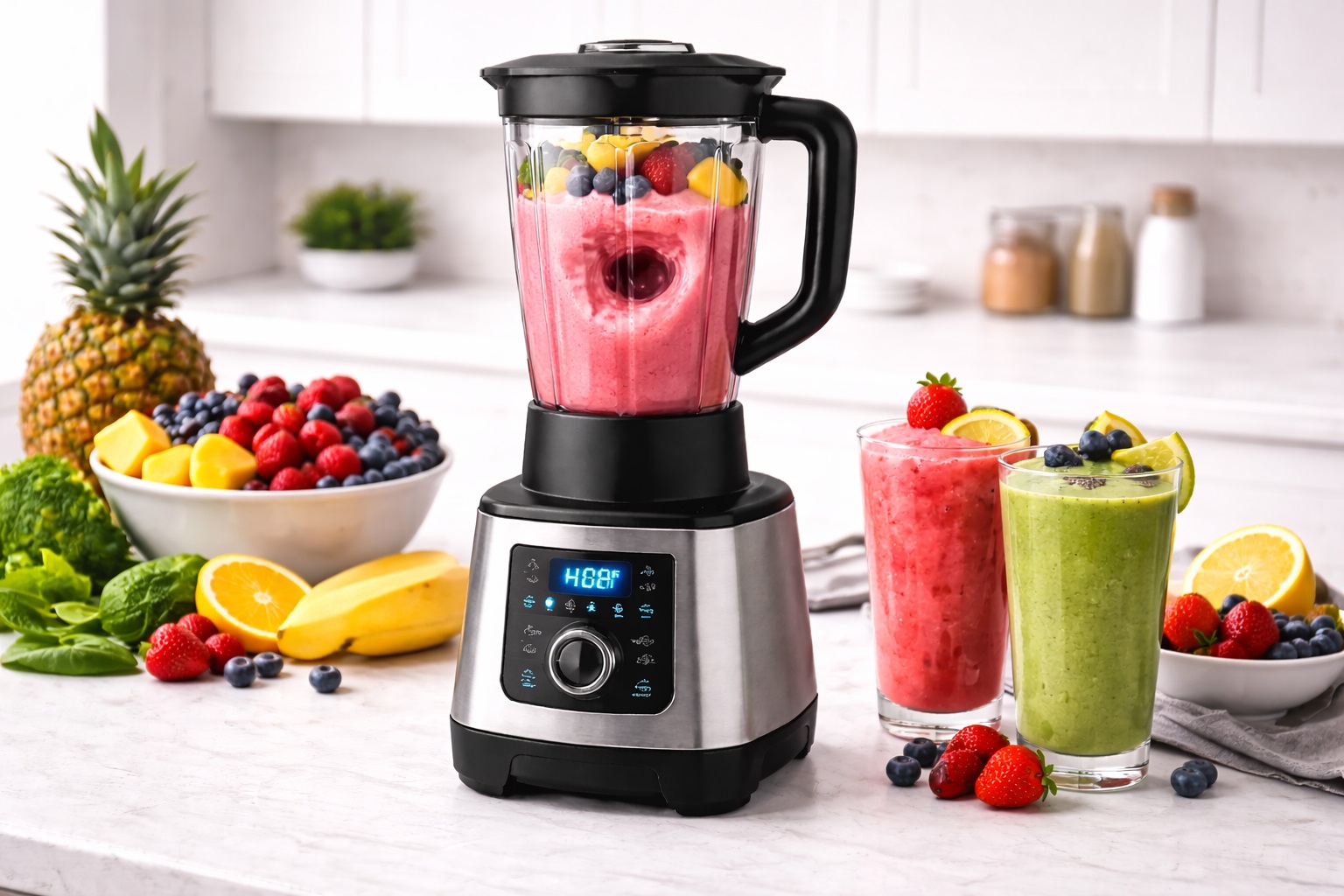
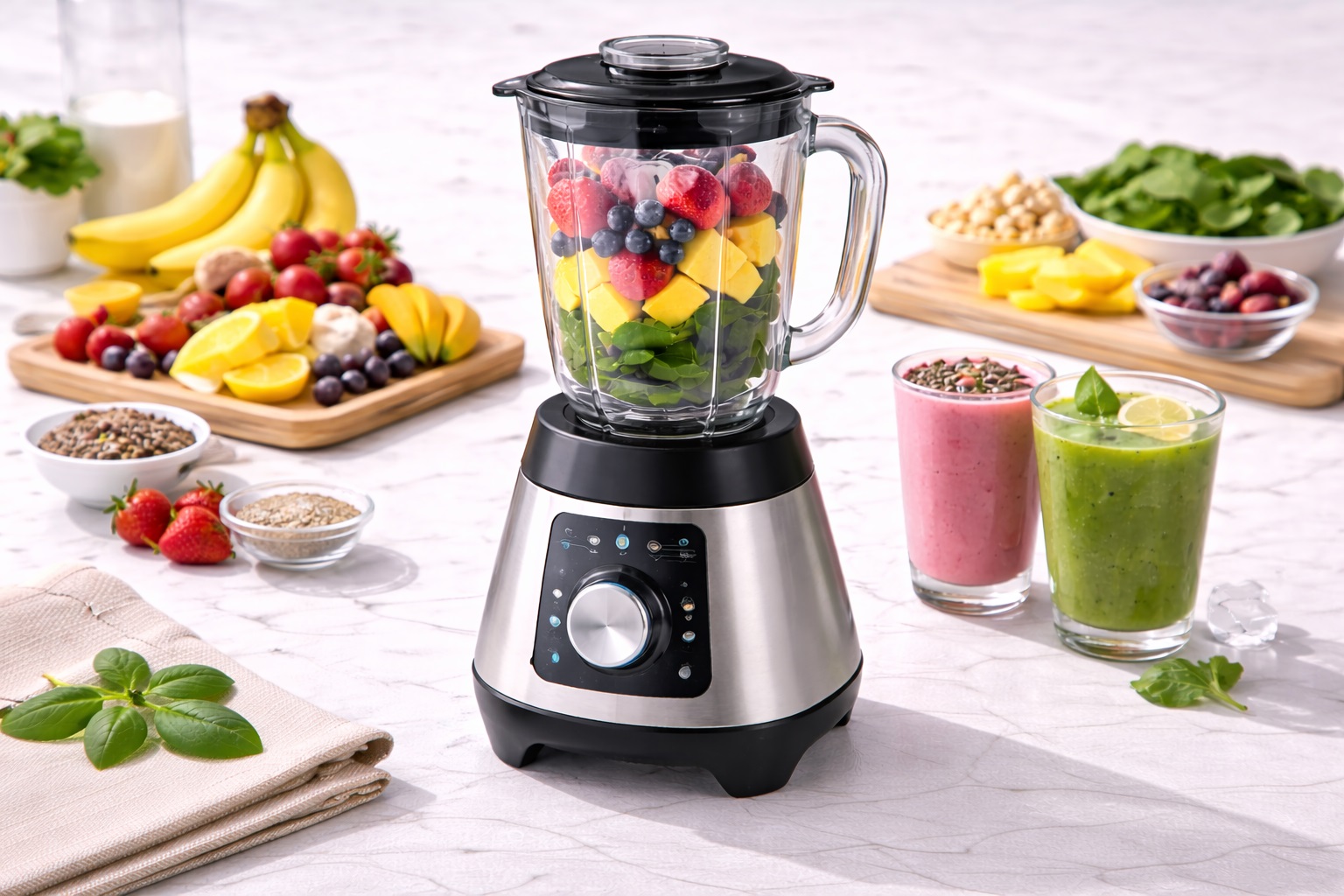
A 1000–1400W countertop blender with a 6-blade stainless steel assembly produces the vortex force necessary to fully break down fibrous vegetables, frozen fruit, ice, and seeds into completely smooth blends without leaving chunks or gritty particles. This power tier handles every blending task from green smoothies with raw kale to frozen cocktails to hot soup purées.
Quality models in this power tier include variable speed control (5–10 speeds) plus pulse, which allows precise texture management from slightly textured salsas to completely smooth soups. A 64-ounce (2-liter) BPA-free jar handles family-size blending volumes in single batches. A self-cleaning mode (warm water and a drop of dish soap, 30-second blend, rinse) reduces cleanup to under one minute after most blending sessions.
- Pros:
- Processes frozen fruit, ice, and fibrous vegetables completely smooth
- Variable speed for texture control from chunky to smooth
- 64oz jar for family batches or weekly smoothie prep
- Self-clean function reduces cleanup to under 60 seconds
- Cons:
- Louder than personal or lower-power alternatives
- Larger footprint and weight than compact alternatives
Best For: Households blending daily for smoothies, soups, and frozen drinks who need reliable, complete processing of all ingredient types.
Performance Verdict: High-power blenders at this tier process ingredients that lower-powered alternatives leave incomplete — frozen fruit smoothies without gritty ice chunks, green smoothies where raw kale is fully liquefied rather than leaving green flecks, and protein shakes where raw seeds are fully processed rather than left as particles.
Who Should Buy This: Daily smoothie drinkers, households making soups and sauces regularly, and anyone who processes frozen fruit, ice, or fibrous ingredients as part of their regular blending routine.
Value Assessment: 1000–1400W countertop blenders represent the highest-value tier for serious blending capability. Below this power, certain ingredients won't blend completely smooth regardless of blending time. This tier is the minimum for complete frozen-ingredient processing.
2. Personal Single-Serve Blender — Best for Individual Daily Smoothies
A personal blender blends directly in the serving cup, which becomes the lid-capped drinking bottle immediately after blending — eliminating jar washing entirely and producing the most convenient daily single-serve smoothie workflow. The blending cup typically holds 20–24 oz, appropriate for a standard smoothie serving. Motor power ranges from 600–1000W depending on model tier.
For daily smoothie drinkers who make single-serve blends, a personal blender eliminates the primary friction point of countertop blenders — washing the jar after every use. The cup goes directly from blender base to cap-sealed travel container. The trade-off is capacity (single-serve only) and motor power (typically lower than countertop alternatives), making very fibrous or fully frozen-dense blends more challenging.
- Pros:
- Blend-in-cup design — no jar to wash
- Cap the cup and take it directly for on-the-go consumption
- Compact footprint — fits in a cabinet or drawer
- Adequate for most standard smoothie ingredients at its power tier
- Cons:
- Single-serve only — not suitable for family batches
- Lower power struggles with very dense frozen ingredients or hard fibrous vegetables
Best For: Individual daily smoothie drinkers who prioritize maximum morning routine convenience and on-the-go portability over batch blending capability.
Performance Verdict: The personal blender is the right choice specifically for individuals who make one smoothie per day. The elimination of jar washing is the decisive convenience factor — the time saved across 365 daily cleanups is substantial, and the cup-to-go design integrates seamlessly into commuting routines.
Who Should Buy This: Single-person households, commuters, and anyone who makes daily smoothies and values the minimal cleanup and on-the-go convenience of the cup-to-go design.
Value Assessment: Personal blenders cost significantly less than powerful countertop alternatives. For the specific use case of daily single-serve smoothies, they deliver full value at a fraction of the cost and footprint of larger alternatives.
3. Immersion Hand Blender — Best for Soup Pureeing and Flexible Use
An immersion blender provides blending capability directly in any pot or bowl, eliminating the transfer of hot soup to a blender jar — the most dangerous and messy step in traditional soup pureeing. Quality immersion blenders at 400–800W handle most standard blending tasks: soup purées, smoothies in a tall cup, mayonnaise emulsification, sauces, and whipped cream.
The immersion format stores in a drawer rather than requiring dedicated counter or cabinet space. Most include multiple attachment options — standard blending head plus a whisk and a chopping bowl. The trade-off versus jar blenders is thoroughness: an immersion blender produces smooth purées adequately but doesn't match the complete-blend results of a high-power countertop model for very fibrous ingredients or frozen drinks.
- Pros:
- Blend soups directly in the pot — no dangerous transfer
- Drawer storage — no counter footprint
- Multiple attachments for whipping and chopping
- Easy to clean — rinse the blade head immediately after use
- Cons:
- Less powerful than countertop alternatives for frozen or very dense ingredients
- Handle ergonomics during extended blending can cause hand fatigue
Best For: Home cooks who make pureed soups regularly and want the convenience of in-pot blending, or those who need blending capability without dedicated counter storage.
Performance Verdict: The immersion blender's defining advantage is in-pot blending for soups and sauces. The danger and mess of transferring hot soup to a countertop blender — which can cause explosive steam buildup if the lid isn't held firmly — is completely eliminated. This single safety and convenience improvement justifies the immersion blender for any household that makes pureed soups regularly.
Who Should Buy This: Home cooks who frequently make pureed soups and sauces and want to blend directly in the cooking vessel, or those who need blending capability in a minimal-storage format.
Value Assessment: Immersion blenders are typically the most affordable category in the blender market at $25–80 for quality models. For in-pot soup blending, the immersion design delivers better results at lower cost than purchasing a countertop blender specifically for this task.
Complete Buying Guide: How to Choose the Best Best Blenders Under $150: High-Performance Blending at a Smart Price
Knowing which product to buy is one challenge. Understanding why one product is better suited to your specific situation is the more useful skill. The following guide explains every important buying factor in plain, practical terms.
1. Motor Wattage and Real-World Performance
Blender wattage indicates maximum power draw during peak load — not sustained operating power. A 1000W blender draws 1000W when processing its hardest ingredient at maximum load. During lighter blending tasks, it draws significantly less. The practical significance of wattage is in peak performance capability: can the blender fully process frozen fruit and dense vegetables without stalling or leaving particles?
Pro Tip: A useful wattage guideline for daily smoothie blending: 600W minimum for soft fruit and yogurt. 800W for frozen fruit and light ice. 1000W+ for dense greens, large ice quantities, hard vegetables, and nut butters. Match wattage to your hardest regular blending task, not your average task.
2. Blade Assembly: The Critical Variable
The blade assembly design — blade count, blade geometry, and metallurgy — determines how effectively the blender creates a vortex that pulls ingredients down toward the blade consistently. A 6-blade assembly in opposing angles creates a more complex vortex than a 4-blade design, producing more even processing with fewer voids where ingredients avoid the blade. Stainless steel blade quality determines edge retention across thousands of blending cycles.
Pro Tip: Blade quality is the primary differentiator between blenders at similar wattage. A 1000W blender with a poorly designed blade assembly produces worse results than a 750W blender with a precision-engineered blade system. This is why established brands with well-tested blade assemblies (Vitamix, Blendtec, Ninja) consistently outperform generic alternatives at equivalent wattage.
3. Jar Material: BPA-Free Plastic vs Glass vs Tritan Copolyester
Standard blender jars use BPA-free polycarbonate or Tritan copolyester plastic — both safe for food contact and impact-resistant. Glass jars are heavier, more fragile, but retain no taste or odor between uses and never scratch to create bacterial-harboring surfaces. Tritan copolyester (used by premium brands) is BPA/BPS-free, impact-resistant, and highly scratch-resistant — superior to standard polycarbonate. For daily use, Tritan is the best plastic option; glass is best for taste-sensitive users.
Pro Tip: The stain retention issue: certain spices (turmeric) and strongly pigmented ingredients (beets, berries) can permanently stain standard plastic jar interiors over time. Tritan copolyester is the most stain-resistant plastic. If you regularly blend high-pigment ingredients, jar material matters more than for standard green/protein smoothie preparation.
4. Noise Management for Daily Blending
High-powered blenders are loud — typically 85–90 dB during operation. This is louder than a vacuum cleaner and can be disruptive in open-plan living spaces and early-morning household routines. Noise enclosures (available as accessories for some brands) reduce noise by 20–30 dB to conversational levels. Vibration dampening mats under the blender base reduce transmitted noise to countertops.
Pro Tip: For morning smoothie routines in shared living spaces, the noise of high-powered blending is a real household impact. Test the noise level of any powerful blender during the return period at your typical blending time to verify it's acceptable for your household.
5. Container Capacity for Your Use Pattern
Personal blenders: 20–24 oz — one serving only. Countertop compact: 40–48 oz — 2–4 servings. Full countertop: 64–72 oz — family batches or 4–6 servings. For single daily smoothies: a 20–24 oz personal blender is the optimal size. For making 2–3 servings simultaneously: a 40–48 oz jar. For family batches or weekly meal prep: 64 oz minimum. Oversize containers are less efficient for small batches — the liquid doesn't reach the blade vortex properly in too large a jar with too little fill.
Pro Tip: The minimum fill for effective blending is approximately 1/4 of the jar capacity. Below this, the blade isn't fully immersed and the vortex doesn't develop properly. Match jar capacity to your typical blend size at 50–75% fill for optimal blending performance.
6. Variable Speed and Preset Programs
Variable speed control allows precise texture management across the full range from slightly textured to completely smooth. Starting at low speed and gradually increasing prevents splashing and allows ingredients to break down progressively before reaching full blend power. Preset programs (smoothie, ice crush, soup) encode the ramp-up sequence that produces optimal results for each preparation type.
Pro Tip: For daily smoothie blending, the smooth-progression preset produces better results than starting at maximum speed — which throws ingredients against the jar walls without effective vortex formation in the first few seconds. Variable speed mastery is the technique skill that separates adequate from excellent blending results.
7. Self-Clean Function Value
A self-cleaning function (typically: add warm water and a drop of dish soap, run on high for 30 seconds, discard, rinse) reduces jar cleaning to under 60 seconds for most blending tasks. For daily smoothie blenders, this cleaning convenience is one of the highest-value features — it removes the primary friction point of jar cleaning that causes many people to make their blender less frequently than they otherwise would.
Pro Tip: Clean the blender immediately after use before residue dries and adheres. Dried protein residue (from protein powders) and fat residue (from nut butters) require more effort to clean than residue cleaned immediately after blending. The self-clean cycle is most effective on fresh residue within 5 minutes of use.
8. Hot Liquid Safety
Blending hot liquids (soups at cooking temperature) in a sealed blender jar creates significant steam pressure risk. The hot liquid expands when blended, and if the lid is sealed tightly, pressure builds rapidly and can explosively separate the lid from the jar. Safe hot liquid blending: fill the jar maximum half-full, hold a folded kitchen towel firmly over the lid with your hand throughout blending, start at the lowest speed, and blend in short bursts rather than sustained high speed.
Pro Tip: Alternatively: use an immersion blender for all hot liquid blending. The in-pot design eliminates steam pressure risk entirely by blending in an open vessel.
9. Smoothie Preparation Technique for Best Results
The order ingredients are added to the blender affects blending efficiency and results. Optimal order: liquids first (water, milk, yogurt), then soft ingredients (bananas, berries), then greens (spinach, kale), then frozen ingredients and ice last. This order ensures liquid contact with the blade from the start, which promotes efficient vortex formation. Adding frozen ingredients first creates a dense mass the blade cannot penetrate effectively.
Pro Tip: Pre-freezing ingredients eliminates the need for ice in smoothies — ice dilutes flavor as it melts. Freeze overripe bananas in pieces, portion berry mixes into zip-lock bags, and freeze spinach portions. Pre-frozen ingredient smoothies are creamier, more flavorful, and longer-lasting cold than ice-added equivalents.
10. Nutritional Impact of Blending
High-powered blending breaks open plant cell walls more completely than lower-power blending or chewing, releasing more nutrition from fibrous vegetables and seeds. This is the physiological basis for claims about increased nutrient bioavailability from blending. However, the same mechanical action oxidizes some heat-sensitive nutrients (certain vitamins and polyphenols) during blending. The net nutritional effect is positive for most ingredients — complete cell disruption benefits outweigh oxidation losses for green smoothies.
Pro Tip: If preserving specific nutrients is a priority, consume blended smoothies immediately rather than storing — oxidation continues after blending. Blending frozen ingredients rather than room-temperature ones also reduces oxidation by lowering the blending temperature.
11. Nut Butter and Dense Food Processing
Quality high-power blenders can process nut butters from raw or roasted nuts — a task requiring sustained 2–4 minute operation at the highest speed setting. The heat generated by extended high-speed operation is normal and necessary to release the nuts' natural oils, which form the binding agent in nut butter. Process in 30-second bursts with 30-second cooling pauses to prevent motor overheating during extended processing sessions.
Pro Tip: Start nut butter blending with a small amount of oil (1 tablespoon per cup of nuts) to help initiate the blending process before the nuts' natural oils are released. This prevents the initial dry grinding phase that stresses the motor most significantly.
Understanding blender under $150: What the Specifications Actually Mean
Product listings for blender under $150 use technical language that can be difficult to evaluate without context. This section translates the most important specifications into plain terms so you can compare products accurately.
The Physics of Effective Blending: Cavitation and Vortex Formation
Effective blending depends on creating a stable vortex — a downward spiral flow that continuously pulls ingredients from the top of the liquid toward the rotating blade at the bottom. Without a stable vortex, ingredients circulate around the blade rather than through it, producing inconsistent results where some material is fully processed and other pieces avoid the blade entirely. High-powered blenders with quality blade geometry maintain a stable vortex across a wider range of ingredient types and jar fill levels than lower-powered alternatives.
Cavitation — the formation and collapse of microscopic vapor bubbles from pressure changes — occurs during high-speed blending and contributes to cell disruption of plant materials. This mechanical cavitation effect is partially responsible for the more complete nutrient release from high-powered blenders compared to lower-powered alternatives that cannot generate sufficient cavitation conditions.
Why Blender Price Correlates with Longevity
Budget blenders use lower-quality motor windings that overheat faster during sustained operation, lower-grade bearing materials that wear faster under blade stress, thinner-wall plastic jars that crack more readily under thermal and mechanical stress, and blade assemblies machined to looser tolerances that allow wobble under load. These quality differences don't significantly affect results on the first day of use — they manifest over hundreds of blending cycles as performance gradually degrades.
The most reliable indicator of blender longevity in the consumer market is warranty length. A 5–10 year warranty from an established brand signals engineering confidence in sustained performance. A 90-day warranty signals the opposite — and should be treated as a strong signal about expected lifespan under daily use conditions.
Understanding the Vitamix and Blendtec Premium
Vitamix and Blendtec blenders cost $400–700+ and are the most frequently recommended options by professional chefs, food scientists, and experienced daily blender users. The premium reflects commercial-grade motor windings designed for sustained operation, precisely engineered blade assemblies that maintain vortex consistency across all ingredient types, BPA/BPS-free Tritan jars that don't cloud, scratch, or retain odor over years, and warranties of 7–10 years. For households who blend daily and want an appliance that maintains its performance for 10+ years, this price tier becomes economically rational when divided across the expected usage lifespan.
A $600 Vitamix used daily for 10 years costs $60 per year of ownership. A $60 budget blender replaced every 18 months costs $40 per year but provides significantly degraded performance from month 6 onward. For daily-use blenders, the premium brand's cost-per-year of quality performance is often more favorable than the replacement cycle economics of budget alternatives.
Nutrient Retention in Blended Foods
Research into blending and nutrient bioavailability shows complex, ingredient-specific results. For leafy greens, high-power blending improves nutrient bioavailability by disrupting rigid cell walls that reduce absorption of intact cells. For delicate water-soluble vitamins (B vitamins, Vitamin C), the heat and oxidation from blending causes some degradation — typically 10–30% loss depending on blending duration and temperature. For fat-soluble antioxidants (beta-carotene, lycopene), blending with a small amount of healthy fat significantly increases bioavailability compared to consuming the raw ingredient without fat.
The practical nutritional guidance: blend green smoothies at high power for short durations (20–30 seconds is sufficient for complete blend), consume immediately, and include a small healthy fat source (avocado, nut butter, seeds) to maximize fat-soluble nutrient absorption.
Frequently Asked Questions About blender under $150
These are the questions buyers most commonly ask before purchasing a blender under $150. Each answer reflects real-world usage rather than manufacturer marketing language.
1. How much power does a blender need to make a good smoothie?
For soft fruit and yogurt smoothies: 600W is adequate. For smoothies with frozen fruit: 800W minimum for consistent results. For smoothies with raw leafy greens and ice: 1000W+ for completely smooth results without green flecks or ice particles. Match wattage to your hardest regular ingredient — frozen-dense smoothies require meaningfully more power than soft-fruit alternatives.
2. Why does my blender leave lumps in my smoothie?
Most common causes: insufficient motor power for the ingredients used (particularly frozen fruit or dense greens), incorrect blending order (frozen ingredients first block the vortex), jar overfilling (prevents vortex formation), or blades that have dulled from extended use. Solutions: ensure liquid is added first, fill jar to maximum 70%, blend in stages from low to high speed, and verify your blender has adequate wattage for the ingredients.
3. Are personal blenders as good as full-size countertop blenders?
For standard soft-fruit smoothies: comparable results. For frozen-dense smoothies, green smoothies with fibrous kale, or anything requiring sustained high-power processing: countertop high-power blenders produce significantly smoother results. The personal blender's compromise is motor power — the format prioritizes convenience over raw blending performance. For soft smoothies, this compromise is invisible; for demanding ingredients, it's noticeable.
4. Can I blend hot soup in a regular blender?
Yes, with proper safety precautions: fill maximum half-full, hold the lid firmly with a towel throughout, start at lowest speed, and increase gradually. Never seal the lid tightly with hot liquid — steam pressure can separate the lid explosively. Alternatively, let soup cool slightly before blending, or use an immersion blender directly in the pot for the safest hot-liquid blending experience.
5. How long should a quality blender last?
Budget blenders: 1–3 years with daily use. Mid-range ($80–150) quality brands: 3–7 years. Premium brands (Vitamix, Blendtec): 10+ years with proper maintenance. The motor and blade bearing are the primary longevity components. Proper maintenance (immediate cleaning, not overfilling, not running continuously for extended periods) extends lifespan at every quality tier.
6. Is it worth buying a Vitamix or Blendtec for home use?
For daily blenders who blend fibrous ingredients or frozen foods regularly: yes. The performance difference is most noticeable on difficult ingredients — green smoothies, nut butters, frozen dense blends. For occasional soft-fruit smoothie makers: the premium is difficult to justify. The economic case improves with blending frequency — the more you blend daily, the more the cost-per-use economics favor the premium brand.
7. Can I use a blender as a food processor?
For some tasks: yes. For liquid-based processing (smoothies, soups, sauces, dips): blenders are ideal. For chopping dry or semi-dry ingredients: food processors produce better results — blenders require liquid for effective vortex formation and don't chop without liquid. The tools are complementary rather than interchangeable for the full range of food preparation tasks.
8. What is the difference between a blender and a nutri-bullet?
A NutriBullet is a brand of personal blender using the blend-in-cup format. It is a specific product within the personal blender category rather than a different appliance type. Standard countertop blenders use a separate jar that attaches to the base; personal blenders including NutriBullet use a cup that attaches inverted to the base for blending and then becomes the drinking vessel. Both are blenders — the difference is format, capacity, and convenience approach.
9. How do I remove blueberry stains from my blender jar?
Fill with warm water and 1–2 tablespoons of baking soda or white vinegar. Blend on medium speed for 30 seconds. Let stand for 10 minutes. Discard and rinse. For persistent staining, a paste of baking soda and water applied with a non-abrasive sponge and rinsed thoroughly removes most pigment staining from plastic jars. Tritan copolyester jars are significantly more stain-resistant than standard polycarbonate.
10. Should I blend ice in my blender?
Only in blenders rated for ice blending — typically 600W+ with specifically designed ice-crushing blades. Attempting to crush ice in a budget blender not rated for it can damage blade tips, motor bearings, and jar integrity. Most 800W+ blenders from established brands handle ice adequately. For daily ice crushing, a blender with specific ice-crush function certification is the reliable choice.
Final Verdict — Which blender under $150 Should You Buy?
Your blender decision is simpler than the market makes it appear. For daily single-serve smoothies with standard ingredients, a quality personal blender delivers maximum convenience at the lowest cost and footprint. For family smoothie routines or demanding ingredients like raw greens and frozen-dense blends, a 1000W+ countertop model is the right tool. For soup pureeing and stovetop cooking applications, an immersion blender is the most practical and safest choice.
- Best for Smooth Blends and Frozen Drinks: High-Performance Countertop Blender (1000-1400W) — Best all-purpose complete-blend performance for daily serious blending.
- Best for Individual Daily Smoothies: Personal Single-Serve Blender — Best daily convenience and portability for single-serve smoothie routines.
- Best for Soup Pureeing and Flexible Use: Immersion Hand Blender — Best in-vessel blending for soups and sauces with maximum storage convenience.
Whatever you choose, clean it immediately after every use — this single habit is the most impactful factor in whether your blender becomes a daily appliance or an occasional one. Buy the cleaning convenience you'll actually maintain, not the performance ceiling you'll only occasionally reach.