Best Water Filters for Apartments: Clean Water Without Installation
Renting comes with a specific constraint that homeowners rarely think about: you generally can't cut into plumbing, install a whole-house filtration system, or make permanent modifications to a kitchen without risking your security deposit or violating a lease. That rules out entire categories of water filtration equipment that assume ownership of the pipes behind the wall. What's left is a surprisingly broad range of products built specifically around that constraint — filters that clip onto a faucet, sit on a countertop, or simply live in the refrigerator as a pitcher, none of which require a plumber, a landlord's permission, or a single tool.
The tradeoffs across these options are real, though, and they matter more than most buyers realize until after they've already purchased the wrong one. A pitcher filter is wonderfully simple but slow and limited in volume. A faucet-mounted filter delivers filtered water on demand but ties up your sink and can't remove everything a more advanced system can. Countertop and reverse osmosis units filter more thoroughly but take up counter space and cost more upfront. None of them is objectively "the best" — the right choice depends on your water quality concerns, your daily water usage, your counter and fridge space, and how much you're willing to spend both upfront and over time on replacement filters.
This guide reviews six practical, no-installation water filter categories that consistently show up in apartment and rental contexts, explains what each one actually filters out and where its limitations lie, and walks through the specific factors that determine whether a filter becomes part of your daily routine or ends up ignored in a cabinet after the novelty wears off.
It's worth noting from the outset that not all filtration methods target the same contaminants. Some filters are built primarily to improve taste and odor by reducing chlorine, while others are certified to reduce lead, specific heavy metals, or a broader range of contaminants. If you have a specific water quality concern — from a known local issue or a water quality report — checking a filter's specific contaminant reduction claims matters more than assuming any filter labeled "water filter" addresses the same list of substances.
Top 6 Water Filters for Apartments (Detailed Reviews)
1. Pitcher Filter – Best For Simple, Low-Volume Everyday Use
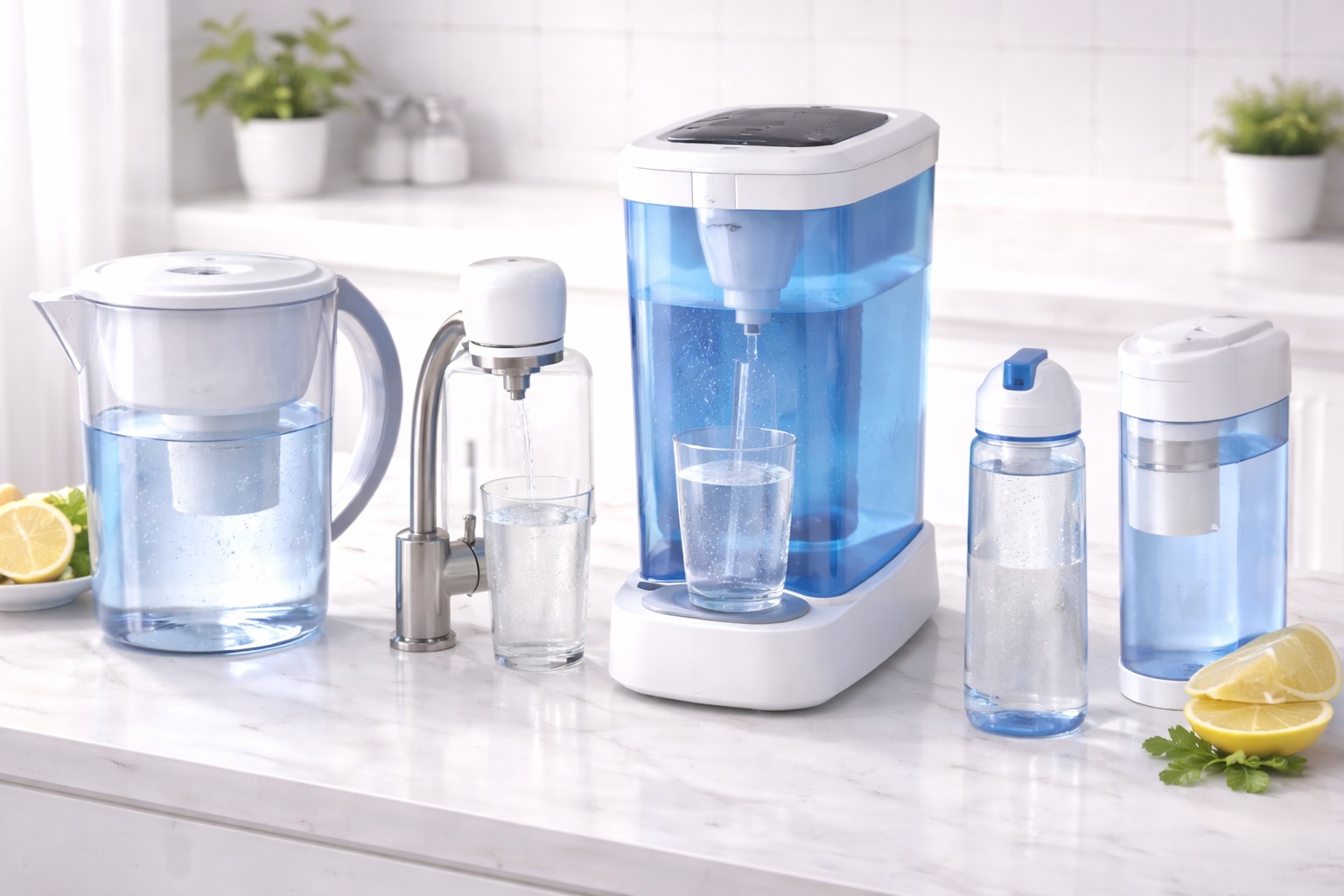
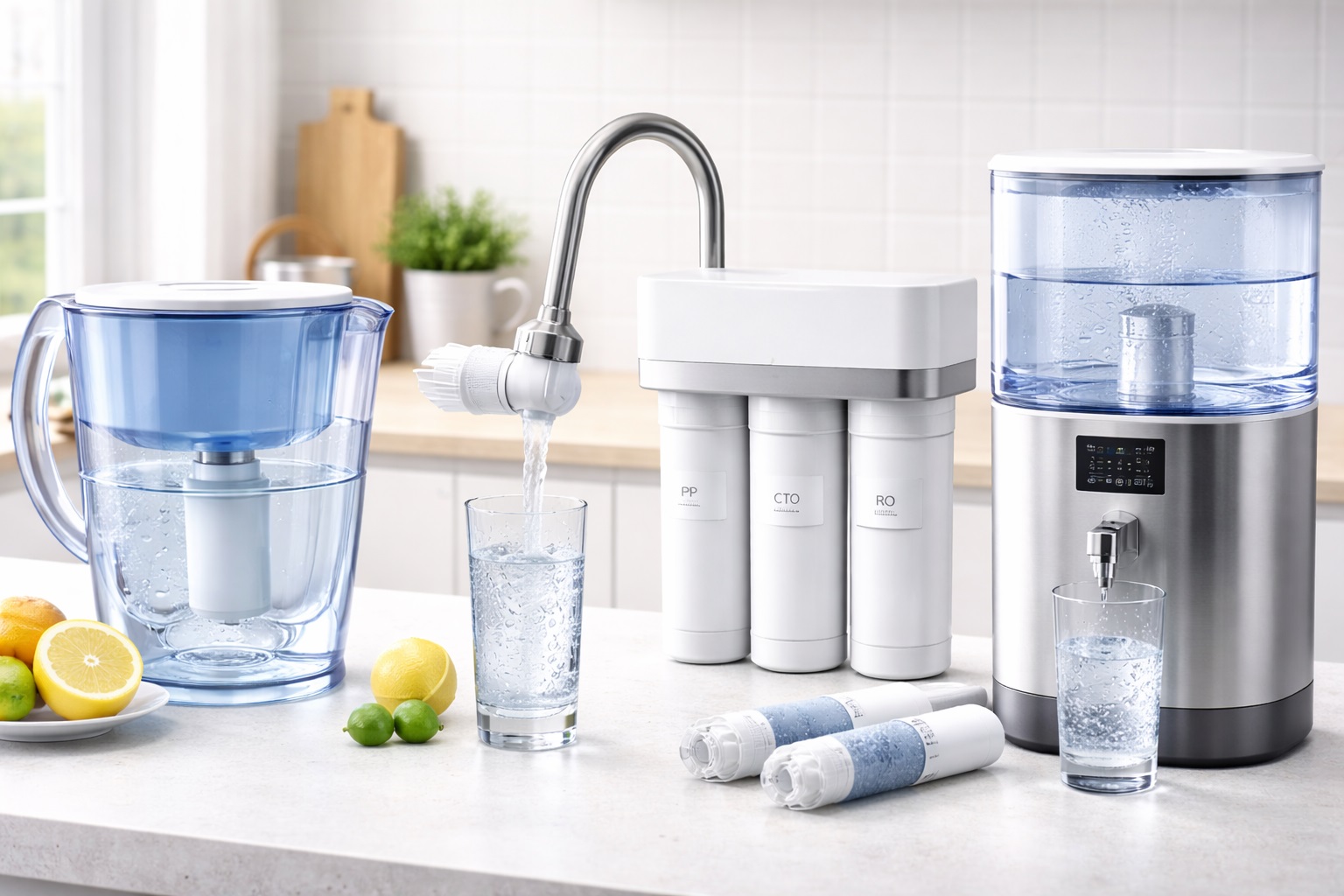
A pitcher filter is the simplest entry point into the category: a reservoir on top holds tap water, which drips slowly through a filter cartridge into a lower chamber, and the whole unit lives in the refrigerator between refills. It requires no setup beyond an initial rinse of the cartridge and produces cold, filtered water with essentially zero installation effort.
- Pros:
- No setup or installation whatsoever — fill, filter, and refrigerate
- Fully portable, so it moves easily between apartments or even to a dorm or office
- Low upfront cost compared to countertop and reverse osmosis systems
- Cons:
- Slow filtration speed means limited water volume available at any given moment
- Takes up refrigerator space that some smaller apartment kitchens don't have to spare
Best For: Renters with modest daily water needs who want the absolute simplest, lowest-commitment filtration option.
Why We Recommend It: For someone who mainly wants better-tasting drinking and cooking water without any setup, a pitcher filter remains the lowest-friction option in the entire category. It asks nothing of your kitchen beyond fridge space.
The tradeoff of slow flow rate becomes more noticeable the more people share a household, since a single pitcher can struggle to keep pace with frequent refills for multiple people. In a one- or two-person apartment, though, this limitation rarely becomes a real problem, and the simplicity generally outweighs the inconvenience of a short wait for the reservoir to drain.
2. Faucet-Mounted Filter – Best For On-Demand Filtered Water Without a Pitcher
A faucet-mounted filter attaches directly to the end of a kitchen faucet, typically with a simple threaded adapter, and filters water as it flows rather than requiring a separate reservoir to fill and wait on. Most models include a switch to toggle between filtered and unfiltered flow for tasks like rinsing dishes that don't need filtered water.
- Pros:
- Delivers filtered water on demand without waiting for a pitcher to drain
- No refrigerator space required since it lives on the faucet itself
- Toggle switch allows quick access to unfiltered water for non-drinking tasks
- Cons:
- Only compatible with certain faucet shapes and threading, which can be a problem in older apartments
- Adds bulk to the faucet itself, which some renters find visually or physically awkward day to day
Best For: Renters who want immediate access to filtered water at the tap without giving up refrigerator space to a pitcher.
Why We Recommend It: The on-demand nature solves the single biggest complaint about pitcher filters — waiting for water to filter through slowly — while still requiring no permanent modification to the plumbing itself.
Compatibility is the main pitfall in this category. Many apartment kitchens, especially in older buildings, have faucets with pull-down sprayer heads, unusual aerator threading, or integrated soap dispensers that make attaching a standard faucet filter awkward or impossible. Checking your specific faucet's compatibility before buying avoids the most common return reason in this category.
3. Countertop Filtration Unit – Best For Higher Volume Without Faucet Modification
A countertop filtration unit sits beside the sink and connects to the faucet with a diverter valve or simply gets filled manually, filtering larger volumes of water than a pitcher while still avoiding any permanent plumbing changes. These units typically use multi-stage filter cartridges and can produce noticeably better-tasting water than either a pitcher or basic faucet filter.
- Pros:
- Higher water volume and often more thorough multi-stage filtration than pitcher or faucet-mount options
- No permanent plumbing modification required despite the larger unit size
- Filter cartridges typically last longer between replacements than pitcher filters given the larger capacity
- Cons:
- Takes up meaningful counter space in kitchens where that's already limited
- Higher upfront cost than pitcher or basic faucet-mounted filters
Best For: Households with higher daily water usage, or anyone who wants noticeably more thorough filtration than a pitcher provides without installing anything permanent.
Why We Recommend It: For a household that goes through a lot of drinking and cooking water daily, refilling a pitcher repeatedly becomes tedious. A countertop unit's larger capacity and multi-stage filtration solve both the volume and thoroughness limitations of smaller options.
Because these units are larger and generally pricier than a basic pitcher, it's worth being realistic about your kitchen's available counter space before purchasing. A unit that technically fits but crowds your primary workspace daily is more likely to become a source of frustration than a filter that's slightly less capable but genuinely convenient to keep in place.
4. Reverse Osmosis Countertop System – Best For Thorough Contaminant Reduction
A countertop reverse osmosis system pushes water through a semi-permeable membrane in addition to standard filter stages, capable of reducing a broader range of dissolved contaminants than pitcher, faucet, or standard countertop filters typically address. Because it doesn't require under-sink installation, it fits the no-plumbing-modification requirement while still delivering a more advanced filtration method.
- Pros:
- Reverse osmosis membrane filtration addresses a broader range of dissolved contaminants than standard carbon filtration alone
- No permanent installation required despite using the same core membrane technology as under-sink RO systems
- Often includes remineralization stages to improve taste after the reverse osmosis process
- Cons:
- Slower processing time than simpler carbon filters due to the membrane filtration stage
- Some water is used in the reverse osmosis process itself, reducing overall efficiency compared to non-RO filters
Best For: Renters with specific water quality concerns who want the most thorough filtration available without a permanent under-sink installation.
Why We Recommend It: This category delivers meaningfully more advanced filtration than the other no-installation options on this list, which matters for anyone dealing with a known local water quality issue rather than simply wanting better-tasting tap water.
The tradeoff for that thoroughness is complexity and cost — reverse osmosis systems have more components, need periodic membrane and filter replacements at a higher combined cost, and process water more slowly than a basic carbon filter. This category rewards renters with a genuine filtration need rather than those simply seeking a mild taste improvement.
5. Under-Sink Renter-Friendly Filter – Best For a Filtration System That Stays Out of Sight
Renter-friendly under-sink filters are designed specifically to avoid the permanent plumbing cuts that traditional under-sink systems require, typically connecting via a diverter valve or quick-connect fitting that attaches without cutting into existing pipework and can be removed cleanly at move-out.
- Pros:
- Keeps the filtration unit hidden under the sink rather than occupying visible counter space
- Non-permanent connection methods are designed to be removed cleanly without damaging existing plumbing
- Often provides higher filtration capacity than pitcher or faucet-mount options
- Cons:
- Installation, while non-permanent, is more involved than simply filling a pitcher or clipping on a faucet filter
- Not all rental leases or landlords are comfortable with any under-sink modification, even a reversible one
Best For: Renters who want a higher-capacity filtration system but strongly prefer keeping the unit out of sight rather than on the counter.
Why We Recommend It: This category threads the needle between the visible bulk of a countertop unit and the plumbing commitment of a permanent system, which makes it appealing specifically for renters who dislike clutter but still want more capacity than a pitcher provides.
Before choosing this option, it's worth confirming with your specific lease terms or landlord whether even a non-permanent under-sink connection is acceptable, since policies vary considerably between buildings and property managers.
Installation typically takes longer than the other categories on this list — often thirty minutes to an hour for a first attempt — but the payoff is a filtration system that behaves like a permanent fixture without actually being one. For renters who plan to stay in the same apartment for a while, that tradeoff of a slightly longer setup for a cleaner, hidden result is often worth making.
6. Budget Apartment Water Filter – Best For First-Time Buyers on a Tight Budget
Budget apartment water filters cover simple, low-cost pitcher or basic faucet-style units that address the core goal of better-tasting tap water without the added filtration stages, capacity, or features of pricier options.
- Pros:
- Lowest cost of entry into apartment-friendly water filtration
- Simple design with minimal parts to maintain or replace beyond the core filter cartridge
- Sufficient for basic taste and odor improvement in most municipal tap water situations
- Cons:
- Limited contaminant reduction compared to multi-stage or reverse osmosis systems
- Filter cartridges at this price point may need more frequent replacement to maintain performance
Best For: First-time filter buyers who mainly want to improve everyday tap water taste and odor without a larger investment.
Why We Recommend It: Not every renter has a specific contaminant concern — many simply want tap water that tastes better for drinking and cooking. A budget filter addresses that goal directly at the lowest possible cost, and buyers who find they want more can upgrade later with a clear sense of what they actually need.
As with any budget-tier product, cartridge replacement frequency and consistency can vary more than in pricier lines, so factoring ongoing filter costs into your comparison — not just the upfront unit price — gives a more accurate picture of long-term value. A modest, reliable budget filter used consistently will generally outperform a more advanced system that gets neglected because it felt like too large an investment to fully commit to at the outset.
Buying Guide: How to Choose the Best Water Filter for Your Apartment
Before making a purchase decision, consider these key factors that separate a water filter that genuinely improves your daily water quality from one that looks appealing in a listing but underperforms in practice.
1. What Contaminants You're Actually Trying to Reduce
Some filters focus primarily on chlorine taste and odor, while others are certified for lead or a broader list of contaminants. Identify your specific concern — whether it's general taste, a known local water quality issue, or a documented contaminant — before assuming any filter in the category addresses the same list of substances.
2. Daily Water Volume Needs
A single person's drinking and cooking water needs look very different from a shared household's. Pitcher filters work well for lighter, occasional use, while countertop or under-sink systems handle sustained daily volume far more comfortably.
3. Available Counter and Refrigerator Space
Countertop and reverse osmosis units require dedicated counter space, while pitcher filters need refrigerator room instead. Measure your available space realistically before choosing a category, since a filter that doesn't fit comfortably is far less likely to get used consistently.
4. Faucet Compatibility
Faucet-mounted filters and diverter-based systems depend on specific faucet shapes and threading. Older apartment faucets, pull-down sprayer heads, and integrated soap dispensers can all complicate installation, so checking compatibility specifications against your actual faucet avoids the most common fit-related return in this category.
5. Filter Replacement Cost and Frequency
The unit price is only part of the total cost of ownership — replacement filter cartridges are an ongoing expense that varies significantly between models and categories. Factor in how often cartridges need replacing and their per-unit cost when comparing options that look similar upfront.
6. Filtration Speed
Pitcher filters are inherently slower than faucet-mounted or countertop units since gravity alone drives the filtration process. If waiting for water is a genuine daily annoyance for your household, prioritize a category with faster on-demand flow over the simplicity of a pitcher.
7. Lease Terms and Landlord Restrictions
Even non-permanent under-sink or diverter-based systems sometimes fall into a gray area with strict leases. When in doubt, confirming with your landlord or property manager before installing anything beyond a simple pitcher or faucet-mount filter avoids potential lease disputes.
8. Certification and Testing Claims
Look for specific, stated contaminant reduction claims rather than general marketing language about "clean" or "pure" water. A filter that lists specific substances it reduces gives you a clearer picture of what it actually does than vague claims alone.
9. Taste and Odor Improvement
Even filters that don't target specific health-related contaminants can meaningfully improve chlorine taste and odor, which is often the primary motivation for apartment dwellers who simply find their tap water unpleasant to drink directly.
10. Portability for Future Moves
Renters move more often than homeowners on average, so a filter that packs up easily and reinstalls in a new apartment without hassle has real practical value. Pitcher and faucet-mount filters generally win here over larger countertop or under-sink systems.
11. Water Waste in Reverse Osmosis Systems
Reverse osmosis filtration inherently produces some wastewater as part of the membrane process. If water conservation is a personal priority, this is worth weighing against the more thorough contaminant reduction reverse osmosis systems provide.
12. Ease of Cartridge Replacement
Some filters use simple twist-and-lock cartridges that take seconds to swap, while others require more careful alignment or tools. A filter that's genuinely annoying to maintain is more likely to get used past its recommended cartridge life, reducing its effectiveness over time.
13. Storage and Countertop Aesthetics
Beyond raw functionality, consider how a filter looks and fits into your kitchen's daily workflow. A bulky unit parked in the middle of a small counter can become a genuine daily annoyance even if its filtration performance is excellent, so weigh appearance and footprint alongside contaminant reduction claims.
14. Combined Household Usage Patterns
If you share an apartment with roommates or family members, total daily water demand across everyone in the household should guide your choice far more than your own individual usage. A pitcher that's perfectly adequate for one person can become a constant bottleneck in a three- or four-person household.
Frequently Asked Questions
Do apartment water filters actually remove lead?
Some do, but not all. Lead reduction requires a filter specifically certified for that purpose, typically using activated carbon block or reverse osmosis technology. Always check a filter's specific contaminant reduction claims rather than assuming general filtration addresses lead by default.
How often do I need to replace a water filter cartridge?
This varies significantly by filter type and manufacturer, ranging from monthly for smaller pitcher cartridges to several months for larger countertop or under-sink units. Checking the manufacturer's specific replacement schedule matters more than assuming a universal timeline across the category.
Is a pitcher filter as effective as a countertop or reverse osmosis system?
Pitcher filters generally address taste and odor well but typically offer less thorough contaminant reduction than multi-stage countertop or reverse osmosis systems. The right choice depends on whether your primary concern is taste or a more specific documented water quality issue.
Can I install a water filter in my apartment without violating my lease?
Pitcher and most faucet-mounted filters require no plumbing modification and are almost universally acceptable under standard leases. Under-sink and diverter-based systems are typically non-permanent but can still fall into a gray area, so checking with your landlord first is a reasonable precaution.
Do faucet-mounted filters fit all faucets?
No. Faucet-mounted filters depend on specific threading and faucet shapes, and older apartment faucets or those with pull-down sprayers and integrated soap dispensers can be incompatible. Checking compatibility specifications before purchasing helps avoid this common issue.
Why does reverse osmosis filtration produce wastewater?
The membrane filtration process used in reverse osmosis systems requires flushing away water that carries filtered-out contaminants, which is an inherent part of how the technology works rather than a design flaw specific to any one product.
Is bottled water a better option than an apartment water filter?
For most renters, a reusable filter is significantly more cost-effective over time than regularly purchasing bottled water, in addition to producing far less plastic waste. The upfront cost of a filter is typically recovered within a relatively short period of regular use.
What's the difference between carbon filtration and reverse osmosis?
Carbon filtration primarily improves taste and odor by adsorbing chlorine and certain organic compounds, while reverse osmosis uses a membrane to physically block a broader range of dissolved contaminants, generally at the cost of slower processing and some water waste. Many countertop and under-sink systems combine both methods in stages, using carbon filtration to handle taste and chlorine before or after the reverse osmosis membrane does the more thorough contaminant reduction work.
How do I know if my apartment's tap water needs additional filtration?
Checking your local water utility's annual water quality report is a good starting point, since it lists documented contaminant levels for your specific area. If a particular contaminant is flagged, look specifically for a filter certified to reduce that substance rather than assuming any general filter addresses it.
Can I take an apartment water filter with me when I move?
Yes, this is one of the core advantages of non-permanent filtration options. Pitcher and faucet-mount filters are essentially plug-and-play between apartments, and even renter-friendly under-sink systems are designed to disconnect cleanly for relocation. It's still a good idea to keep the original packaging or a written note of the installation steps if you plan to reinstall an under-sink system in a future apartment, since the process is straightforward but easier the second time with a reminder of the exact steps involved.
Do countertop water filters need to be connected to the faucet?
Some countertop units connect via a diverter valve on the faucet, while others are filled manually without any faucet connection at all. Check the specific product's setup method, since this affects both installation and daily convenience.
Are more expensive apartment water filters always better?
Not necessarily. A higher price often reflects more filtration stages or higher capacity, which matters if you have a specific contaminant concern or high water usage, but isn't automatically better for someone whose main goal is simply improved taste from a basic filter.
Does filtered water need to be refrigerated after filtering?
Refrigeration isn't strictly required for safety in most cases, but pitcher filters are typically designed to be stored cold since chilled water is more palatable and most models are sized specifically to fit refrigerator shelves. Countertop and faucet-mounted units are generally used at room temperature and refrigerated separately if desired.
Can a water filter improve the smell of tap water, not just the taste?
Yes, activated carbon filtration — the core technology in most pitcher, faucet-mount, and countertop filters — is particularly effective at reducing the chlorine smell that many people notice in municipal tap water, often producing a noticeable improvement even when the taste change alone might be subtle.
Final Verdict
Choosing the right apartment water filter comes down to being honest about what problem you're actually solving. Improving the taste of chlorinated tap water is a fundamentally different goal from reducing a documented lead concern, and the right filter category for each of those situations looks quite different.
- For simple daily use: A pitcher filter offers the lowest-effort way to improve taste with zero setup.
- For higher volume or more thorough filtration: A countertop or reverse osmosis system addresses both capacity and a broader range of contaminants.
- For a hidden, higher-capacity setup: A renter-friendly under-sink filter keeps the system out of sight while still avoiding permanent plumbing changes.
Whatever your specific water quality concern, a genuinely apartment-friendly filter should require no tools, no landlord approval beyond a quick check of your lease terms, and no risk to your security deposit — and within that constraint, there's a practical option suited to nearly every renter's daily water habits and budget. Take stock of your household's actual water use, your available counter and fridge space, and whether you're solving a taste problem or a documented contaminant concern before choosing between these six categories, and the resulting decision will hold up far longer than one made on price or packaging alone.