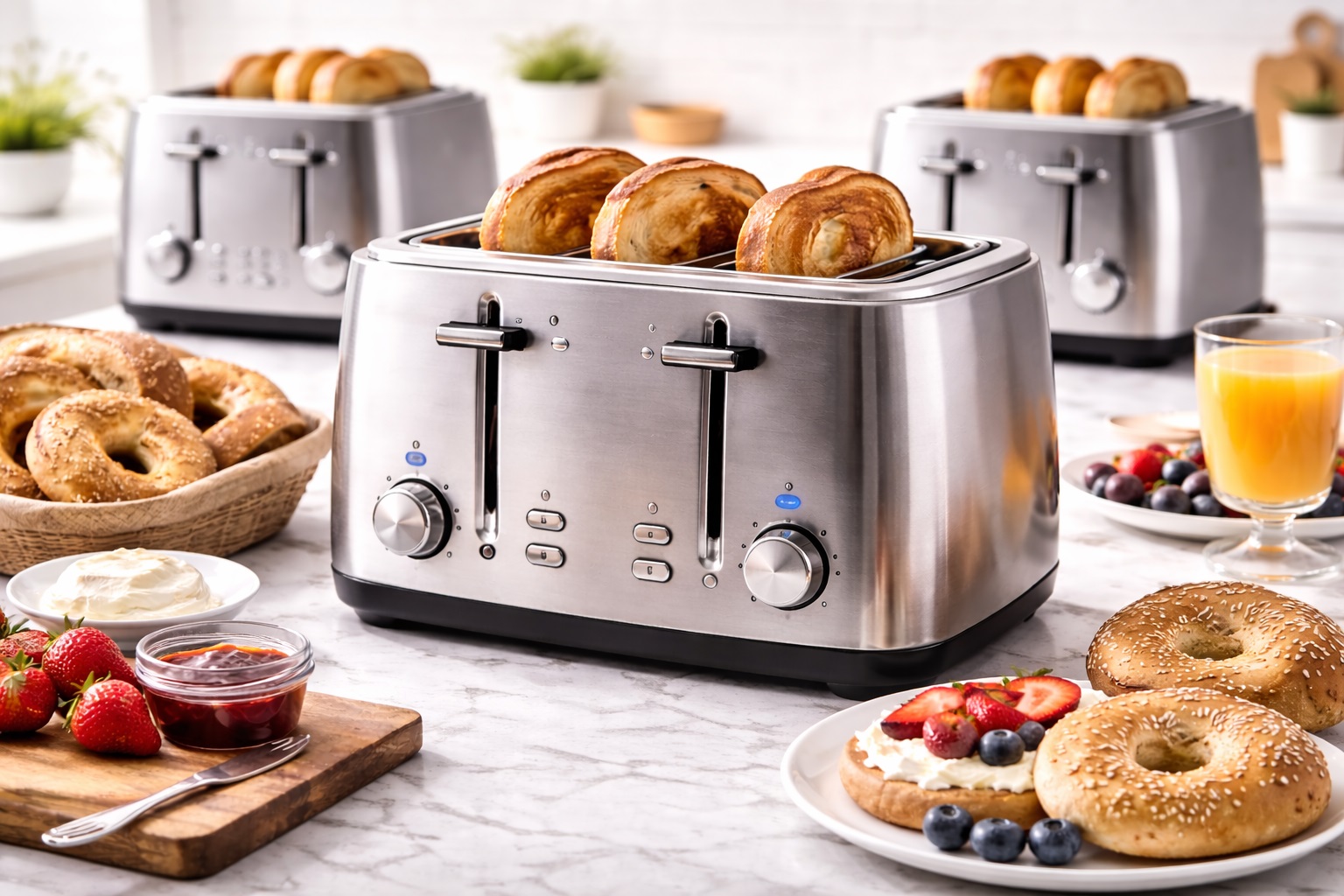
Best Toaster for Even Browning in 2026
Uneven browning is one of the most common frustrations with a cheap toaster — one side comes out pale while the other is nearly burnt, or the middle slice in a four-slot model lags behind its neighbors. This guide compares eight toasters from well-known kitchen appliance brands, focusing on the design choices and features that actually influence how evenly a toaster browns bread, so you can choose a model that's more likely to deliver consistent results slice after slice.
Even browning isn't a single feature you can check off a spec sheet; it comes from a combination of heating element quality, slot design, and browning-control precision working together. This guide compares the top models on the market, looking at how each one approaches that combination rather than assuming a higher price automatically means more even results.
It's worth setting realistic expectations from the outset: no toaster guarantees perfectly identical browning on every single slice, especially with irregular homemade bread. What separates the better-designed models here is consistency across repeated use and across multiple slots at once, which matters more in daily practice than any single impressive-looking spec.
It also helps to separate two related but distinct ideas: evenness between two slices toasted side by side in the same cycle, and consistency of a single toaster's output from one morning to the next over months or years of use. Some of the design choices below address one of those problems more directly than the other, and we've tried to be specific about which is which rather than treating "even browning" as one single, uniform claim.
Top 8 Best toaster Picks (Detailed Reviews)
1. KitchenAid 2-Slice – Best For Even Results On Small Batches
The KitchenAid 2-Slice pairs a metal body with a high-lift lever, and because it only manages two slices at a time, it has less work to do balancing heat across a wide chamber compared to four-slice competitors. That narrower focus tends to help with consistency between the two slots, since the heating elements only need to serve a compact space rather than stretching evenly across a longer unit. At approximately $80, it's priced in upper-mid-range territory, and buyers considering it for browning consistency should weigh that against simpler mid-range options that do the same job for less. Owners who've compared it side by side with cheaper two-slice units often note that the difference shows up more in build feel and lever action than in a dramatic browning improvement, which is worth keeping in mind before paying the premium purely for evenness.
- Pros:
- Compact two-slot design supports more even heat distribution
- High-lift lever for retrieving smaller items
- Sturdy metal construction
- Cons:
- Priced higher than similarly performing mid-range models
- Only two slices per cycle limits batch size
Best For: Individuals or couples who want consistent results on smaller toasting batches.
Why We Recommend It: Its smaller, focused chamber design is a straightforward way to reduce the variability that comes with heating more slots at once.
2. Smeg 2-Slice – Best For Style-Conscious Buyers Who Still Want Consistency
Smeg's 2-Slice toaster is best known for its retro 50s style design, but the two-slot layout shares the same practical advantage as the KitchenAid: fewer slots to balance heat across generally means more predictable results between them. At around $170, it's priced at a premium driven substantially by design and brand rather than functional superiority in browning specifically, so shoppers focused purely on consistency should weigh whether the styling premium is worth it to them. That said, the enamel-coated steel body distributes heat similarly to other solid metal two-slot designs, so buyers aren't sacrificing browning performance to get the retro look — they're mainly paying for the aesthetic rather than any functional downside.
- Pros:
- Two-slot layout supports consistent side-to-side results
- Distinctive retro design and color options
- Sturdy steel body
- Cons:
- Premium price driven by design as much as function
- No specific browning-focused technology beyond its compact layout
Best For: Buyers who want reliable two-slice consistency without sacrificing countertop style.
Why We Recommend It: It delivers the same structural consistency advantage as other two-slice models while adding genuine design appeal.
3. Hamilton Beach Keep Warm – Best For Budget-Friendly Consistency
Hamilton Beach's Keep Warm model doesn't market itself specifically around browning technology, but its straightforward two-slot design and no-frills approach keep the variables simple. At around $35, it's one of the more affordable options here, and its keep warm function is a bonus for households where toast doesn't get eaten the instant it pops. For buyers who just want dependable, unfussy results without paying for extras, it's a sensible pick. It won't outperform premium models on refinement or long-term calibration stability, but for a household replacing an aging or unreliable unit on a modest budget, it's a reasonable step up in consistency over the very cheapest options available.
- Pros:
- Affordable price point
- Simple two-slot design keeps results predictable
- Keep warm function for staggered breakfasts
- Cons:
- No dedicated browning-evenness technology
- Basic build quality compared to premium models
Best For: Budget-conscious buyers who want dependable results without extra features.
Why We Recommend It: It keeps things simple, which in itself reduces the number of variables that can lead to uneven toasting.
4. Oster 4-Slice Long Slot – Best For Even Browning Across Four Slots
The Oster 4-Slice Long Slot is built specifically around advanced toasting technology aimed at addressing the classic four-slice problem: outer slots browning differently than inner ones. Its long-slot design and technology are engineered to even out heat distribution across all four positions rather than letting the middle or edges lag behind. At approximately $50, it's a reasonably priced option for anyone who needs to toast in batches of four and specifically cares about consistency across the whole load, not just a single slice. This is one of the few models in this lineup that markets its even-browning capability as an explicit design goal rather than a side effect of general build quality, which is worth noting if consistency across a full four-slot batch is your specific priority.
- Pros:
- Advanced toasting technology targets even browning across four slots
- Long slots accommodate bagels and thick bread
- Reasonable price for a four-slice unit
- Cons:
- Larger footprint than two-slice models
- Not a specialty stainless build
Best For: Households that regularly toast four slices at once and want them to come out matching.
Why We Recommend It: It directly targets the specific failure mode — uneven browning across multiple slots — that a lot of cheap four-slice toasters struggle with.
5. Cuisinart CPT-180 – Best For Predictable Mid-Range Performance
The Cuisinart CPT-180 doesn't lean on a single standout browning feature, but its solid metal construction and Cuisinart's broader reputation for dependable mid-range appliances add up to consistent, repeatable results cycle after cycle. At around $60, it undercuts the premium options while still outperforming the cheapest budget units on evenness, making it a sensible middle-ground choice for buyers who haven't settled on a specific specialty feature they need. Its lack of a headline browning feature is arguably a point in its favor for shoppers who are skeptical of marketing claims and would rather trust solid, well-reviewed general construction over an unproven specialty technology.
- Pros:
- Solid metal construction supports even heat retention
- Consistent, repeatable results
- Reasonable mid-range price
- Cons:
- No dedicated even-browning technology beyond solid build quality
- Fewer specialty settings than some competitors
Best For: Buyers who want dependable, consistent toasting without paying for a specific specialty feature.
Why We Recommend It: Solid, well-built construction is itself one of the more reliable paths to consistent browning over time.
6. Black+Decker 2-Slice – Best For Basic, No-Fuss Toasting
The Black+Decker 2-Slice is the most affordable model in this lineup at roughly $25, and its extra-wide slots help bread sit centered between the heating elements rather than off to one side, which is a simple but genuinely relevant factor in how evenly a slice browns. It won't match pricier models on refinement, but for basic day-to-day toasting it does a reasonably competent job without asking much of your budget. Buyers should temper expectations around long-term calibration stability at this price point, since budget elements are more prone to drifting unevenly after a couple of years of regular use than the sturdier elements found in mid-range and premium models.
- Pros:
- Lowest price point in this lineup
- Extra-wide slots help center bread between elements
- Simple, easy-to-use controls
- Cons:
- Basic construction compared to premium models
- No dedicated browning-evenness technology
Best For: Budget shoppers who want acceptable, centered toasting without a big investment.
Why We Recommend It: Its wide slots address one of the simplest causes of uneven toasting — bread sitting closer to one heating element than the other.
7. Breville Die-Cast 2-Slice – Best For Fine-Tuned Browning Control
Breville's Die-Cast 2-Slice combines a substantial die-cast housing with the Lift and Look feature, letting you check browning progress mid-cycle and adjust your approach on subsequent batches without guessing. That kind of direct feedback is arguably more useful for achieving consistent results over time than any single automated technology, since it lets you learn your particular toaster's quirks and compensate for them. At about $100, it's priced for buyers who specifically want that level of control. Over repeated use, that feedback loop tends to compound: buyers who pay attention to what they see through a few Lift and Look checks often dial in their preferred setting for a given bread type faster than they would on a toaster that only lets them guess and check after the cycle ends.
- Pros:
- Lift and Look allows mid-cycle browning checks
- Die-cast housing supports even heat retention
- Strong reputation for engineering quality
- Cons:
- Priced above most mid-range alternatives
- Only available as a 2-slice model here
Best For: Buyers who want to actively monitor and fine-tune browning rather than rely purely on a preset dial.
Why We Recommend It: Being able to check toast mid-cycle without restarting is one of the more genuinely useful tools for achieving the exact browning you want.
8. Dualit NewGen 4-Slice – Best For Consistent Commercial-Grade Results
Dualit's NewGen 4-Slice uses ProHeat elements engineered to heat quickly and hold their calibration over years of daily use, which directly supports consistent browning cycle after cycle rather than results that drift as the appliance ages. Its commercial pedigree — the same technology found in cafe and hospitality settings — is built around exactly this kind of repeatability. At around $300, it's the most expensive model here, reflecting hardware built to a higher standard than typical home appliances. That standard is also backed by an unusually long manufacturer warranty relative to most home toasters, which is itself a signal of how confident Dualit is that the ProHeat elements will keep performing consistently well past the point where cheaper units typically start to slip.
- Pros:
- ProHeat elements maintain calibration over years of use
- Commercial-grade design built around repeatable results
- Genuine stainless steel construction
- Cons:
- Highest price point on this list
- Larger and heavier than typical home two-slice units
Best For: Buyers who want commercial-grade consistency and are willing to pay for it.
Why We Recommend It: Elements engineered to hold calibration over years address the root cause of toasters that get less even with age.
Buying Guide: How to Choose the Best Toaster for Even Browning
1. Heating Element Quality and Calibration
Elements that hold their calibration over years of use, like Dualit's ProHeat design, are one of the biggest factors in long-term browning consistency. Cheaper elements can drift out of calibration faster, which shows up as toast that gets less even the longer you own the appliance.
2. Slot Width and Bread Centering
Bread that sits closer to one heating element than the other will brown unevenly regardless of how good the elements are. Extra-wide slots, like those on the Black+Decker 2-Slice, help keep standard bread centered between elements rather than pressed to one side.
3. Number of Slots and Chamber Width
Two-slice toasters generally have an easier time distributing heat evenly than four-slice models, simply because there's less chamber width to manage. If even browning is your top priority and you don't need four-slice capacity, a compact two-slot model may actually serve you better.
4. Dedicated Even-Browning Technology
Some models, like the Oster 4-Slice Long Slot, are specifically engineered with technology aimed at balancing heat across multiple slots. If you need four-slice capacity and care about consistency across all of them, prioritize a model that explicitly addresses this rather than assuming any four-slice toaster will perform the same.
5. Mid-Cycle Monitoring Features
Features like Breville's Lift and Look let you check progress without cancelling the cycle, giving you direct feedback you can use to adjust future settings. This kind of manual feedback loop can be just as valuable as automated technology for dialing in consistent results over time.
6. Browning Dial Precision
A dial with more distinct, clearly marked settings gives you finer control than one with only a handful of vague positions. If you've struggled to hit a consistent shade with a previous toaster, a wider range of clearly defined settings can help.
7. Build Material and Heat Retention
Solid metal and die-cast housings, as used by Cuisinart and Breville respectively, tend to retain and distribute heat more evenly than thin plastic shells. This contributes to consistency both within a single cycle and across a toasting session with back-to-back batches.
8. Bread Type and Thickness Consistency
Irregular homemade bread with uneven slice thickness will brown less consistently than uniform packaged bread, regardless of how good the toaster is. If perfectly even results matter to you, slicing bread to a consistent thickness helps as much as the appliance itself.
9. Preheating and First-Slice Variance
The very first toasting cycle after a toaster has been sitting idle is often slightly less even than subsequent cycles, since the elements haven't reached a stable operating temperature yet. This is normal and applies across most brands, not just budget models.
10. Long-Term Calibration Drift
Even well-built toasters can drift slightly out of calibration after years of heavy use. Premium models with more robust elements, like Dualit's, are designed to resist this drift longer, which is part of why they carry a higher price tag.
11. Cleaning and Element Maintenance
A buildup of crumbs and debris around the heating elements can interfere with even heat distribution over time. Regularly emptying the crumb tray and keeping the interior clear helps maintain consistent browning for the life of the appliance.
12. Price-to-Consistency Trade-Off
Spending more doesn't automatically buy better browning consistency; some mid-range models like the Cuisinart CPT-180 perform reliably without a premium price tag. Match your spending to genuinely relevant features rather than assuming price alone predicts evenness.
13. Matching Capacity to Actual Usage
If you consistently toast just one or two slices at a time, a four-slice toaster with even-browning technology is solving a problem you don't have. Buy the capacity you actually use regularly rather than the maximum available.
14. Warranty as a Confidence Signal
Manufacturers that back their toasters with longer warranties, like Dualit, are implicitly signaling confidence that their heating elements will perform consistently for years. It's a reasonable secondary data point when comparing otherwise similar models.
15. Comparing Specification Claims Before You Buy
Reading a spec sheet only tells part of the story, since terms like "advanced toasting technology" or "even-heat design" are used inconsistently across brands and don't always map to a standardized test. Where possible, look at verified buyer feedback specifically mentioning slice-to-slice consistency rather than relying on marketing language alone, and treat any single feature name as a starting point for further research rather than a guarantee.
16. Reheat Settings and Their Effect on Evenness
A dedicated reheat setting runs at lower intensity than a full toasting cycle, warming bread through without adding further browning. Using the standard toast setting to reheat already-toasted bread can cause uneven over-darkening, so a proper reheat mode helps preserve the original evenness of the first cycle.
17. How Ambient Kitchen Temperature Can Play a Role
A toaster starting from a cold kitchen may need a slightly longer first cycle to reach full operating temperature than one used in a warmer room, which can subtly affect how the very first slice of the day browns compared to later ones. This is a minor factor compared to element quality and slot design, but it explains some of the day-to-day variation people notice.
Frequently Asked Questions
Why does my toaster brown one side darker than the other?
This is usually caused by bread sitting closer to one heating element than the other, uneven element wear, or a chamber design that doesn't distribute heat symmetrically. Extra-wide slots and centered bread placement can help reduce this issue.
Do four-slice toasters brown less evenly than two-slice models?
Not necessarily, but they have a harder engineering problem to solve since heat needs to distribute across a wider chamber. Models with dedicated even-browning technology, like the Oster 4-Slice Long Slot, are specifically designed to address this.
Does a higher browning number always mean darker toast?
Generally yes, but the exact shade at each setting varies between brands and models, so it's worth testing a new toaster at a middle setting first before assuming the same number will match your previous appliance's results.
Can old or worn heating elements cause uneven browning?
Yes. Elements that have drifted out of calibration through years of use are a common cause of toast that browns less consistently than it used to, even on a toaster that once performed evenly.
Does the type of bread affect browning evenness?
Yes. Uniform, machine-sliced bread tends to brown more evenly than hand-cut or irregularly shaped bread, simply because slice thickness is more consistent from one piece to the next.
Is it normal for the first slice of the day to toast differently?
Yes, this is common across most toasters since the heating elements haven't reached a stable operating temperature yet on a cold start. Subsequent cycles in the same session are typically more consistent.
Does cleaning the crumb tray actually affect browning consistency?
It can. A buildup of crumbs and debris around the heating elements may interfere with even heat distribution, so regular cleaning is a simple maintenance step that supports consistent results.
Are premium toasters always more consistent than budget models?
Not always immediately, but premium models with robust, well-calibrated elements tend to stay consistent for longer as they age, whereas budget elements may drift sooner.
Should I buy a two-slice toaster specifically for better evenness?
If you rarely need to toast more than two slices at once, a compact two-slot design can be an easier path to consistent results than managing a wider four-slice chamber.
What is Lift and Look and how does it help with browning?
It's a Breville feature that lets you raise the toast mid-cycle to check its progress without cancelling the cycle or losing your heat setting, giving you direct feedback to fine-tune future toasting sessions.
Is a wider browning dial range worth paying extra for?
If you've struggled to consistently hit your preferred shade with a previous toaster's limited dial, yes — a wider, more clearly marked range of settings makes it easier to repeat the exact result you want.
Do commercial-grade toasters really stay consistent longer?
Generally yes. Commercial-grade elements, like those in Dualit's lineup, are built to standards intended for heavy daily use in cafes and hotels, which typically translates to slower calibration drift at home.
Can I fix a toaster that has started browning unevenly?
Sometimes cleaning out crumb buildup around the elements resolves the issue, but if the elements themselves have drifted out of calibration through age and heavy use, replacement is usually the only real fix.
Does the reheat setting affect how evenly toast browns?
A proper reheat setting runs at reduced intensity specifically to avoid adding more color to already-toasted bread. Using the regular toast setting to warm up bread that's gone cold risks over-darkening it unevenly compared to its original cycle.
Can a cold kitchen affect how a toaster performs?
Slightly. A toaster starting completely cold may take a touch longer to reach full operating temperature, which can make the very first slice of a session brown a little differently than later ones. It's a minor factor next to element quality and slot design, but it does contribute to the small variations people sometimes notice.
Is it worth trusting marketing terms like "advanced toasting technology"?
Treat such phrases as a starting point rather than a guarantee, since there's no universal industry standard behind the wording. Cross-checking with verified buyer feedback about actual slice-to-slice consistency is generally a more reliable way to judge whether a given feature delivers in practice.
Is it better to buy a two-slice toaster if I only care about evenness?
If your household rarely needs to toast more than two slices at a time, a compact two-slot design is generally an easier path to consistent results than a wider four-slice chamber, simply because there's less heating area to balance.
Do specialty even-browning technologies actually make a noticeable difference?
They can, particularly in four-slice toasters where the engineering challenge of balancing heat across a wider chamber is greater. In two-slice models, the compact chamber itself already does much of that work, so the practical benefit of extra technology is smaller.
Final Verdict
- Top Pick: Oster 4-Slice Long Slot for directly targeting even browning across a full four-slice load.
- Budget Choice: Black+Decker 2-Slice, the lowest-priced model on this list at around $25 and a reasonable choice for basic centered toasting.
- Premium Choice: Dualit NewGen 4-Slice, the highest-priced option at around $300 and the most consistent performer over years of heavy use.
If consistent browning across a full four-slice batch is your main concern, the Oster 4-Slice Long Slot is purpose-built for exactly that problem at a reasonable price. If you want the most durable path to long-term consistency and don't mind paying for it, the Dualit NewGen 4-Slice is the strongest option here, with commercial-grade elements designed to resist the calibration drift that causes evenness to degrade over years of use. Buyers on a tighter budget can still get acceptable, centered results from the Black+Decker 2-Slice, and the remaining models in this lineup — from the Breville Die-Cast with its mid-cycle monitoring to the dependable Cuisinart CPT-180 — offer reasonable middle-ground choices depending on how much control and capacity you actually need day to day. If your priority is simply avoiding the frustration of mismatched slices every morning, start by deciding whether you actually need four-slice capacity; if you don't, a compact two-slot model like the KitchenAid or Smeg is often the more straightforward path to consistent results, since it has a smaller heating chamber to manage in the first place. If four-slice capacity is non-negotiable for your household, the Oster and Dualit options here are the two most explicitly engineered to keep that wider chamber in balance, just at very different price points and levels of long-term build quality.